Where Tomorrow’s Investors Get Their First Move
“Recommended by Wall Street fund managers.” For fifteen seasons, the global investing competition where middle- and high-school market curiosity meets professional discipline.
The Student Investment Challenge (SIC) is the CEE-endorsed global investing competition for students in grades 6 through 12. Two tracks. Four months. One Omaha summit. Apply by June 1, 2026 — the next chapter of disciplined student investing begins here.
Fifteen Seasons of Building Market Thinkers
SIC is not a flash-in-the-pan tournament. It is a continuously running, academically governed business competition — now in its fifteenth season — that has trained students from middle school through the final year of secondary education to think about capital with structure, evidence, and conviction.
Two Tracks, One Discipline
SIC runs in two parallel competition tracks. The Junior Division puts each student in front of a simulated portfolio of their own; the Senior Division asks teams of two to four to author a defended investment strategy report. Both tracks are judged on the same underlying virtue — clarity of thinking under uncertainty — not on a season’s return.
Trading Track
Individual · Grades 6–12Each Junior participant runs their own simulated portfolio from week one. Trades are made on real-market data; positions are reviewed weekly against a written thesis the student files with the program desk. Promotion to the Global Stage depends on the strength of the thesis trail, not on terminal NAV.
- FormatIndividual entry
- EngineOnline portfolio simulator
- DeliverableWeekly thesis log
- Best forSelf-directed analysts
Strategy Track
Team of 2–4 · Grades 6–12Senior teams produce a single end-of-stage investment strategy report — a defended thesis on one company, sector, or macro position. Reports are judged on the four-axis academic rubric: thesis clarity, evidence quality, risk articulation, and revision discipline. Teamwork, not solo brilliance, is the entry point.
- Format2–4 person team
- EngineResearch brief + defense
- DeliverableInvestment Strategy Report
- Best forCollaborative researchers
S15 Timeline · March – August 2026
The fifteenth season runs from late March applications through the Global Stage in August. The midpoint Omaha Dialogue Summit is timed to the Berkshire Hathaway annual meeting — a tradition since the program’s earliest seasons.
Three Pillars Behind the Program
SIC is built around three deliberate outcomes — what a student should leave the season with, beyond a ranking. These pillars guide curriculum, judging, and mentor selection.
Global Financial Practice
Students work in the same markets institutional analysts do — equities, sectors, macro signals — using the same valuation frameworks taught at top business schools. SIC is not a game; it is an introduction to professional method.
University Admissions Edge
Standing out in competitive university admissions takes more than transcripts. A defended investment thesis or a multi-month portfolio log gives admissions readers something specific — a piece of structured intellectual work — to evaluate. SIC alumni have used their entries in applications to leading business and economics programs worldwide.
ESG & Responsibility
Modern capital allocation cannot be taught without environmental, social, and governance literacy. SIC’s rubric explicitly rewards entries that engage with ESG factors as inputs to thesis, not as marketing dressing on top of it.
Editorial Notes & S15 Bulletins
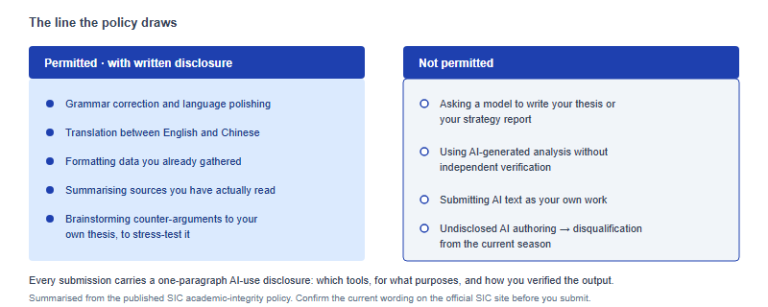
Using AI on a SIC Brief: What the Integrity Policy Allows, and Why the Rubric Punishes Shortcuts
SIC permits AI for polishing, translation and stress-testing, bans it for authoring, and requires a disclosure paragraph. Where the line sits, and why the…
Read →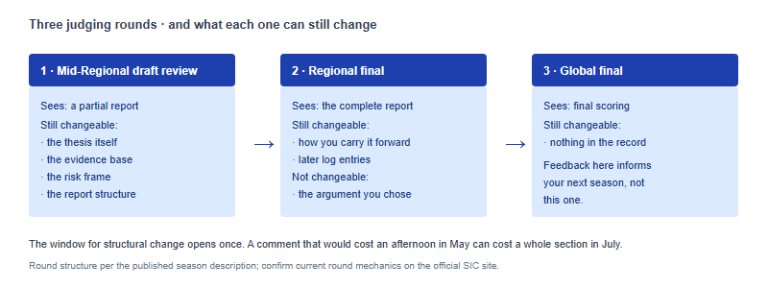
The SIC Mid-Stage Draft Review: What to Submit, What to Ask, and What Mentors Cannot Do for You
The mid-Regional draft review is the only SIC round early enough to change your thesis. How to submit an unfinished report, ask useful questions,…
Read →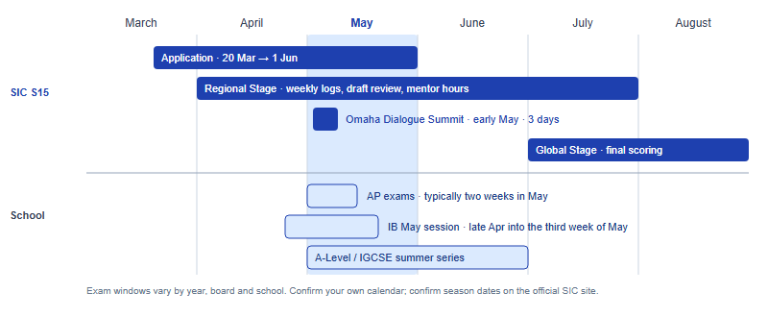
The SIC Hour Budget: Fitting 5-8 Hours a Week Around IB, AP and A-Level Exam Season
SIC asks 3-5 hours a week from Junior entrants and 5-8 from each Senior member, straight through IB, AP and A-Level exam season. How…
Read →Applications Close June 1, 2026.
2026.03.20 — 2026.06.01 · Open now
SIC operates a WhatsApp & WeChat intake. There is no online registration form. Scan the code at right to reach a program advisor — they walk you through eligibility, division selection, and the consent paperwork your school may need. All conversation, paperwork, and follow-up happens with a real program staff member, never a chatbot.
SIC is operated by SKT, endorsed by the Council for Economic Education, and academically supported by ACME. There are no third-party brokers, no agents, and no enrolment fees collected outside the official program desk.

Frequently Asked Questions
Who can participate in the Student Investment Challenge?
Any student currently enrolled in grades 6 through 12 — anywhere in the world — is eligible to apply. There is no nationality, residency, or school-type restriction. Junior Division entries are individual; Senior Division entries are teams of two to four students. School consent is required for participants in grades 6 to 9.
What is the difference between the Junior and Senior Divisions?
The Junior Division (Trading Track) is an individual format in which each student manages a simulated portfolio across the program window and files a weekly thesis log. The Senior Division (Strategy Track) is a team format — two to four students collaborate on a single end-of-stage investment strategy report defending one company, sector, or macro position. Both divisions accept all grades 6 to 12; choose based on whether you prefer individual portfolio work or collaborative research.
What does the Omaha Dialogue Summit involve?
The Omaha Dialogue is a mid-program summit timed to the Berkshire Hathaway annual shareholders meeting in early May. It is the centerpiece mentor and alumni event of every SIC season — a chance for current participants to engage with practicing investors, past winners, and academic mentors in an intentionally small, structured format. Participation in the dialogue is open to all active S15 entrants.
How are entries judged — is it based on portfolio returns?
No. SIC has, since its earliest season, judged entries on the quality of strategic thinking rather than terminal portfolio NAV. The four-axis rubric weighs thesis clarity, evidence quality, risk articulation, and revision discipline equally. A team that posts a moderate return with a sharply argued thesis advances above a team that posts a strong return with a thesis that quietly shifted to match the position. This is by design — SIC is a competition of thinking, not of luck.
When does the S15 season begin and end?
Applications for the fifteenth season (S15) open March 20, 2026, and close June 1, 2026. The Regional Stage runs April through July, the Omaha Dialogue Summit takes place in early May, and the Global Stage concludes in August. Final cohort recognition is published shortly after the Global Stage closes.