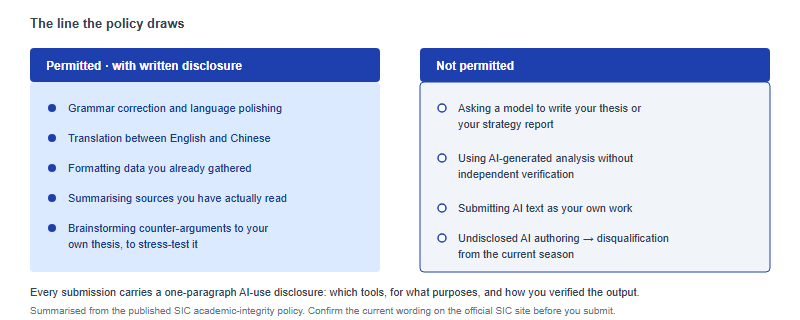
SIC’s published academic-integrity policy does not ban AI. It permits a defined set of uses — language polishing, English-Chinese translation, formatting data, summarising sources you have read, and brainstorming counter-arguments — prohibits AI authoring of your thesis or report, and requires a one-paragraph AI-use disclosure at the end of every submission. The more interesting fact is that the four-axis rubric would expose an outsourced brief even if no policy existed.
The rule, stated plainly
Three things are true at once, and students routinely get one of them wrong.
First, some uses are explicitly permitted — provided you disclose them. The policy names grammar correction and language polishing, translation between English and Chinese, formatting and summarising primary-source documents you have read, and using a model to brainstorm counter-arguments in order to stress-test your own reasoning.
Second, some uses are explicitly prohibited. Asking a model to write your investment thesis or strategy report is out. So is using AI-generated analysis without independent verification, and so is presenting AI text as your own work. The policy names a fourth prohibition students overlook: using AI to circumvent the rubric, such as generating multiple drafts and submitting the highest-scoring one.
Third, disclosure is not optional. The policy requires a brief AI-use paragraph at the end of the submission, covering which tools you used, for what purposes, and how you verified the output. Note the third element — verification is part of the disclosure, not a separate courtesy.
The consequences ladder is graduated rather than binary: a minor disclosure failure results in the submission being returned for completion, while plagiarism or undisclosed AI authoring results in disqualification from the current season, and repeated violations or fraud add a future-season ban. That structure is worth reading twice. Forgetting to write the paragraph is a fixable administrative problem. Hiding what you did is not.
The permitted uses, done properly
Translation and polishing. For a China-based international-school student this is the most consequential permission on the list, and it is worth using without guilt. Thinking through a valuation argument in Chinese and then writing it in English is not cheating; it is how a large share of professional analysts in Asia actually work. The failure mode is different from what students expect — it is not that you get caught, it is that heavy polishing flattens your argument into fluent generality. Polish sentences you wrote. Do not ask for "a better version of this section", because what comes back is usually smoother and less specific, and specificity is what scores.
Summarising documents you have read. The qualifier does the work. Running a 200-page annual report through a model to locate the segment disclosure is a search operation, but the permitted use is written as summarising documents you have read in full, so read the section yourself before you cite it. Running it to find out what the company does, and then writing about the company on that basis, is the prohibited version wearing a search operation’s clothes. A practical test: could you, unaided, point to the page the claim came from?
Brainstorming counter-arguments. This is the most underused permission and the one most aligned with how SIC scores. Ask a model to attack your thesis, collect the attacks, then go and check each one against primary sources yourself. What you keep is not the model’s text but your own verified response to it — which is exactly the material the risk section needs.
Why the rubric catches shortcuts on its own
Set the policy aside for a moment. Suppose a team outsourced a report entirely and nobody checked. The four-axis rubric — Thesis Clarity, Evidence Quality, Risk Articulation and Revision Discipline, each carrying 25% — would still surface it, because each axis independently tests something a generated draft cannot supply.
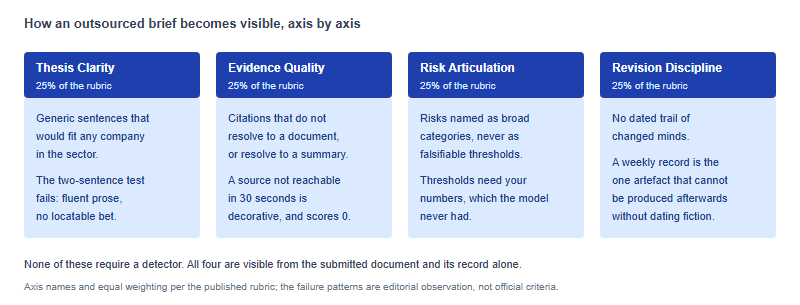
The Revision Discipline column deserves emphasis. Because SIC scores a written research process rather than portfolio returns — the structural difference explored in the side-by-side comparison with trading-window formats — the dated record of how your thinking changed is itself a graded artefact. It is the only part of the submission that cannot be produced at the end, because producing it at the end requires claiming you knew things before they were public.
Writing the disclosure paragraph
The disclosure is one paragraph, and a weak one costs you nothing directly but signals carelessness to a reader who is about to grade your evidence standards. Three elements are required: tools, purposes, verification. Most students write the first two and skip the third.
| Element | Weak version | What a reader needs |
|---|---|---|
| Tools | "We used AI." | Name them, including translation tools and grammar checkers, which students routinely forget count. |
| Purposes | "For help with writing." | Map each tool to a specific task: polishing section 3, translating my Chinese notes, generating counter-arguments for the risk section. |
| Verification | Omitted entirely. | State how output was checked — every figure traced back to the filing, every counter-argument confirmed against a primary source before inclusion. |
| Scope limit | Not stated. | Say what you did not use it for. "No section of the thesis or analysis was drafted by a model" is a sentence worth writing if it is true. |
A workable shape, adapted to your own facts: "I used [tool] for grammar and language polishing on sections 2 to 5, and [tool] to translate my own Chinese research notes into English. I used [tool] to generate counter-arguments against my thesis; each was then checked against primary filings before I decided whether to address it, and three were discarded as unsupported. No part of the thesis, analysis or risk assessment was drafted by a model. All figures cited were read from the original documents listed in the source log." Adjust to what you actually did — a disclosure describing work you did not do is itself a disclosure failure.
The plagiarism rules AI makes easier to break by accident
Three provisions in the policy are worth flagging because AI-assisted workflows collide with them without anyone intending it.
- Paraphrase still requires citation. The policy is explicit that rewriting someone’s analysis in your own words does not remove the obligation to cite it. When a model summarises a source for you and you then rewrite the summary, the citation obligation survives both steps — and the original source is now two removes away, which is precisely when students lose track of it.
- Charts carry attribution. Reproducing a chart from a published research note without attribution is named as plagiarism. If you asked a model to rebuild a chart based on someone else’s figures, the underlying data still has an owner.
- Self-plagiarism requires disclosure and approval. Reusing your own work from a previous SIC season is not automatically permitted. Returning entrants who keep a research file across seasons should raise this before submitting, not after.
None of these are AI-specific rules. They are ordinary citation rules that an assisted workflow makes easier to trip over, because every additional processing step puts more distance between the claim in your document and the document it came from. The defence is the same one the programme’s evidence standard already demands: a source log where every claim resolves to something a reader can open.
A pre-submission check that takes fifteen minutes
Run these five before you submit, in this order.
- Open five citations at random. If any takes more than thirty seconds to reach the underlying document, fix it — and then assume there are more.
- Read your thesis statement aloud to someone outside finance. Ask them what you are claiming. If they describe a sector rather than a bet, the clarity problem is real regardless of how it got there.
- Check each risk for a number. Every risk should contain a threshold that could be observed and would change your view.
- Scan your log for gaps and for uniformity. Gaps look like abandonment; entries that all sound identical look generated. Real logs are uneven, because real weeks are.
- Write the disclosure paragraph last, from memory of what you actually did — not from a template, including this one.
Frequently asked questions
Is AI banned in SIC submissions?
No. Polishing, English-Chinese translation, formatting, summarising sources you have read, and counter-argument brainstorming are permitted, with disclosure.
What happens if I forget the disclosure paragraph?
Per the published policy, a minor disclosure failure results in the submission being returned for completion. Undisclosed AI authoring is treated far more seriously.
Does using a grammar checker count as AI use?
Treat it as in scope and disclose it. Over-disclosure costs nothing; under-disclosure is the category the policy penalises.
Can I reuse my report from a previous SIC season?
Not without permission. Self-plagiarism requires explicit disclosure and approval under the published policy — confirm the process officially.
Published by the SIC editorial desk, operated by Hanlin Education for China-based international-school students. Official rules are set by the competition and change yearly — confirm the current academic-integrity policy, disclosure requirements and rubric on the official SIC site before submitting. Any error identified here is corrected within 7 working days.