The Student Investment Challenge (SIC) and the Wharton Global High School Investment Competition are the two most-searched investing programs for high schoolers, and they are fundamentally different. SIC is a five-month, rubric-judged academic research program operated for fifteen seasons by SKT, with parallel Junior (individual) and Senior (team) divisions, culminating in the Omaha Dialogue Summit. The Wharton competition is a 10-week, ranked portfolio competition operated by the Wharton Global Youth Program at the University of Pennsylvania, culminating in a Global Finale at the Wharton School in Philadelphia each April. Below: a side-by-side comparison across format, judging, calendar, cost, and audience fit, plus the “do both” sequencing strategy that serious finance applicants use.
Quick Comparison Matrix
| Dimension | SIC | Wharton Global HS Investment Competition |
|---|---|---|
| Operator | SKT (with academic support from ACME; CEE-endorsed) | Wharton Global Youth Program, University of Pennsylvania |
| Program category | Academic research program | Team strategy competition (judged on strategy, not portfolio returns) |
| Years running | 15 seasons (S1 – S15) | Active for over a decade (formerly KWHS, rebranded under Wharton Global Youth Program) |
| Eligible grades | Grades 6 – 12 (global) | Grades 9 – 12 (global) |
| Team structure | Two parallel tracks: Junior individual + Senior team of 2-4 | Single team format, four to six students per team, teacher advisor required |
| Duration | ~5 months active (Mar 20 – Aug) across 4 stages | 10 weeks of trading (Sep 28 – Dec 4 in the 2026-27 season) + Global Finale April 29-30, 2027 |
| Virtual capital | Simulated equities-and-ETFs portfolio (size scaled to division) | Virtual cash in the Wharton Investment Simulator (WInS) — the current amount is not published on the competition page; confirm with the organisers |
| Core deliverable | Junior: weekly thesis log + portfolio · Senior: 15-30 page strategy report | Two required deliverables: an Investment Policy Statement (IPS) and a comprehensive report |
| Judging | Four-Axis Rubric (each 25%): Thesis Clarity, Evidence Quality, Risk Articulation, Revision Discipline | Per Wharton: “success is not determined by portfolio performance” — teams are judged on how well the strategy serves the client’s objectives, the strength of their research and analysis, and their ability to communicate and defend their recommendations |
| Recognition structure | Non-rank: Featured Cohort / Honorable Mention / Season Participant | Ranked: Top 50 Semifinalists → top 10 Global Finalist teams → Global Champion (FigCapital, Stuyvesant High School, New York, in 2026) |
| Capstone event | Omaha Dialogue Summit (3 days, early May, Omaha, fixed since S4) | Learning Day & Global Finale: April 29-30 at The Wharton School, University of Pennsylvania, Philadelphia |
| Application channel | WhatsApp advisor desk inquiry | Online registration through Wharton Global Youth Program |
| Program fees | Vary by region/school (discussed with program desk; no published price card) | Free to participate |
Category Distinction: Why “Which Is Better?” Is the Wrong Question
The most common framing — “SIC vs Wharton, which is better?” — conflates two categorically different programs. A more useful framing: which category of educational experience matches your goals.
Per SIC’s own program statement, “SIC is an academic research program…recognition is awarded through evaluation of research output and process, not through rank-based prizes.” That’s a research program. The output is a rubric-evaluated artifact — a body of weekly thesis logs (Junior) or a long-form research report (Senior) — and the recognition reflects sustained craft across the program rather than tournament position.
Per Wharton Global Youth Program’s competition description, the Wharton competition is a 10-week experiential challenge where student teams “develop an investment strategy, analyze industries and companies, and build and manage a portfolio using virtual cash in the Wharton Investment Simulator (WInS). A panel of judges selects 50 semifinalist teams, then the top 10 advance to the Global Finale. “Winners are selected on the strength and articulation of their team strategies, not on the growth of their portfolios” — an important point that the Wharton competition is not pure trading performance, but the structural fact remains that there is a Global Champion and a leaderboard.
The signal to an admissions reader, internship interviewer, or future campus recruiter is distinct:
- SIC recognition signals: “this student can articulate, defend, and revise an investment thesis under expert critique across five months.” — research process under sustained pressure
- Wharton recognition signals: “this student’s team strategy and execution outperformed thousands of teams in a 10-week tournament.” — strategic discipline under tournament pressure
Both signals are valuable. They are different signals.
Format Comparison: Three Concrete Differences
1. Track Structure
SIC has two parallel divisions. The Junior Division is for individual participants who manage a simulated portfolio and file weekly thesis logs — a solo-craft path designed for self-directed students. The Senior Division is for teams of 2-4 producing a single end-of-stage research report — a collaborative path designed for students who prefer debating a thesis in a small group. Both divisions are judged on the same Four-Axis Rubric, so a Junior participant and a Senior team can earn equivalent recognition; there is no Junior-vs-Senior prestige hierarchy.
Wharton runs a single team format: four to six students working under a teacher advisor. There is no solo path. Students who prefer working alone or whose chapter doesn’t have enough teammates either find a way to assemble a team or wait until the following year. For schools without an active business club or finance teacher, organizing a Wharton team can itself be a project.
2. Time Commitment
SIC: Junior participants commit 3-5 hours per week during the Regional Stage (April-July) — the cadence of a serious side-project. Senior team members commit 5-8 hours per week each — closer to a substantial co-curricular.
Wharton: The 10-week trading window (September-December) requires sustained team coordination, weekly trading decisions, and a final report drafted in November. Total commitment varies by team approach, but most competitive teams spend 6-10 hours per week during the active 10 weeks and additional time in semifinal/finalist rounds.
SIC’s time profile is more flexible (months long with manageable weekly load); Wharton’s is more concentrated (10 weeks of higher weekly load). Students with heavy academic terms in spring (AP exams in May) often find SIC’s longer-but-lighter cadence easier to sustain; students with heavy fall terms (PSAT/SAT preparation, college applications) sometimes find Wharton’s compressed schedule preferable because it ends before peak application deadlines.
3. Core Deliverable
SIC Junior deliverable: An ongoing portfolio plus a weekly thesis log — a documented record of every trade decision, the reasoning at the time, and any subsequent revision. Quality is measured by the depth and discipline of the log, not by portfolio returns.
SIC Senior deliverable: A 15-30 page investment strategy report, structured as long-form research — thesis statement, market analysis, instrument selection, risk analysis, revision history. Mid-Regional draft review, then Regional final, then Global final. Three rounds of judging across the season.
Wharton deliverable: A portfolio managed through the 10-week trading window in the Wharton Investment Simulator, plus two required written deliverables — an Investment Policy Statement (IPS) setting out the team’s long-term strategy, and a comprehensive report. Teams work from a real case study built around an actual Wharton alum client, whose financial scenario is written for the competition. In the 2026-27 season the final report and school documentation are due Friday, December 4 (5:00 p.m. ET).
Calendar Comparison: Sequential, Not Conflicting
Critical fact for serious applicants: SIC and Wharton run in different parts of the calendar year, and a student can do both within the same year.
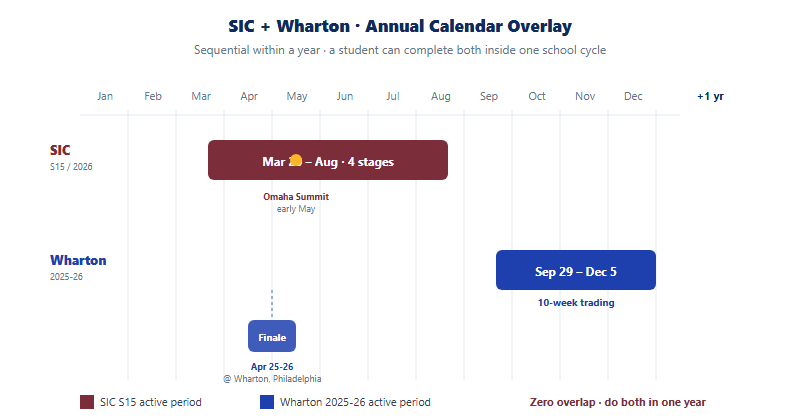
| Date | SIC | Wharton Global HS Investment Competition (2026-27) |
|---|---|---|
| Monday, August 10, 2026 | — | Registration opens |
| Friday, September 11, 2026 | — | Registration closes; all student team accounts must be created (5:00 p.m. ET) |
| Tuesday, September 15, 2026 | — | Designated team leader receives the SurveyMonkey Apply invitation; competition details released to registered teams |
| Monday, September 28, 2026 | — | Competition begins — first day of trading (10-week window) |
| Friday, December 4, 2026 | — | Final report and school documentation due (5:00 p.m. ET) |
| To be announced | — | Top 50 semifinalists announced · Virtual Semifinals |
| Spring 2027 | SIC season runs across roughly five months; current dates come from the SIC program desk | — |
| April 29-30, 2027 | — | Learning Day & Global Finale at The Wharton School, University of Pennsylvania, Philadelphia |
| Early May 2027 | Omaha Dialogue Summit (3 days) | — |
A 9th or 10th grader interested in finance can do both SIC S15 (Mar-Aug 2026) and the Wharton 2026-27 competition (Sep 2026 onward) inside a single calendar year — gaining the season-long research process from SIC and the 10-week portfolio sprint from Wharton. This sequencing is increasingly common among serious finance applicants and is the most useful framing for students who want both kinds of experience on their record.
Judging Comparison: Process vs Tournament
SIC: Four-Axis Rubric, Non-Rank
SIC judging is structured around the Four-Axis Rubric, with each axis weighted 25%:
- Thesis Clarity — Can a non-expert reader understand the investment thesis in two sentences?
- Evidence Quality — Are claims supported by primary sources (10-Ks, regulatory filings, peer-reviewed research, ESG disclosures)?
- Risk Articulation — What would have to be true for the thesis to lose? Are key risks identified, sized, and addressed?
- Revision Discipline — When facts changed during the season, did the thesis update on schedule?
Recognition tiers: Featured Cohort (highest, published in the SIC Hall of Fame), Honorable Mention, and Season Participant. Multiple entries can earn the same recognition tier in the same season. There is no Champion; there is no Top 10 ranking.
Wharton: Ranked Tournament Structure
Wharton judging selects 50 semifinalist teams from thousands of submissions. Those 50 teams present in the virtual Semifinals; the top 10 then advance to the Global Finale at the Wharton School. Wharton states plainly that “unlike other investment competitions, success is not determined by portfolio performance” — teams are evaluated on how well the strategy serves the client’s objectives, the strength of the research behind it, and how clearly they can defend it. One team is named Global Champion each year (Stuyvesant High School’s FigCapital team won 2026).
The structural difference matters for how each program signals to admissions readers. A Featured Cohort designation at SIC tells the reader “evaluated as excellent across all four research axes.” A Wharton Global Finalist designation tells the reader “competed and advanced past 99%+ of a thousand-plus team tournament.” Different qualities are demonstrated by each.
Cost Comparison: The Honest Difference
This is the dimension where the two programs diverge most clearly:
- Wharton: Free to participate. The Wharton Global Youth Program publishes that the competition is free, including the stock-market simulator access during the trading window. Teams advancing to the Global Finale handle their own travel and accommodation to Philadelphia.
- SIC: Program fees vary by region and school partnership. Per the program statement, “there is no published price card because terms vary by region and school partnership.” Fees are discussed directly with the SIC program desk during the application inquiry.
The honest framing: Wharton’s free model lowers the entry barrier; SIC’s mentored-program model justifies its fee structure through advisor access, mid-stage draft reviews, the Omaha Dialogue Summit experience, and the editorial-quality rubric reporting. Whether the fee is worth it depends on what the student values from the program experience — a self-directed student comfortable working without mentor scaffolding may extract more relative value from the free Wharton format; a student who values structured feedback, capstone in-person events, and a documented rubric report may extract more relative value from SIC despite the fee.
Audience Fit: Who Should Pick Each
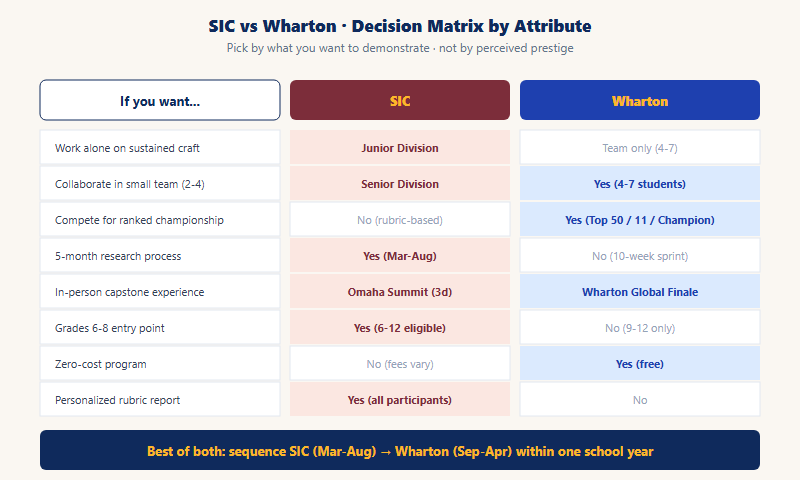
Choose SIC if you…
- Want a five-month research process that demonstrates sustained craft, not a 10-week sprint
- Are in grade 6 or 7 or 8 and want an entry-point into investing competitions before the typical 9-12 grade window opens at other programs
- Prefer solo work on a defined craft (Junior Division) or small-group collaboration producing a polished artifact (Senior Division)
- Value the Omaha Dialogue Summit in-person experience timed to the Berkshire Hathaway shareholders meeting
- Want a personalized rubric report on your work, regardless of competition outcome
- Have school terms that are heavier in fall (PSAT/SAT, applications) and lighter in spring/summer
Choose Wharton if you…
- Want the compressed 10-week sprint with clear start and end dates
- Have 4-7 reliable classmates and a teacher adviser willing to support a team
- Are motivated by tournament structure and the prospect of advancing through ranked rounds
- Want the Global Finale at the Wharton School in Philadelphia as the capstone experience
- Are in grade 9-12 with strong fall-semester availability and lighter spring
- Value the zero-cost entry and want to demonstrate competitive performance without program fees
Choose Both (sequenced) if you…
- Are seriously committed to finance / economics / business as a college direction
- Want to demonstrate two distinct kinds of investing-related skill on your record
- Have the time and motivation to do SIC S15 (Mar-Aug 2026) followed by Wharton 2026-27 (Sep 2026 onward)
- Plan to leverage SIC’s research artifact (Senior Division 15-30 page report) and Wharton’s competitive performance (Global Finale invite or Top 50 placement) as complementary application signals
The “Both” Strategy: How Serious Applicants Sequence
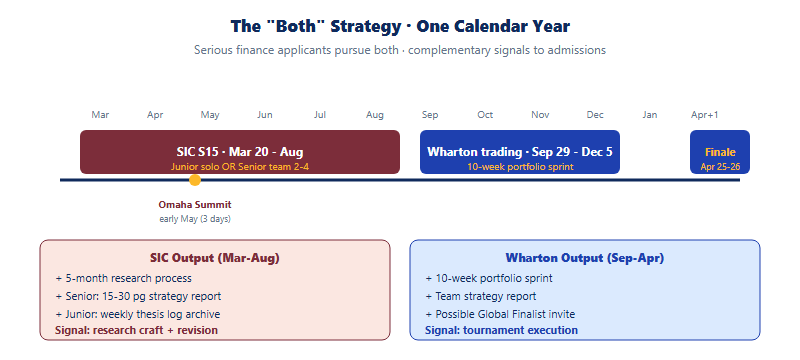
For students committed enough to do both, the calendar makes sequencing straightforward. A typical timeline:
- March 20 – June 1, 2026: Apply to SIC S15. Choose Junior or Senior division.
- April – July 2026: SIC Regional Stage (3-8 hours per week depending on division).
- Early May 2026: Omaha Dialogue Summit (if attending in-person).
- July – August 2026: SIC Global Stage final submission.
- September 2026: Wharton 2026-27 registration opens. Use the summer to assemble a team of 4-7 classmates and identify a teacher adviser.
- Late September – early December 2026: Wharton 10-week trading window.
- December 2026: Wharton final report submission.
- January – April 2027: Wharton semifinals + (if advancing) Global Finale at Wharton in late April 2027.
The total academic-year output: one SIC rubric report (Senior) or weekly thesis log archive (Junior), plus one Wharton team strategy report and 10-week trading record. Both go on the activities list, both can be referenced in supplemental essays, both demonstrate seriousness to admissions readers, internship interviewers, and future campus recruiters at investment banks and asset managers.
Frequently Asked Questions
Is SIC the same program as the Wharton Global High School Investment Competition?
No. SIC is a CEE-endorsed academic research program operated for fifteen seasons by SKT, with a five-month Junior (individual) or Senior (team of 2-4) format judged on the Four-Axis Rubric. The Wharton Global High School Investment Competition is a 10-week portfolio competition operated by the Wharton Global Youth Program at the University of Pennsylvania, with teams of four to six students competing for a ranked Global Champion title. They are different categories of program; comparison only on common dimensions, not as substitutes.
Can a student do both SIC and Wharton in the same year?
Yes. SIC runs March-August. The Wharton competition’s trading window runs September-December (with the Global Finale in late April of the following year). The two programs are sequential within a calendar year, not in time conflict. Many serious finance applicants pursue both.
Which one carries more weight for college admissions?
Both are recognized by admissions readers, but they signal different qualities. SIC recognition signals sustained research craft and revision discipline over five months. Wharton finalist status signals competitive strategy execution under tournament pressure. Neither is “better” — they are complementary signals. Strong finance-track applicants commonly include both on their record.
How much does each program cost?
Wharton: free to participate. Teams advancing to the Global Finale handle their own travel and lodging to Philadelphia. SIC: program fees vary by region and school partnership; discussed directly with the SIC program desk during the application inquiry, with no published price card.
What grades can apply?
SIC is open to grades 6-12. Wharton is open to grades 9-12. Students in grades 6-8 can use SIC as their entry-point investing program before becoming Wharton-eligible at grade 9.
Does either program guarantee a Wharton or Ivy League admission?
No competition guarantees any college admission. Both SIC and Wharton recognition strengthen a finance-track applicant’s record, but admissions outcomes depend on the full application context (academic record, essays, recommendations, demonstrated interest, the rest of the activities list). Treat either program as a meaningful signal among many, not a guaranteed admit factor.
Related Resources
- 📖 SIC foundation → What Is the Student Investment Challenge (SIC)? Complete 2026 Guide
- 📅 S15 timeline → Reading the S15 Timeline: What Each Stage Actually Requires
- ⚖️ Four-Axis Rubric → The Four-Axis Rubric, Section by Section
- 🏛️ Omaha Summit → The Omaha Dialogue Summit, Explained
- 🎯 Editorial methodology → How the SIC Editorial Desk Verifies Every Number
- 📚 Reading list → A Short Reading List for First-Time SIC Participants
- 📞 SIC application inquiry → Contact (WhatsApp advisor desk)
SIC data drawn from this site’s About and Competition pages. Wharton Global High School Investment Competition data drawn from the Wharton Global Youth Program at globalyouth.wharton.upenn.edu, including the 2026 Global Finale result and the published competition timeline for the 2026-27 season, checked on 31 July 2026.
Hanlin Education’s View on the Dual-Track Decision
As the SIC China editorial desk operated by Hanlin Education (linstitute.net), we work with Chinese international school applicants navigating both SIC and Wharton Global Youth Investment Competition each year. Three observations from our advisory work that the generic SIC-vs-Wharton comparisons online don’t capture:
- Calendar non-conflict matters more than calendar overlap: SIC (March-August) and Wharton (September-December) do not time-overlap, so the dual-track is operationally feasible. But the cognitive overlap — both ask “build a thesis on a public company” — means cross-contamination is high. Students who attempt both without explicit narrative differentiation often produce two B-tier theses instead of one A-tier.
- Thesis style genuinely differs: SIC’s Four-Axis Rubric weights revision discipline heavily; Wharton’s rubric weights presentation polish more. A student strong in iterative revision but weaker in slide design tends to medal at SIC and finalist-without-medal at Wharton.
- Common App framing problem: Both competitions look similar on a US application unless the student articulates the difference explicitly. Listing “SIC participant + Wharton finalist” without explaining the methodology gap reads as “two parallel programs” rather than “two distinct skills.”
For applicants targeting the dual track, Hanlin’s advisory work focuses on the narrative differentiation problem — not on rerunning the comparison every applicant can find online.
Talk to a Hanlin Education Advisor
Editorial desk · Hanlin Education · last updated 2026-05-27 · This guide is published by the Hanlin Education editorial desk. Hanlin Education is an authorized China-region educational partner, but this site is not the official program administration site. All facts on this page are cross-referenced against the program’s official publications. We correct any factual errors within seven working days of a reported issue.