SIC publishes its own load figures: roughly 3–5 hours a week for a Junior entrant, and 5–8 hours a week for each member of a Senior team, across a season that runs March to August. Those months contain the entire IB May session, the AP exam fortnight and the A-Level summer series. The fix is not working fewer hours overall. It is moving them out of May before May arrives.
The published numbers, and the part they do not tell you
Start with what the programme itself states. The Junior Division is an individual track built on weekly thesis logs paired with a simulated portfolio, at roughly 3–5 hours a week. The Senior Division is a team of 2–4 producing a 15–30 page strategy report, at roughly 5–8 hours a week per member. Read that last phrase carefully: a four-person Senior team at the top of the band is committing something like 32 person-hours a week, not eight.
Across the Regional Stage alone, which runs April to July, a Senior member sitting mid-band at six hours a week is committing on the order of 100–110 hours. That is a real number, comparable to a serious Extended Essay or a full IA cycle, and it deserves to be planned like one rather than absorbed week by week and hoped for.
What the weekly average hides is that the load is not flat. Some weeks are genuinely light — you read one filing, update one number, write one log entry. Other weeks are drafting weeks, and a 15–30 page report does not get drafted in six hours. If you plan against the average, you will meet the heavy weeks with an average-sized budget, and the heavy weeks always land near a deadline.
The collision map: where the season meets your exam calendar
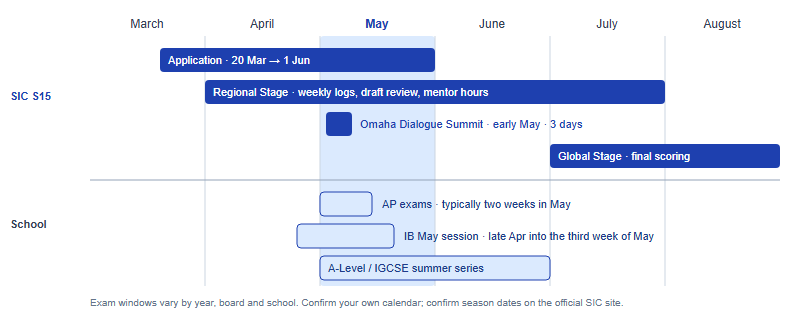
The S15 season structure, as published, runs across four stages: Application from 20 March to 1 June; the Regional Stage from April through July; the Omaha Dialogue Summit in early May, timed to the Berkshire Hathaway annual meeting; and the Global Stage from July into August.
Now overlay a typical international-school calendar. AP examinations are administered over roughly two weeks in May. The IB Diploma May session typically begins in late April and runs into the third week of May. Edexcel and Cambridge summer series papers typically run from May into June, which also catches IGCSE candidates in Years 10–11. Exact dates change every year and differ by board, so treat those as shapes rather than dates and check your own school’s published calendar.
The shape that emerges is unambiguous: May is the pinch, June is the aftershock, and July–August is open. That last point is worth pausing on, because it is the season’s structural gift — the Global Stage sits in the summer, when most international-school students have finished examinations entirely.
Front-load; do not pause
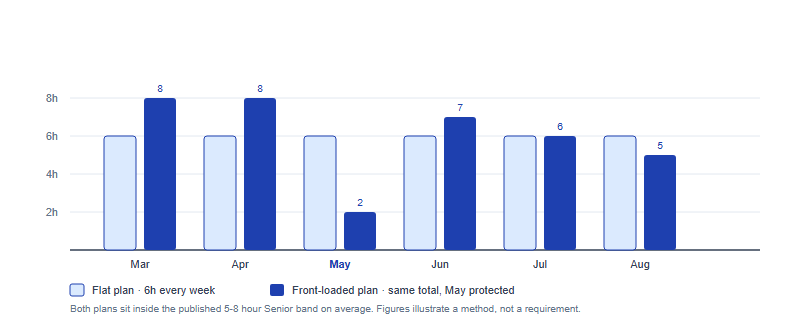
The obvious response to the map above is to stop working in May and resume in June. That instinct is half right and half expensive, because of how the programme is scored.
SIC judges on a four-axis rubric with equal 25% weightings: Thesis Clarity, Evidence Quality, Risk Articulation and Revision Discipline. Three of those four are qualities of a finished document, and a finished document does not care when you wrote it. The fourth is different. Revision Discipline asks whether you updated your analysis when circumstances changed — and that is a question about the record, not the output.
A four-week silence is visible in the record in a way that no amount of June effort erases. Worse, it tends to fall across the calendar-Q1 reporting season, meaning the gap sits exactly where a real analyst would have had the most to update. Coming back in June and retro-fitting four weeks of logs is both dishonest and obvious — the entries all cite information that was not public on the dates they claim.
So the plan is not pause. The plan is a declared low-intensity month at a level you can genuinely sustain, with the hours you would have spent in May moved forward into March and April, and backward into June and July. The total stays inside the published band; the distribution changes.
What a genuine two-hour maintenance week contains
"Two hours" only works if you know precisely what those two hours buy. The point of a maintenance week is not to advance the report — it is to keep the evidence trail unbroken and the thesis honest while you are otherwise occupied. Here is a defensible allocation.
| Block | Minutes | What you actually do | Which axis it protects |
|---|---|---|---|
| Scan | 25 | Read only what was newly filed or newly said about your company or sector this week. No exploratory reading. | Evidence Quality |
| Update the hinge number | 20 | Refresh the single metric your thesis turns on — the margin, the backlog, the policy rate. One number, not a model rebuild. | Risk Articulation |
| Log entry | 30 | Write what changed, what did not, and explicitly whether the thesis moved. "Nothing material this week" is a valid, dated entry. | Revision Discipline |
| File sources | 25 | Add this week’s documents to your source log with direct links, so nothing has to be re-found in July. | Evidence Quality |
| Team handoff | 20 | One message to your team flagging anything that needs a decision after exams. Senior teams only. | Revision Discipline |
Notice what is absent: no new company screening, no valuation work, no writing of report sections. Those are Build activities and they belong in Build weeks. The single most common way students blow a maintenance week is by letting a scan turn into a research session two days before an exam.
Building your own budget in four steps
Step one: count your real weeks. From your application date to the close of the Global Stage, how many calendar weeks do you actually have? Do not count from March if you enter in May — the Application window runs to 1 June, and a late entrant has a materially shorter runway and should say so in planning.
Step two: mark blackout weeks from your school’s published calendar, not from memory. Blackouts include exam weeks, the week before them, mock weeks, and any week containing an IA, EE or coursework deadline. Most students under-count here by two to three weeks.
Step three: tier every remaining week as Build (7–8h), Steady (5–6h) or Maintenance (about 2h). Then check that your Build weeks are not all clustered in the fortnight before a submission.
Step four: sanity-check the average against the published band. If your plan averages eleven hours a week, you have not built a budget, you have built a wish.
| Period | Tier | Primary work | Why here |
|---|---|---|---|
| Late March – mid April | Build | Choose and defend the subject; assemble the source base; write the first thesis statement. | Nothing else is due; this is your cheapest available time. |
| Mid – late April | Build | Draft the sections that do not depend on later data; prepare the mid-stage draft submission. | Gets a reviewable draft in front of the mid-Regional round before exams. |
| May | Maintenance | Two-hour weeks per the table above. Attend the Summit only if your exam schedule genuinely allows. | The AP fortnight and IB session sit here. |
| June | Steady, rising | Act on draft-review feedback; rebuild the sections it flagged as structural. | A-Level and IGCSE candidates ramp later than IB and AP candidates. |
| July – August | Build | Final revision, risk section, defence preparation, submission. | The Global Stage sits in the holidays, when your calendar is clear. |
Three failure modes worth naming
The heroic April. A team spends thirty hours in three weeks and produces a beautifully written report about a company they had not yet finished understanding. Front-loading means moving hours forward, not moving conclusions forward. If April’s output is a locked thesis rather than a well-sourced draft, you have pre-committed yourself and the Revision Discipline axis will find the seam later.
The silent May. Covered above, and by far the most common. The tell is a log that jumps from late April to mid June with no acknowledgement that anything happened in between.
The August scramble. Students who did pause completely often try to recover the whole season in the summer. The output can look fine; the record does not. The Global Stage is for sharpening a thesis you have been carrying for months, not for building one from scratch in three weeks.
One structural note in your favour: because the Wharton competition’s registration, trading and report window sits between August and early December, its calendar meets SIC’s mainly at its Global Finale in late April — a point covered in more detail in the side-by-side comparison. If you are planning a two-year extracurricular arc, that sequencing is worth building around deliberately rather than discovering by accident.
Frequently asked questions
Is the 5-8 hour figure per team or per person?
Per member, according to the published guidance. A four-person Senior team at mid-band is committing roughly 24 person-hours weekly.
Can I skip the Omaha Dialogue Summit if it clashes with exams?
The Summit is published as a dialogue event rather than a scored checkpoint; whether attendance is expected of every participant is not stated. Confirm attendance expectations on the official SIC site.
Does a quiet May hurt my score directly?
Not by itself, but Revision Discipline is a scored axis worth 25%, and an unexplained multi-week gap in your log is visible evidence against it.
Is it too late to enter if I only decide in May?
The Application window is published as 20 March to 1 June, so a May entry is possible — but budget for a compressed runway. Confirm current dates officially.
Published by the SIC editorial desk, operated by Hanlin Education for China-based international-school students. Official rules are set by the competition and change yearly — confirm current details, dates and requirements on the official SIC site. Any error identified here is corrected within 7 working days.