If you are in the SIC Junior Division for the S16 season and you want a review method that does not end in a Senior-style investment strategy report, the practical answer is to review trades as decisions rather than as report chapters. The Hanlin Courses WeChat article SIC Investment Competition S16 Autumn Season Is Here! Investment Practice for Grades 6–12, published 19 October 2026, describes the Junior Division, or Trading Group, as individual participation evaluated through online simulation and trading. It lists the investment strategy report under the Senior Division, or Strategy Group. It also states that the Junior Division does not involve advancing to the Global Station study phase. For a Junior participant, the useful review loop is therefore: log the trade thesis, position size, exit rule and falsification condition; compare the outcome with the plan; then adjust the next decision.
This article is for students who have already chosen, or are seriously considering, the Junior Division route. It does not assume that a Junior participant must produce a written report. It also does not treat the source article as a substitute for any future official rulebook. The goal is narrower and more useful: build a repeatable review habit that turns simulated trading into deliberate practice.
What the S16 Source Actually Says About Junior vs Senior Evaluation
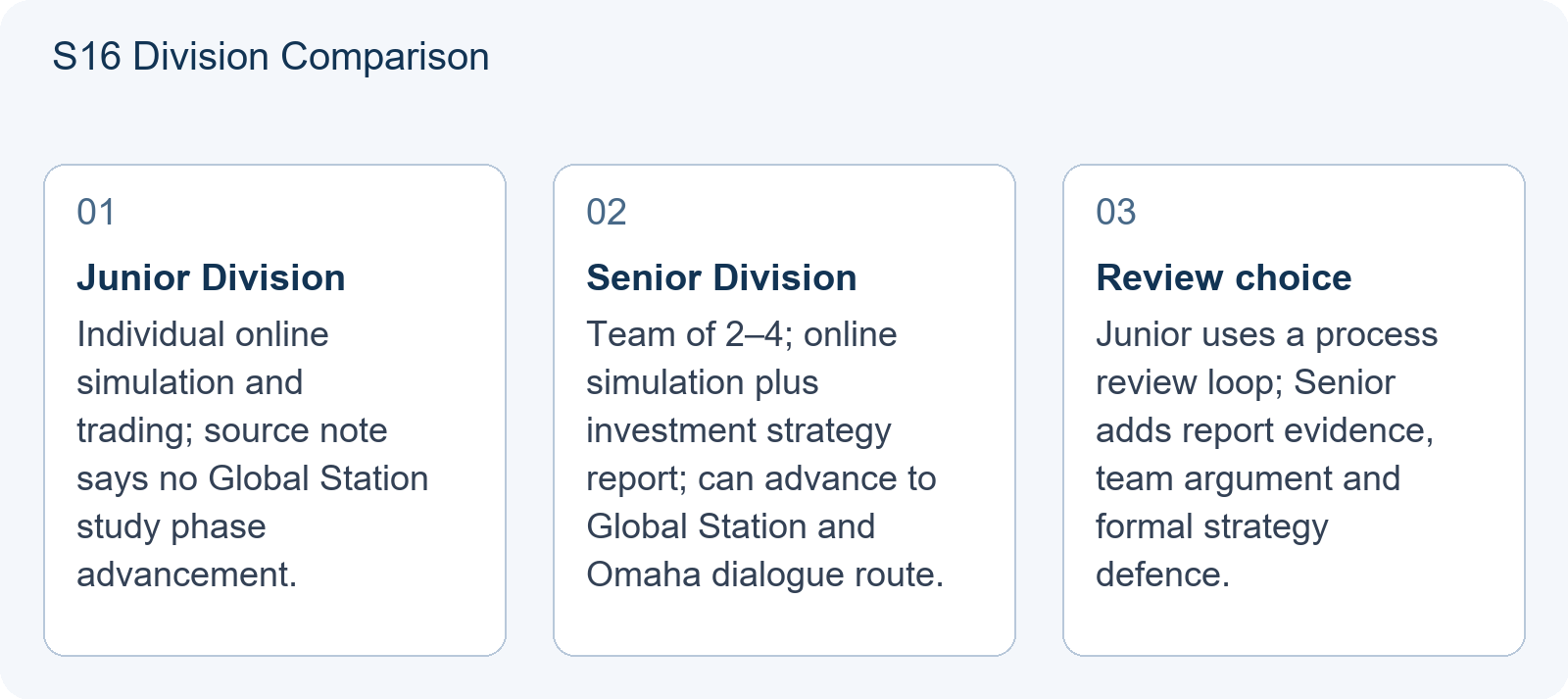
The source distinction matters because it tells Junior participants what to optimise. The table below summarises the S16 description from the Hanlin Courses article dated 19 October 2026. It is a description of the source note, not a claim that no future official update can change details.
| Feature | Junior Division (Trading Group) | Senior Division (Strategy Group) |
|---|---|---|
| Participation mode | Individual | Team of 2–4 students |
| Evaluation described | Online simulation and trading | Online simulation plus investment strategy report |
| Advancement described | No Global Station study phase advancement | Can advance to Global Station and Omaha dialogue route |
| Primary emphasis | Practical trading experience and interest cultivation | Academic application and deeper strategy analysis |
For Junior participants, the absence of a listed report requirement does not mean the absence of analytical work. It changes where that work shows up. In the Junior route, analytical quality is visible in trade selection, position sizing, risk control, exit discipline and consistency inside the simulation. A written report may still be useful as a personal learning tool, but the source note does not present it as the Junior evaluation route.
Why a Junior Trader Still Needs a Review Routine
Simulated trading without review can teach the wrong lesson. A student might earn a large profit from a speculative position and conclude that the process was sound. Another student might lose money on a well-reasoned trade because of short-term market noise and abandon a reasonable approach too early. A review routine helps separate luck from repeatable decision quality.
The Junior Division is individual, so the feedback loop is largely self-managed. That is why a simple written review habit is valuable even when no report is submitted. If you are competing solo, the workflow described in Competing Solo: How a SIC Junior Runs a Months-Long Research Project Without a Team is a useful companion because it treats the season as a project with checkpoints rather than a daily price-watching exercise.
A good review does not need to be long. It needs to be honest. The question is not “Did I make money?” but “Did I follow a process that I could explain before the outcome was known?” That distinction is central to improving as a Junior trader.
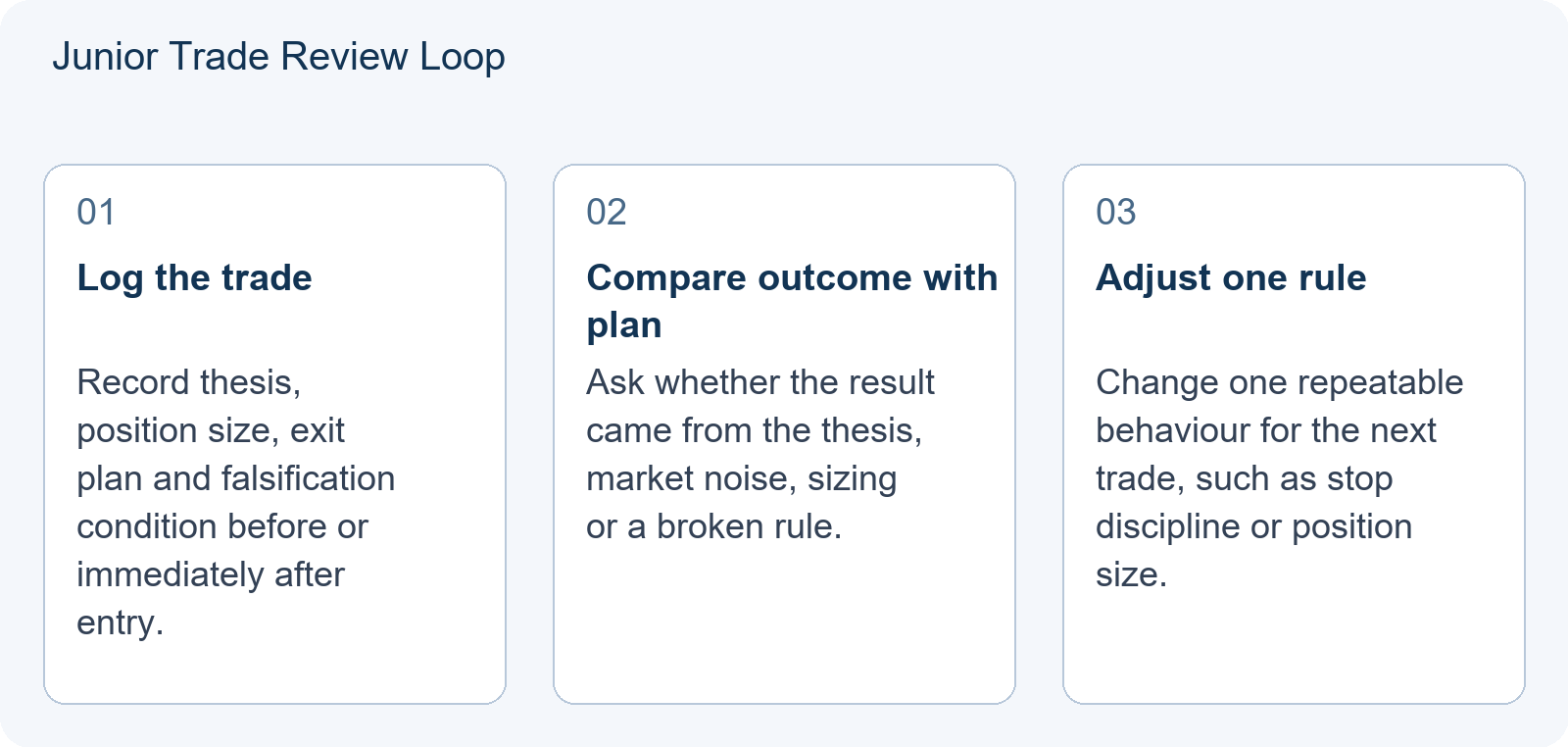
A One-Page Junior Trade Review Sheet
Use one page per significant trade, or one page per week if you trade frequently. The sheet should take less than ten minutes to complete. Its purpose is to create a record you can compare across the season.
- Thesis: What did you believe about the company, sector or market? Write it in one or two sentences without jargon.
- Position size: What percentage of the simulated portfolio did you allocate? Why was that size appropriate for the uncertainty?
- Entry trigger: What specific event, price level or data point caused you to act now rather than later?
- Exit plan: What price, time limit or condition would make you close the trade? Did you write this before entering?
- Falsification condition: What evidence would show that your thesis was wrong? Did you see that evidence before you exited?
- Review after exit: Was the outcome driven by your thesis, by market noise, by position sizing, or by an unexplained rule change on your part?
This format keeps the Junior review practical. It also prevents the common mistake of turning every trade into a long narrative. The point is to build pattern recognition: you want to see whether your mistakes repeat because of the same missing rule.
Teaching Illustration: Reviewing Three Hypothetical Trades
The following is a teaching illustration using a hypothetical Junior participant named Alex. It is not an actual contest problem, official scoring example or real student case. The purpose is to show how the review sheet separates outcome from process.
Trade 1: Technology stock buy. Alex buys shares of a semiconductor company after reading a news article about increased demand for AI chips. The stock rises 5% in two days, and Alex sells for a profit.
Review insight: The trade was profitable, but the entry trigger was reactive. Alex did not define what would falsify the thesis. The process was fragile because a headline drove the decision. Next time, Alex should write a falsification condition before entering, such as: “If next-quarter chip orders decline, I exit.”
Trade 2: Energy sector short. Alex shorts an oil company expecting prices to fall because of oversupply. Prices remain flat for a week, then rise 3%. Alex holds, hoping for a reversal, and eventually closes at a loss.
Review insight: The missing element was an exit plan for adverse movement. The review should not focus only on the loss. It should ask whether the short position was sized correctly and whether a stop rule existed. For a closer look at short-specific risk, see SIC Short Selling Risks: How to Size Positions and Define Stops in Simulation.
Trade 3: Healthcare stock hold. Alex buys a pharmaceutical company based on a long-term research pipeline thesis. The stock drops 10% because of broad market volatility. Alex holds because the fundamental thesis is unchanged. After a month, the stock recovers and gains 15%.
Review insight: This trade shows better alignment between thesis and action, but the review still needs a check: did the drop result from new negative information about the pipeline, or from unrelated market movement? If the thesis remained intact, holding was consistent with the plan. If not, Alex should have updated the exit decision.
The lesson across all three trades is that profit alone is not enough. A Junior trader should review whether the decision was understandable before the result was known.
Diagnostic: Are You Improving Process or Only Watching P&L?
Use these questions to diagnose your review quality. If you answer “yes” to several of the first group, your process needs attention even if your portfolio value is rising.
- Do you frequently enter trades without writing a thesis first?
- Do you change position size based on emotion rather than conviction or risk?
- Do you abandon exit plans when a trade moves against you?
- Do you explain a loss only as “bad luck” without checking the decision?
If you answer “yes” to the following group more often, your process is strengthening:
- You can state why you bought or sold before you see the result.
- You size positions in a consistent way.
- You write exit rules before entering.
- You record what would change your mind.
- You review recurring mistakes and adjust one rule at a time.
This diagnostic is not a scoring formula. It is a self-check for Junior participants who want to improve trading discipline rather than merely watch daily profit and loss.
When to Consider Moving to Senior Division Later
Some Junior participants enjoy the simulation so much that they begin writing detailed notes, reading financial statements and forming longer-term views. That curiosity can be a signal to consider the Senior Division in a later season. The Senior route described in the same S16 source involves a team of 2–4 students, online simulation plus an investment strategy report, and advancement to the Global Station and Omaha dialogue route.
The transition is not only about writing more. It is about collaborating, defending an argument and connecting trades to a stated strategy. If you later move to Senior, the linked article SIC Trading Journal: How to Turn Simulated Trades Into Report Evidence discusses how trade records can become report evidence. That is a Senior-oriented use of the same review habit, not a Junior requirement.
For now, the Junior priority is simpler: master the simulation mechanics, record your decisions, and improve one weakness at a time. Position sizing, stop rules and thesis validation are the core skills. They will remain useful whether you stay in Junior Division or eventually move to a team-based strategy route.
Conclusion: Junior Division Review Is a Skill, Not a Report Substitute
The SIC Junior Division offers a direct way to learn investing through simulated trading. Because the source note does not list a strategy report as the Junior evaluation route, participants should not force themselves into a Senior-style writing process. Instead, they should build a compact review system that captures thesis, size, exit and falsification. That system turns trading activity into evidence of improving judgment.
Success in this review routine is not measured by a single profitable week. It is measured by whether you can explain your decisions, follow your risk rules and learn from repeated mistakes. Those habits are valuable in the competition and in any later academic or professional interest in markets.
General event background is available at Event background.
Frequently Asked Questions
Does the SIC Junior Division require a written strategy report?
For the S16 description in the Hanlin Courses article dated 19 October 2026, the Junior Division is evaluated on online simulation and trading. The investment strategy report is listed under the Senior Division. The source note does not list a Junior strategy report as the evaluation route.
Can Junior Division students advance to the Global Station?
The same S16 source note says the Junior Division does not involve advancing to the Global Station study phase. It lists advancement to the Global Station and Omaha dialogue route under the Senior Division.
How should Junior students measure success if there is no report?
Measure success through process consistency: whether you wrote a thesis, sized positions deliberately, defined exits and followed or consciously changed your rules. Total portfolio value alone does not show whether your decision quality is improving.