A solo analyst does not have a smaller job than a team — they have the same job without three of its supports. A team supplies challenge, division of labour, and deadline enforcement. Run the Junior division well and you rebuild all three deliberately: a scheduled self-critique loop, roles rotated across the week rather than shared across people, and checkpoints someone else can see.
Three things a team gives you, and what happens when nobody does
The SIC publishes two divisions: a Junior division entered individually and a Senior division in a team of 2–4. Choosing the individual route is a legitimate choice, not a lesser one — but it changes the project’s failure modes, and the students who struggle are rarely the ones who lacked ability. They are the ones who never noticed what a team was quietly doing for them.
| Team function | What it does in a group | How it fails silently when you are alone | Deliberate substitute |
|---|---|---|---|
| Challenge | Someone asks “why do you believe that?” before a judge does | Every idea sounds convincing because it never meets resistance | A scheduled written pre-mortem plus one outside reader per checkpoint |
| Division of labour | Four people cover research, modelling, risk and writing in parallel | You do the enjoyable task repeatedly and postpone the rest until it is too late | Rotate roles across days; never leave a role untouched for two weeks |
| Deadline enforcement | Letting the group down is a real social cost | An internal deadline is infinitely negotiable at 11pm | Externalise checkpoints to a teacher, parent or peer who expects to see something |
| Shared memory | Someone remembers why a decision was made in week three | You remember the decision but reconstruct the reason from hindsight | A dated log entry written the same day, never reconstructed later |
| Morale | A flat week is carried by the group | A flat fortnight becomes a lapsed project | Small standing commitments that survive low motivation |
Of these, the challenge function is the one that decides outcomes. The other four cost you efficiency. This one costs you accuracy, because an argument nobody has attacked has not been tested, and it will meet its first real resistance at exactly the moment it is being assessed.
Manufacturing the challenge you no longer get for free
You cannot argue with yourself in real time and win anything useful. What you can do is separate the writer from the critic in time, so the person attacking the draft has genuinely lost access to the reasoning that produced it.
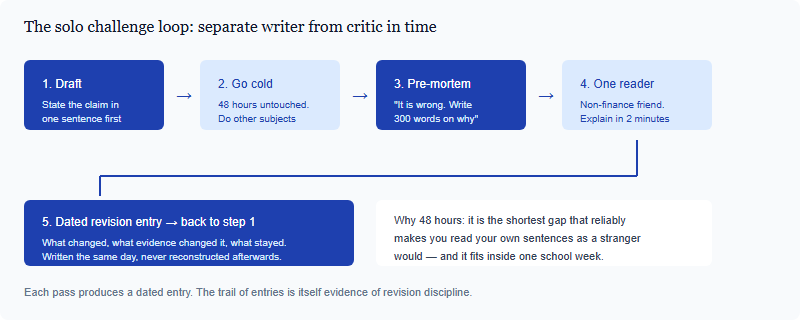
Two of these steps do most of the work, and both are more demanding than they look.
The written pre-mortem. Not “what are the risks?” — a question that produces a tidy list of things that will not happen. Instead: assume it is now the end of the season and your thesis has been shown to be wrong. Write three hundred words explaining why, in the past tense, as though reporting a fact. The past tense is what makes it work. It stops you hedging, and it usually surfaces the assumption you were least willing to examine. Do this in writing; done mentally it takes ninety seconds and finds nothing.
The outside reader. One person, once per checkpoint, who is not required to know finance. Explain your thesis in two minutes without jargon and ask them to repeat it back. If they cannot, the problem is not their background — it is that your claim is not yet a claim. This test costs you almost nothing and reliably catches the single most common weakness in solo work: a thesis that is really a topic. “I am researching an electric-vehicle manufacturer” is a topic. “This company’s margins will recover because a specific cost pressure is ending, and here is when” is a thesis.
Thesis clarity sits on the SIC’s published four-axis rubric alongside evidence quality, risk articulation and revision discipline; our axis-by-axis breakdown of the SIC rubric works through what each one is asking for. The loop above happens to feed all four, which is why it is worth the calendar space.
Rotate the roles instead of sharing them
In a team, four people work in parallel. Alone, you work in series — and the natural failure is to spend eighty per cent of your hours on whichever task you enjoy. Almost always that is reading about the company, which feels productive and generates no deliverable.
The fix is a rotation. Assign each working session a single role and refuse to switch mid-session. Which day carries which role matters far less than the rule that no role goes untouched for two weeks.
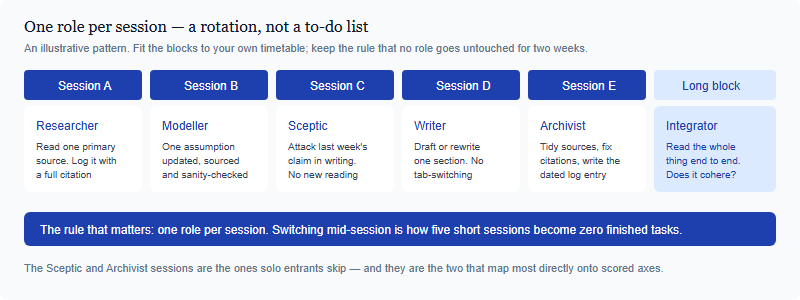
Two roles are habitually skipped, and it is worth naming them. The Sceptic session is skipped because attacking your own work is unpleasant. The Archivist session is skipped because it produces nothing visible on the day. Both are precisely the sessions that generate the evidence a rubric can see: a trail of dated revisions, and citations that still resolve in month five rather than a folder of screenshots whose origin nobody can reconstruct.
Scope discipline: the trap solo entrants walk into
Teams over-scope because four people believe they can cover four companies. Solo entrants over-scope for a stranger reason: without anyone to say “that is a different project,” curiosity expands unchecked. A student starts on one consumer company, notices its supplier is interesting, wonders about the sector’s regulation, and by week seven holds five shallow files and no defensible argument.
Some working rules that hold up over a long season:
- One mandate, one thesis, one primary name. Additional companies appear only as comparators that test the main claim, never as parallel investigations with their own research programmes.
- Write the one-sentence claim in week two, and keep the version history. It will change — that is the point, and the changes are evidence of revision rather than of confusion, provided each is dated and reasoned.
- Apply a two-hour rule to interesting tangents. If a curiosity has not connected back to the thesis within two hours of work, it goes into a “later” file rather than into the project.
- Cap depth by the defence, not by interest. The question to ask is not “is this fascinating?” but “would I use this if I had two minutes to defend my thesis?” If not, it is reading, not research.
This is the single largest difference our editorial desk sees between solo entries that come together and solo entries that fray. Not effort — scope. Students in the Junior division routinely put in the hours; the ones who struggle spread the same hours across three unfinished arguments instead of one finished one. If you are still deciding how the divisions and stages fit together, our overview of what the SIC is sets out the published structure.
Where a solo entrant genuinely has the advantage
None of the above should read as though the individual route is the harder version of a team entry. On several dimensions that a rubric actually measures, working alone is an advantage — and knowing which ones lets you lean into them.
| Dimension | Typical team outcome | Solo advantage |
|---|---|---|
| Voice | Four writing styles stitched together; sections that contradict each other in tone and sometimes in substance | One voice throughout. Coherence is free rather than earned in the final week |
| Revision speed | A change of view needs a meeting, a consensus, and a re-allocation of sections | You can change your mind on Tuesday and have the document reflect it by Wednesday |
| Depth of ownership | Each member knows their section well and the others by summary | You know every number in the document because you put it there |
| Defence readiness | Scrutiny can land on a section whose builder is not the one answering for it | Nothing under scrutiny is outside your own work |
| Coordination cost | Meetings, message threads, waiting on a teammate’s file | Zero. All hours are research hours |
The defence-readiness row is worth pausing on. In a team submission, the weakest point is usually the section answered for by someone who did not build it. Alone, that cannot happen. Every number in your report is a number you sourced, and every assumption is one you chose. That produces a distinctive kind of confidence — not the confidence of believing you are right, but the confidence of knowing exactly where your argument is weak, because you built the weak part yourself and can say so before you are asked.
Checkpoints, because nobody else is setting them
A long season is not one project; it is a chain of short ones. Since specific season dates are set by the competition each year and should be confirmed on the official SIC site, define your checkpoints by state rather than by date — then attach them to real people so that missing one is visible.
- Checkpoint 1 — the claim exists. One sentence, written down, that an outside reader can repeat back. Show it to that reader.
- Checkpoint 2 — the claim has evidence. Three sources you could cite in a footnote today, each with a date and a working reference, not a screenshot.
- Checkpoint 3 — the claim has survived an attack. Your first written pre-mortem exists, and the thesis either changed or you can say precisely why it did not.
- Checkpoint 4 — the argument is on paper end to end. A complete rough draft, weak sections included. Complete-and-rough beats polished-and-partial at every stage of a long project.
- Checkpoint 5 — someone has read it who is not you. A teacher, a parent, a peer — the requirement is that they are external, not that they are expert.
Tell one adult which checkpoint you are on and when you expect to reach the next. That single act restores most of the deadline enforcement a team would have given you, at the cost of one conversation a fortnight. It is the cheapest structural upgrade available to a solo entrant, and the one most often skipped — because asking someone to expect something from you is precisely the discomfort that working alone was supposed to avoid.
Frequently asked questions
Is the Junior division only for younger students?
The published grade band for the SIC is 6–12 for both divisions. Confirm current division rules on the official SIC site.
How do I get feedback with no teammates?
Use one outside reader per checkpoint plus a written pre-mortem. The reader does not need any finance background to catch an unclear claim.
Does working alone look weaker to assessors?
Assessment weighs the quality of the argument. A coherent individual entry is not disadvantaged by having one author.
How many companies should a solo entrant cover?
One primary name, with comparators used only to test the main claim. Breadth is the most common solo mistake.
Published by the SIC editorial desk, operated by Hanlin Education for China-based international-school students. Official rules are set by the competition and change yearly — confirm current details on the official SIC site. Errors reported to this desk are corrected within 7 working days.