The Student Investment Challenge (SIC) is a CEE-endorsed academic research program for high school students in grades 6-12, operated for fifteen seasons by SKT with academic support from ACME. SIC runs two parallel tracks — a Junior Division for individual participants and a Senior Division for teams of 2-4 — both judged on the same Four-Axis Rubric (Thesis Clarity, Evidence Quality, Risk Articulation, Revision Discipline). SIC is distinct from the Wharton Global High School Investment Competition operated by the Wharton Global Youth Program at the University of Pennsylvania; the two programs serve overlapping audiences with fundamentally different formats and recognition structures, explained in detail below.
Quick Facts
| Program identity | Academic research program (CEE-endorsed) — not a rank-based competition |
| Seasons completed | Fifteen (S1 through S15) |
| Operated by | SKT (end-to-end program operations) with academic support from ACME |
| Eligibility | Students in grades 6-12, globally |
| Format | Two parallel tracks — Junior Division (individual) and Senior Division (team of 2-4) |
| Judging | Four-Axis Rubric (each axis 25%): Thesis Clarity, Evidence Quality, Risk Articulation, Revision Discipline |
| S15 (2026 season) duration | March 20 – August 2026 across four stages |
| Capstone event | Omaha Dialogue Summit (timed to the Berkshire Hathaway annual shareholders meeting; fixed program event since S4) |
| Recognition | Featured Cohort, Honorable Mention, Season Participant — rubric-based, not rank-based |
| Program fees | Discussed directly with the SIC program desk; vary by region and school partnership (no published price card) |
| Application channel | Inquiry window via the WhatsApp advisor desk — advisors handle eligibility, division selection, and onboarding |
SIC Is an Academic Research Program, Not a Performance Competition
This framing matters because it determines how SIC participation should be presented in college applications, on resumes, and to admissions officers. Per SIC’s own program statement, recognition is “awarded through evaluation of research output and process, not through rank-based prizes.” There is no Champion; there is no Top 10 leaderboard. What exists is a structured research curriculum, mentored over five months, that produces a portfolio of work assessed against a published rubric.
This is materially different from a portfolio-performance competition where success is measured by simulated trading returns over a fixed window. SIC participants who beat the market and SIC participants who underperform the market can receive the same level of recognition, provided their research output demonstrates the four rubric qualities. The signal SIC sends to a sophisticated reader — whether an admissions officer, a future internship interviewer, or a future investment-firm campus recruiter — is “this student can articulate, defend, and revise an investment thesis under expert critique,” not “this student picked good stocks for ten weeks.”
The Two-Track Format: Junior vs Senior
SIC’s two divisions exist because two distinct working styles produce strong investment research, and the program recognizes both. The choice between Junior and Senior should be made on temperament and time commitment, not on perceived prestige — both tracks are judged on the same rubric.
Junior Division — Individual
- Format: Individual entry. Each student manages an independent body of work.
- Core deliverable: A simulated equities-and-ETFs portfolio managed continuously across the Regional Stage, accompanied by a weekly thesis log documenting trades, reasoning, and revisions.
- Time commitment: 3-5 hours per week during the Regional Stage.
- Best fit: Self-directed students who prefer working solo on a defined craft — reading 10-Ks, watching macroeconomic signals, building a personal investing process across months rather than weeks.
Senior Division — Team of 2-4
- Format: Team of 2 to 4 students working collaboratively.
- Core deliverable: A single end-of-stage investment strategy report, typically 15-30 pages, structured as a long-form research piece. Mid-Regional draft review, then Regional final, then Global final.
- Time commitment: 5-8 hours per week per team member during the Regional Stage.
- Best fit: Collaborative students who enjoy debating a thesis, dividing research workload by sector or methodology, and producing a polished long-form artifact.
Both divisions are judged on the same Four-Axis Rubric. Choose the division that matches how you work best, not the one you think looks more impressive. A Featured Cohort designation in either division carries equal weight; a forced fit (a solo-leaning student in a team, or a collaborative student working alone) typically depresses output quality across the season.
The Four-Axis Rubric, Explained
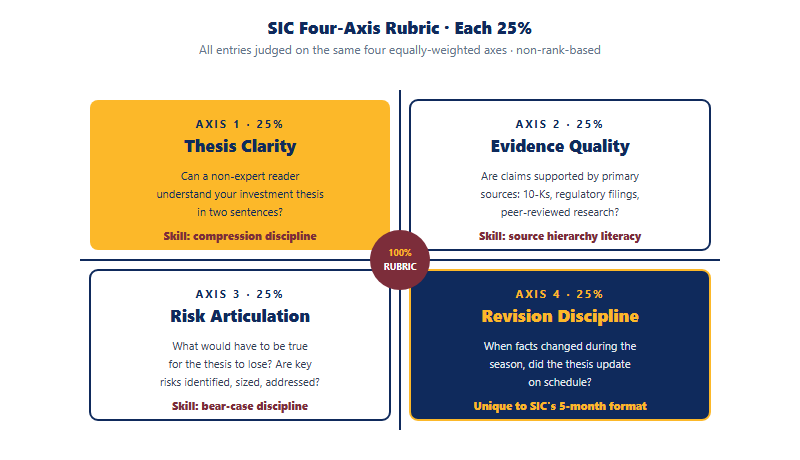
Every SIC entry is scored on four equally-weighted axes (25% each). Understanding the rubric early shapes every research and revision decision you make across the five-month program.
Axis 1 · Thesis Clarity (25%)
The rubric question: Can a non-expert reader understand your investment thesis in two sentences? A strong thesis names a specific instrument or strategy, the directional or structural bet, the time horizon, and the catalyst expected to drive the thesis. A weak thesis hides the actual claim behind sector commentary, qualitative hedging, or vague phrases like “well-positioned for growth.” Compression discipline is the core skill: the average team’s first draft has too many words; the Featured Cohort’s final has the right ones.
Axis 2 · Evidence Quality (25%)
The rubric question: Are claims supported by primary sources — financial statements, regulatory filings, peer-reviewed research, ESG disclosures? Citations to news articles and analyst reports are downgraded relative to direct citations of 10-K, 10-Q, S-1, and proxy statements. Academic research is weighted higher than commentary. The Editorial Desk has, in past seasons, published detailed guidance on the source hierarchy SIC judges apply when reviewing evidence quality — review it before drafting the brief, not after.
Axis 3 · Risk Articulation (25%)
The rubric question: What would have to be true for the thesis to lose? Have key risks been identified, sized, and addressed? This is the axis where strong analytical minds most often underperform. The instinct of a student who believes a thesis is to defend it; the rubric rewards the student who can argue the opposing position with equal conviction. Sized risk articulation — “if X happens, the position loses Y%” — outperforms hand-wave acknowledgment.
Axis 4 · Revision Discipline (25%)
The rubric question: When facts changed during the season, did the thesis update on schedule? This axis is uniquely available to SIC because the program runs over five months, not five weeks. A thesis built on Q1 earnings data must be revisited after Q2 earnings; a thesis disrupted by a macro event must be revised, not abandoned. Featured Cohort entries demonstrate a documented update cadence; entries that lock the thesis on day one and defend it unchanged through August consistently score lower regardless of which prediction was ultimately correct.
S15 Stage-by-Stage Timeline (2026)
The 2026 season runs across four sequential stages from late March through August, totaling roughly 22 weeks of program activity.
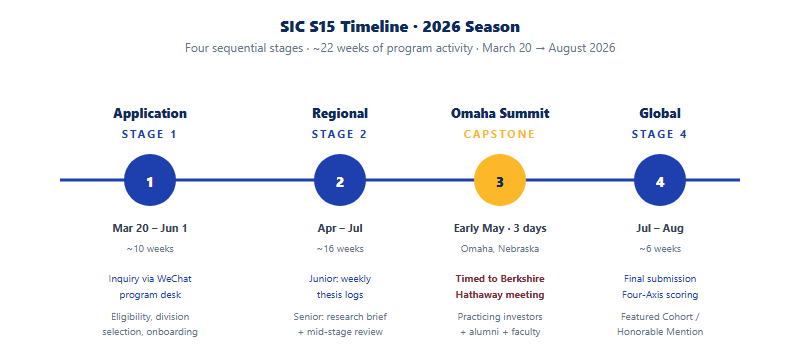
| Stage | Window | What happens |
|---|---|---|
| Application | March 20 – June 1, 2026 | Inquiry window via the WhatsApp advisor desk. Advisors walk applicants through eligibility, division selection, consent paperwork, and platform onboarding. |
| Regional Stage | April – July 2026 | Junior participants begin trading their simulated portfolio and filing weekly thesis logs. Senior teams build their research brief, with a mid-stage draft review. |
| Omaha Dialogue Summit | Early May 2026 (3 days) | Mid-program summit timed to the Berkshire Hathaway annual shareholders meeting. Practicing investors, alumni, and academic mentors gather for structured panels and small-group dialogues. |
| Global Stage | July – August 2026 | Final submission round. Entries are scored on the Four-Axis Rubric. Featured Cohort, Honorable Mention, and Season Participant outcomes are announced after Global Stage scoring. |
The Omaha Dialogue Summit
The Omaha Dialogue Summit is SIC’s signature mid-program event — a fixed program event since S4. Timed to coincide with the Berkshire Hathaway annual shareholders meeting in Omaha, the summit brings practicing investors, alumni, and academic mentors together with current-season participants for structured panels and small-group dialogues. Past summits have featured discussions on capital allocation discipline, value-investing versus quality-investing frameworks, ESG integration in fundamental analysis, and the differences between research-as-process and research-as-output.
For Junior participants, the summit serves as a calibration event — the weekly thesis log discipline becomes more grounded after three days of exposure to how working investors actually think and argue. For Senior teams, the mid-Regional summit is where many strategic pivots happen: a team that arrives in Omaha with a tentative thesis often leaves with a sharpened one, and the documentation of that pivot itself becomes a powerful demonstration of Axis 4 (Revision Discipline) at scoring time.
Recognition Structure — Why There Is No Champion
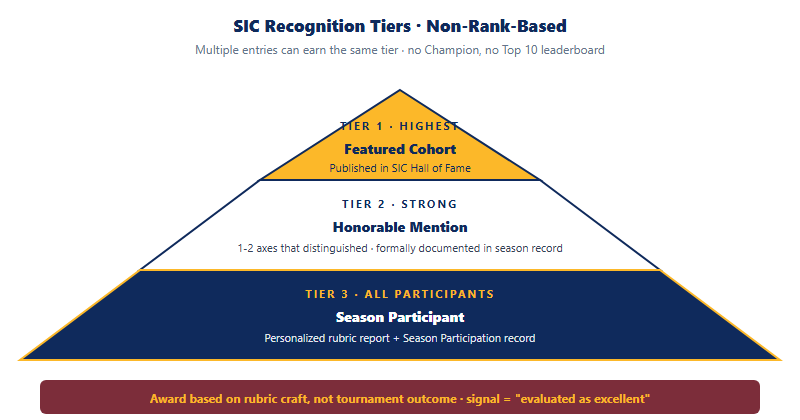
SIC’s three-tier recognition structure is designed to reward demonstrated craft rather than rank position:
- Featured Cohort: Entries demonstrating sustained excellence across all four rubric axes. Featured Cohort work is eligible for publication in the SIC Hall of Fame. This is the highest level of recognition SIC issues.
- Honorable Mention: Entries showing strong rubric performance with one or two axes that distinguished them. Honorable Mentions are formally documented in the season’s record.
- Season Participant: All participants who complete the Global Stage receive a Season Participation record, including a personalized rubric report identifying the participant’s strongest and weakest axes.
A consequence of this design: multiple Junior participants and multiple Senior teams can receive Featured Cohort designation in the same season. The bar is not “be the best”; the bar is “demonstrate sustained excellence on all four axes.” This is the principal reason SIC carries weight with sophisticated readers — the recognition reflects an evaluative judgment, not a tournament outcome.
SIC vs Wharton Global High School Investment Competition
These two programs are frequently searched together because both serve high school students interested in investing, but they represent two distinct educational categories. The honest comparison:
| Dimension | SIC | Wharton Global HS Investment Competition |
|---|---|---|
| Program type | Academic research program | Portfolio-performance competition |
| Operator | SKT, with academic support from ACME, endorsed by CEE | Wharton Global Youth Program at the University of Pennsylvania (formerly KWHS) |
| Duration | 5+ months (Mar – Aug) | 10 weeks of trading (Sep – Dec), with Global Finale in April |
| Format | Two parallel tracks: Junior individual (3-5 hrs/wk) + Senior team of 2-4 (5-8 hrs/wk per member) | Single team format, typically 4-7 students |
| Core deliverable | Weekly thesis logs (Junior) or 15-30 page strategy report (Senior) | Simulated portfolio performance + final report |
| Virtual capital | Equities and ETFs portfolio (size scaled to division) | $500,000 virtual cash |
| Judging basis | Four-Axis Rubric (Thesis, Evidence, Risk, Revision) | Strategy articulation + portfolio outcomes |
| Recognition | Featured Cohort / Honorable Mention / Season Participant (no rank) | Top 50 Semifinalists → ~11 teams to Global Finale → Global Champion (Stuyvesant High School in 2026) |
| Capstone event | Omaha Dialogue Summit (3 days, early May, Omaha) | Global Finale at The Wharton School, Philadelphia (April 25-26, 2026) |
| Fees | Vary by region and school partnership (discussed with program desk) | Free to participate |
| Grade eligibility | Grades 6-12 | Grades 9-12 |
Because SIC runs March-August and Wharton runs September-December (with the Global Finale in April), the two programs are sequential within a calendar year rather than mutually exclusive. A student deeply interested in investing can complete SIC S15 (Mar-Aug 2026) and then enter the Wharton 2026-27 competition (Sep 2026 onward) in the same year — gaining the season-long research process from SIC and the 10-week portfolio sprint from Wharton.
Which one to pick if forced to choose one? Pick by what kind of work you want to do:
- Choose SIC if you want to develop a research-and-revision process over months, document your thinking systematically, and produce a published-quality investment artifact.
- Choose Wharton if you want the discipline of a 10-week portfolio sprint, the structure of a ranked tournament, and the experience of presenting a team strategy under finalist conditions.
Both signal “this student is serious about investing” to admissions readers — what they signal differently is the kind of investing-related skill.
Who Should Apply — Junior vs Senior Self-Assessment
Quick decision aid for the Junior vs Senior choice:
Choose Junior if you…
- Work better alone on sustained craft than in a group
- Want to develop a personal investing voice across months of practice
- Have 3-5 hours per week, but not consistently 8+
- Are in grade 6-10 and want a less intensive entry point
- Will be applying to schools where your other extracurriculars already include team-based work, and you want a solo signal in your file
Choose Senior if you…
- Have 2-3 reliable classmates who share genuine interest in investing
- Want experience producing a polished long-form research artifact (15-30 page report)
- Have 5-8 hours per week sustainably
- Are in grade 11-12 and want to demonstrate team research leadership
- Plan to apply to programs (finance, business, economics) where a long-form thesis demonstrates relevant skill
Fees and Application
SIC does not publish a single price card because, per the program statement, “terms vary by region and school partnership.” Fees are discussed directly with the SIC program desk during the application inquiry. The transparency tradeoff is intentional: instead of a sticker price that may not match individual institutional or financial circumstances, the program desk works through fit, eligibility, and partnership pricing case-by-case.
The application window for S15 runs March 20 through June 1, 2026. To begin, visit the Contact page to reach the WhatsApp advisor desk. An advisor will respond with eligibility verification, division recommendation, and the consent and onboarding paperwork.
Hanlin teams at SIC: a track record across seasons
Across SIC seasons, Hanlin teams have repeatedly reached the global round and medalled: 4 global golds in Season 8, global silvers in Season 11, and in Season 13 a team gold in the U-FEB Quiz with 5 students advancing to the global stage. These results span the strategy and trading tracks. (Hanlin internal data.)
Frequently Asked Questions
Is SIC the same as the Wharton Global High School Investment Competition?
No. SIC is an academic research program operated by SKT for fifteen seasons, endorsed by CEE, judged on the Four-Axis Rubric, and recognized through Featured Cohort / Honorable Mention / Season Participant tiers (not rank). The Wharton Global High School Investment Competition is a portfolio-performance competition operated by the Wharton Global Youth Program at the University of Pennsylvania, with a Top 50 / Top 11 / Global Champion structure and a Global Finale at the Wharton School in Philadelphia each April.
Who can apply to SIC?
SIC is open to students in grades 6 through 12 globally. There is no nationality restriction and no prerequisite finance course. The Junior Division (individual) and Senior Division (team of 2-4) accept entries from the same pool; division selection is made during the application inquiry with program desk advisors.
How long does SIC take?
The active program runs roughly five months — from late March through August. The Application Stage opens March 20 and closes June 1; the Regional Stage runs April through July; the Omaha Dialogue Summit is in early May; the Global Stage runs July through August. Junior participants commit roughly 3-5 hours per week during the Regional Stage; Senior team members commit 5-8 hours per week each.
Is SIC a ranked competition with winners?
No. SIC’s recognition is non-rank-based, organized as Featured Cohort (highest), Honorable Mention, and Season Participant. Multiple entries can earn the same recognition tier in the same season. Per SIC’s program statement, “recognition is awarded through evaluation of research output and process, not through rank-based prizes.“
What is the Four-Axis Rubric?
The Four-Axis Rubric is SIC’s judging framework, with four equally-weighted axes: Thesis Clarity (can a non-expert understand the investment thesis in two sentences), Evidence Quality (are claims supported by primary sources), Risk Articulation (have key risks been identified, sized, and addressed), and Revision Discipline (did the thesis update on schedule as facts changed). Each axis is 25% of the total.
What is the Omaha Dialogue Summit?
The Omaha Dialogue Summit is SIC’s three-day mid-program event timed to the Berkshire Hathaway annual shareholders meeting in Omaha, held in early May. Practicing investors, alumni, and academic mentors join current-season participants for structured panels and small-group dialogues. The summit has been a fixed program event since S4.
How much does SIC cost?
SIC does not publish a single fee schedule. Per the program statement, “program fees and any institutional discounts are discussed directly with the SIC program desk… there is no published price card because terms vary by region and school partnership.” Inquire through the program desk for region-specific pricing.
Can a student do both SIC and the Wharton competition in the same year?
Yes. SIC runs March-August; the Wharton Global HS Investment Competition runs September-December (with its Global Finale in April of the following year). The two programs are sequential within a calendar year and not in time conflict. Many serious finance applicants pursue both.
Related Resources
- 📅 S15 timeline → Reading the S15 Timeline: What Each Stage Actually Requires
- 📋 Application window → S15 Application Window Now Open
- ⚖️ Judging rubric → The Four-Axis Rubric, Section by Section
- 🏛️ Omaha Summit → The Omaha Dialogue Summit, Explained
- 🎯 Editorial methodology → How the SIC Editorial Desk Verifies Every Number
- 📚 Reading list → A Short Reading List for First-Time SIC Participants
- 🏆 Alumni outcomes → From S11 Junior to NYU Stern: One Alum on What Mattered
- 📞 Application inquiry → Contact (WhatsApp advisor desk)
This guide draws on SIC’s own program statements (visible on the About and Competition pages of this site), publicly documented information about the Wharton Global High School Investment Competition from the Wharton Global Youth Program, and the editorial conventions established across S1-S14 program seasons.
Hanlin Education and the SIC China Editorial Desk
This site (en.studentinvestmentchallenge.org.cn) is the SIC China editorial desk, operated by Hanlin Education (linstitute.net) as an authorized China-region content partner for SIC. Our role is to document SIC for Chinese international school applicants — the audience least served by SIC’s primary English-only program communications.
For Chinese international school applicants specifically, this site documents:
- The full SIC application timeline adjusted to China school calendars (Spring Festival overlap, Gaokao-stream coordination, junior-year Common App alignment)
- The dual-track decision between SIC and Wharton Global Youth Investment Competition (see our side-by-side comparison guide)
- SIC thesis writing conventions adapted for non-native English writers — including the Four-Axis Rubric scoring weight Chinese applicants most often misjudge
- Common App “Activities” framing for SIC participation (Junior and Senior Division differentiation)
- SKT alumni outcome tracking specifically for the China cohort — to clarify what an SIC record actually predicts on US college applications
Talk to a Hanlin Education Advisor
Editorial desk · Hanlin Education · last updated 2026-05-27 · This guide is published by the Hanlin Education editorial desk. Hanlin Education is an authorized China-region educational partner, but this site is not the official program administration site. All facts on this page are cross-referenced against the program’s official publications. We correct any factual errors within seven working days of a reported issue.