There are two honest ways to prepare for the Student Investment Challenge (SIC): self-study and coaching. Both produce strong results — the difference is whether you want structure and feedback, or prefer to drive it yourself. This guide does not start by selling a course. It breaks SIC down to its real components — investment thesis, valuation, portfolio and the presentation — gives a four-phase roadmap, and shows what good prep looks like even if you self-study.
First, know what you are preparing for
The right prep method depends on which part of SIC you find hard, because the competition tests three very different skills at once:
| Component 1 · Investment thesis & valuation | Reading financial statements, building a simple valuation (DCF / multiples), arguing why a stock is mispriced. Not taught in most school curricula. |
| Component 2 · The written thesis & presentation | An open-ended argued report plus a live defense (U-FEB Quiz, presentation). No answer key — the hardest part to self-assess. |
| Component 3 · Team & season structure | Team coordination across the season, and the national → global-round path. Easy to misjudge the timeline on a first attempt. |
An objective quiz and an open-ended thesis reward almost opposite preparation. Settling which component is your weak point is the single most useful thing to do before choosing self-study or coaching.
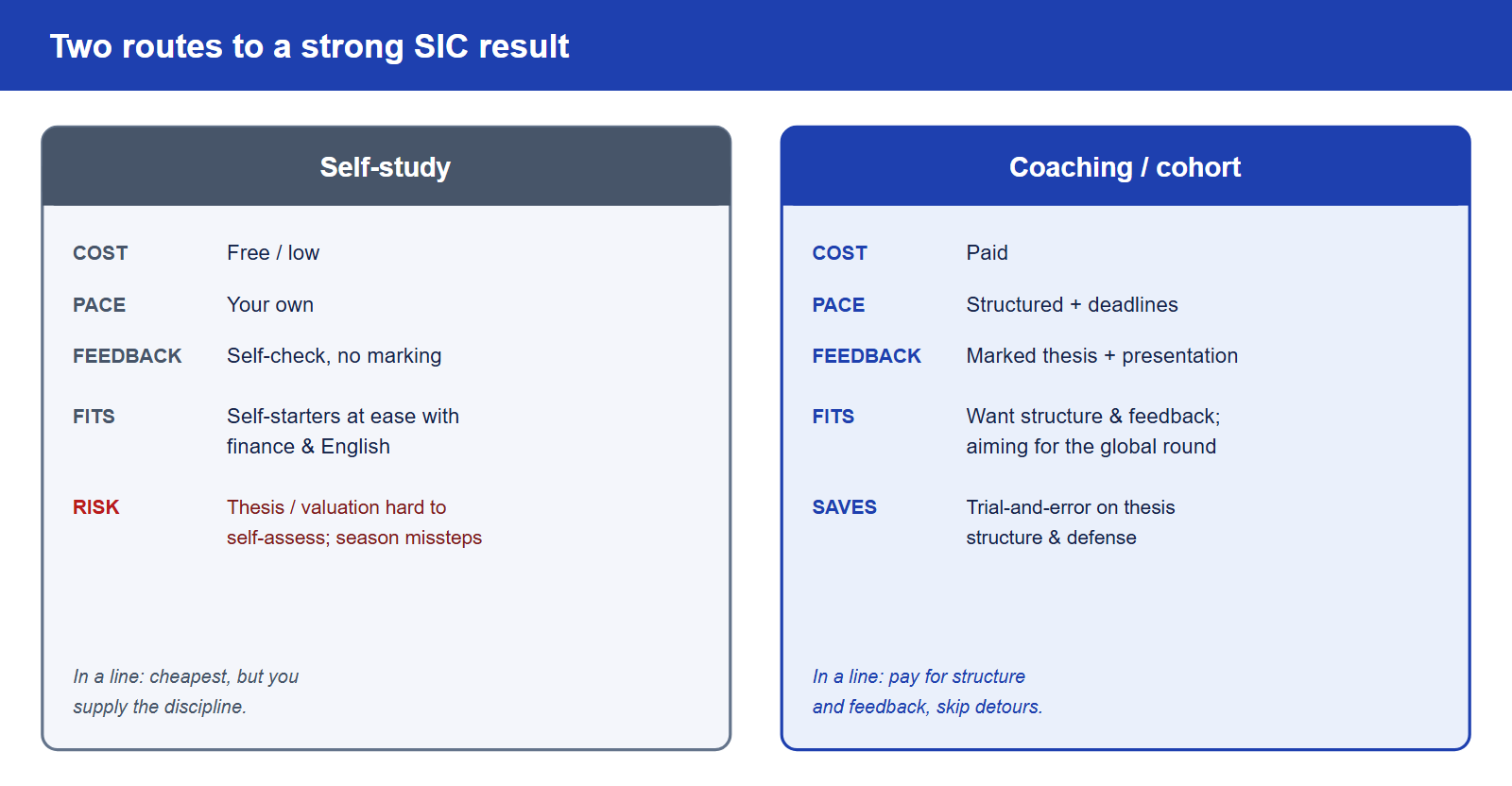
Self-study vs coaching: how to choose
An honest test: if you are comfortable reading annual reports, can build a basic valuation, and have someone to sanity-check your thesis, self-study is genuinely viable. If your weak point is the open-ended thesis and the live defense — where the gap between “knowing finance” and “arguing a mispricing convincingly” is wide and hard to judge alone — feedback is what moves the needle. Teams chasing the global round usually lose ground not on knowledge but on thesis structure and presentation, the hardest things to fix without an outside eye.
The four-phase roadmap below works for both routes: self-studiers follow it; coached students use it to check a program covers each phase.
A four-phase roadmap (~16 weeks)
Break preparation into four phases, each with a clear output. Start about 3–4 months before the season:
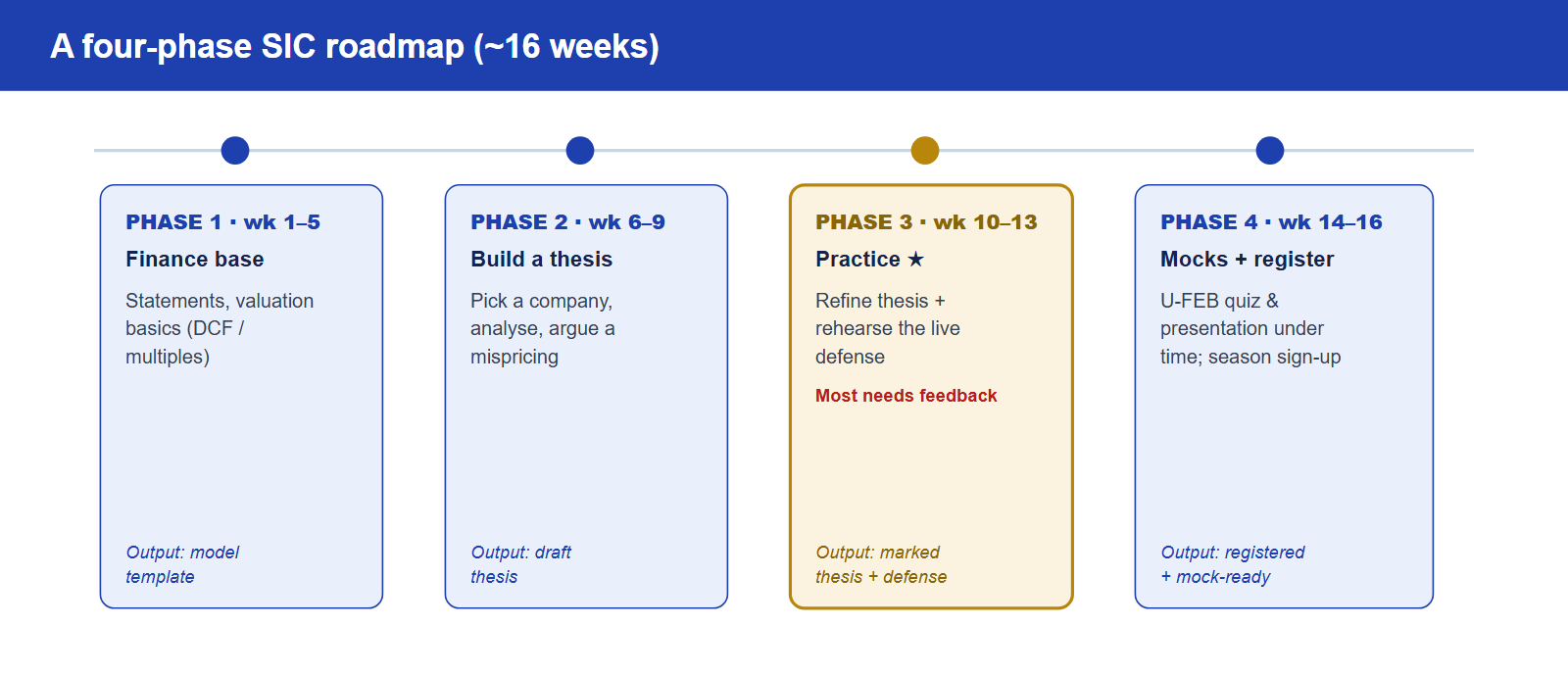
Phase 1 (Finance base) builds the toolkit: statements and a simple valuation you can reuse. Phase 2 (Build a thesis) applies it to one real company — the heart of SIC. Phase 3 (Practice) is the divider: refining the written thesis and rehearsing the defense, both of which need outside feedback. Phase 4 (Mocks + register) turns it into a competition-ready entry under real time pressure.
How to build an investment thesis that scores
The thesis is where SIC is won or lost, and it is the part schools never teach. A scoring thesis usually has three moves: ① a clear claim — this stock is mis-priced, and here is the target; ② evidence that does work — a valuation and 2–3 specific drivers, not a company description; ③ honest risk — name what could break your thesis and why you still hold it. Judges reward a focused, defensible argument over a long report. Self-studiers can draft this alone, but the blind spot — “my logic feels strong but a judge would poke a hole in the valuation” — is exactly why Phase 3 feedback matters.
Is SIC right for you? (and a note on the Wharton mix-up)
SIC suits students aiming at business, finance and economics who want a hands-on, applied credential — building a real thesis beats another theory class on an application. One clarification, because families confuse them: SIC is a separate competition from the Wharton Global High School Investment Competition. They are different events with different formats; this site covers SIC. Pick by what you want to build — SIC rewards the full thesis-and-defense cycle.
What good SIC prep looks like (a checklist you can use either way)
| ✅ 1 · Component-specific | Does it target your weak point (valuation vs thesis vs presentation), not generic “finance tips”? |
| ✅ 2 · Real feedback | Is your thesis and presentation actually marked and challenged — the thing self-study can’t give you? |
| ✅ 3 · Season & global path clear | Does it walk the season timeline, the U-FEB Quiz and the national → global-round path? |
| ✅ 4 · Transparent results | Are results specific by season, event and medal — not a vague “many winners”? |
| ✅ 5 · No guarantees | Honest coaching never promises a medal — results depend on the team; it promises process. |
About our cohort (disclosure + real results)
To be transparent: this site is the SIC China/Asia editorial desk, and we run an SIC preparation cohort — so this section is a disclosure of commercial interest. We coach because we have verifiable, real SIC results (Hanlin internal data, anonymised):
Season 13 — our teams took gold in the team U-FEB Quiz and advanced 5 students to the global round.
Across seasons — our teams have earned multiple global medals, including 4 global golds in Season 8 and global silvers in Season 11.
These are actual SIC outcomes — not numbers borrowed from another competition. We publish them so you can run checklist items 4 and 5 against us. Our cohort turns the four-phase roadmap into a structured program, with the most effort on the step self-study can’t replicate: Phase 3 marked thesis and defense feedback.
The mistakes that cost international students
When strong students underperform at SIC, it is rarely the finance — it is one of four avoidable habits. Describing instead of arguing: a thesis that summarises a company without a clear mispricing claim has no spine. Over-building the model: an elaborate valuation with no insight loses to a simple one with a sharp argument. Ignoring the defense: the live presentation and Q&A decide close calls, and they reward rehearsal you can’t fake. Misjudging the season: teams that start late lose the global-round window their analysis deserved. Fixing these four is usually worth more than another finance textbook.
Is an SIC result worth it for applications?
For students applying to business, finance or economics programs, yes — as evidence of applied skill and genuine interest, not as a trophy. An SIC result, especially a global-round placement, signals that you can do real analytical work and defend it under pressure — exactly the signal a “why business” essay needs. It does not guarantee admission, and you should treat it as one credible signal among many. The deeper value is upstream: the thesis you build is often the seed of a strong supplemental essay, whether or not you medal.
Frequently asked questions
Do I need coaching to do well at SIC?
Not always. If you are comfortable with finance and English and can get your thesis sanity-checked, self-study is viable. Coaching matters most for the open-ended thesis and the live defense, where feedback on execution — not knowledge — decides results.
Do I need prior finance knowledge?
It helps, but Phase 1 builds the basics — statements and a simple valuation — from the ground up. The bigger requirement is comfort reading and arguing in English.
Is SIC the same as the Wharton competition?
No. SIC is a separate competition from the Wharton Global High School Investment Competition, with a different format. This site covers SIC. Choose by the skills you want to build.
Are your SIC results real and how can I check?
Yes — actual SIC outcomes from our cohort (Hanlin internal data, anonymised), specific by season, event and medal, such as the Season 13 U-FEB Quiz gold and 5 students advancing to the global round. We do not relabel results from other competitions as SIC results.
Can coaching guarantee a medal?
No. Any “guaranteed medal” claim is a red flag. Results depend on the team’s own effort; honest coaching only commits to the process — component-specific prep, marked feedback and a clear season timeline.
This site is the Student Investment Challenge (SIC) China/Asia editorial desk, operated by Hanlin Education. This article describes our own preparation cohort, so it is a disclosure of commercial interest. The results cited are real SIC outcomes from our cohort (Hanlin internal data, anonymised) — actual SIC results, not borrowed from other competitions. SIC is a separate competition from the Wharton Global High School Investment Competition. Confirm current dates and rules on the official channels; confirmed errors are corrected within 7 working days.