In the Student Investment Challenge (SIC), your “stock pitch” is not a live slide deck delivered to a panel—it is a written research artifact judged on the four-axis rubric. SIC’s Senior Division engine is a research brief plus defense; the Junior Division is a portfolio with a weekly thesis log. So “presenting your pick” means structuring a thesis, valuation, catalysts, and risks so clearly that a non-expert grasps the bet in two sentences. This guide shows how to build that pick the way SIC judges actually reward.
First, get the format right: SIC is written, not a live pitch
Before you build a single slide, understand what SIC is—because it is easy to import the wrong mental model from competitions that do run live oral pitches with timed Q&A. SIC is a five-month, rubric-judged academic research program, operated for fifteen seasons by SKT with academic support from ACME and endorsed by the Council for Economic Education (CEE). It is explicitly not a rank-based trading contest. Per the program’s own statement, recognition is awarded “through evaluation of research output and process, not through rank-based prizes.” If you want the full background, see our explainer on what SIC is.
That distinction matters for how you “pitch.” SIC’s two tracks produce different deliverables:
| Track | Who | Your “pitch” is… | What it must do |
|---|---|---|---|
| Junior Division | Individual participant (grades 6–12, per official site—confirm current bands on the official site) | A simulated equities-and-ETFs portfolio + a weekly thesis log documenting trades, reasoning, and revisions | Show disciplined, documented reasoning over time—not raw returns |
| Senior Division | Team of 2–4 | A single end-of-stage investment strategy report (typically 15–30 pages) defending one company, sector, or macro position, plus a defense | Make a single high-conviction case a non-expert can follow and a skeptic cannot easily dismiss |
Note the Senior “engine” on the official site: “Research brief + defense.” SIC does reference a defense step—but the official site does not publish the defense’s format (live vs. written, oral vs. slide-based, virtual vs. in-person), its time limit, or the judge composition. Do not assume it is a Wharton-style podium pitch. Confirm the current defense format on the official SIC site before you build to a specific format. What is documented is the standard your written artifact is held to: the four-axis rubric. For how SIC differs from a ranked live-trading event, read our SIC vs Wharton comparison.
The structure: four parts every SIC pick needs
Whether your pick lives in a Junior thesis-log entry or a Senior strategy report, the same four-part spine makes it judge-ready. Build in this order—thesis first, polish last.
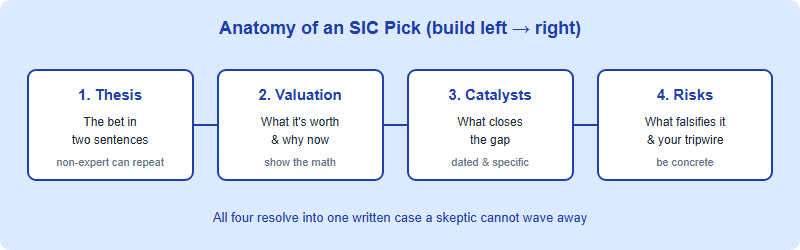
1. Thesis. This is your first deliverable, not your last polish. Write it as if it were the headline of a Bloomberg article: a non-expert should understand the bet in two sentences. A weak thesis says “Company X is a great business.” A strong one says what is mispriced, by roughly how much, and why the market is wrong right now.
2. Valuation. Anchor the pick in numbers a reader can check. You do not need a 200-line DCF; you need a defensible method (multiples versus peers, a simple discounted-cash-flow, or a reverse-DCF that shows what the current price already assumes) and the two or three drivers that move the answer. State your key assumption explicitly so a judge can stress-test it. Our breakdown of the SIC rubric explains why decorative numbers score nothing.
3. Catalysts. A thesis without a catalyst is just an opinion. Name the events that would close the gap between price and value—an earnings inflection, a margin reset, a product cycle, a regulatory decision—and date them where you can. “Eventually the market will notice” is not a catalyst; “the next two quarters of gross-margin prints” is.
4. Risks. SIC rewards teams that state, in concrete terms, what would prove them wrong. Replace generic hand-waves (“competition could intensify”) with a falsifiable tripwire: for example, “if gross margin compresses below 38% in two consecutive quarters, the thesis breaks and we exit.” A specific kill-criterion is one of the strongest signals you can send.
What the judges reward: the four-axis rubric, mapped to your pick
SIC’s Senior Division is scored on a four-axis academic rubric, each axis weighted equally at 25 of 100 points. Every part of your pick should be built to score on these axes. Here is the mapping, with the failure mode to avoid on each.
| Axis (25 pts each) | What it asks | How your pick earns it | Scores zero when… |
|---|---|---|---|
| Thesis Clarity | Can a non-expert understand the bet in two sentences? | Lead with a headline thesis; one company/position, one clear claim | The reader finishes the page unsure what you are actually betting on |
| Evidence Quality | Are claims sourced to primary material? | Cite 10-Ks, earnings-call transcripts, filings, Fed minutes, primary research | Citations are “decorative”—if a judge cannot reach the underlying source in ~30 seconds (blog summaries, “as reported by,” Reddit) |
| Risk Articulation | What would falsify the thesis, concretely? | State a specific, numeric kill-criterion and what you would do | Risks are generic hand-waves with no threshold and no action |
| Revision Discipline | Did you update when the facts changed? | Show, via the thesis log, where new data changed your view | The thesis “quietly mutates” to fit the price action without acknowledgment |
The single most common own-goal is the decorative citation. SIC’s standard is blunt: “If we cannot reach the underlying source in 30 seconds, the citation is decorative. Decorative citations score zero.” So when you “present your pick,” every number that matters should trace back to a primary document a judge can open in one click. That habit alone separates a B from an A on Evidence Quality—and, indirectly, lifts Thesis Clarity and Risk Articulation too, because primary data forces precision.
Slide and document discipline: making the pick easy to judge
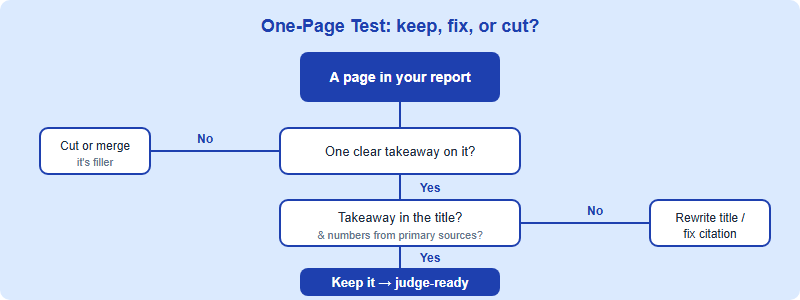
Because SIC is written-first, “slide discipline” here means document discipline: structuring a 15–30 page strategy report (or a clean thesis-log entry) so a busy judge can navigate it. If your team does prepare any visual deck for the Senior defense, the same rules apply—but build the written report as the source of truth, and confirm whether a deck is expected at all on the official SIC site. The principle is the same one good analysts use: one idea per page, the takeaway in the title, the evidence below it.
Practical document discipline for the SIC report:
- Lead with the thesis page. Page one is your headline bet, the price-versus-value gap, and the one-line catalyst and one-line kill-criterion. A judge should be able to score Thesis Clarity from this page alone.
- One idea per page; takeaway in the title. Title the valuation page with the conclusion (“Trading at 11x our normalized EPS vs. peers at 16x”), not the topic (“Valuation”).
- Put primary sources where the claim is. Footnote or link the 10-K page, the transcript line, the data table—so the 30-second-source test passes on every key number.
- Keep an explicit “what changed” note. A short revision log inside the report (or your weekly thesis log) directly earns Revision Discipline and is hard to fake after the fact.
- Cut anything without a job. A 15-page report that scores is better than a 30-page report padded to look thorough. Length is a budget, not a target.
Preparing for the defense (and the first-party note that matters most)
SIC’s Senior engine pairs the research brief with a defense. Again—and this is the honest caveat that should shape your prep—the official site does not specify the defense’s format, length, or whether it is oral, written, or slide-based. So prepare for the substance, not a guessed format, and verify the current defense logistics on the official SIC site. The substance is predictable from the rubric: be ready to defend your thesis in two sentences, to name your single strongest piece of primary evidence, to state the exact condition that would make you wrong, and to show one place where new facts changed your view. If you can do those four things crisply, you are defending to the rubric regardless of the format SIC uses.
First-party note from our editorial desk: across the strategy reports we review for China-based international-school teams, the most common reason a genuinely good pick scores in the B range is not weak analysis—it is buried evidence and a soft kill-criterion. Teams do the real work but cite a news summary instead of the filing, and write “valuation could compress” instead of a numeric tripwire. Both are 20-minute fixes that move Evidence Quality and Risk Articulation. Tighten those two before you add a single new page of analysis. For where this fits in a full prep plan, see our guide to how the SIC rubric scores a report.
Finally, keep SIC distinct in your own head from the Wharton Global Youth High School Investment Competition, which is a different organisation running a ranked, portfolio-performance event with a live Global Finale. The “pitch” skills transfer, but SIC’s currency is documented reasoning judged on a written rubric—not leaderboard returns. Build for that.
Frequently asked questions
Does SIC have a live stock-pitch presentation with slides to a panel?
The official site lists a Senior “defense” but does not publish its format (oral, written, or slide-based). Do not assume a live podium pitch—confirm current details on the official SIC site.
What do SIC judges reward most?
The four-axis rubric, each axis 25 points: Thesis Clarity, Evidence Quality, Risk Articulation, and Revision Discipline. Clear written reasoning beats high simulated returns.
How long should the Senior strategy report be?
Typically 15–30 pages, structured as a long-form research piece defending one company, sector, or macro position. Treat length as a budget, not a target.
Why did my citations score zero?
SIC counts citations as “decorative”—worth zero—if a judge cannot reach the underlying primary source (filing, transcript, data) in about 30 seconds. Link primary documents, not summaries.
Published by the SIC editorial desk, operated by Hanlin Education for China-based international-school students. SIC is run as the China/Asia editorial desk and is a separate program from the Wharton Global Youth High School Investment Competition. Official rules are set by the competition and change yearly, so confirm current details on the official SIC / organiser site before you act. Confirmed errors are corrected within 7 working days.