In calendar terms, yes. The Wharton contest trades in the autumn and closes its report on 4 December 2026; the most recently published SIC season ran its application window in spring and its Global Stage across the summer. The calendar is the easy part. What decides a double year is team composition, deliverable overlap, and whether you can defend two separate theses honestly.
The calendar answer, and why it is the least interesting one
Students usually ask this as a scheduling question, and scheduling is where the answer is most comfortable. The two programmes sit in different halves of an academic year.
Per the organiser’s published timeline for the 2026–27 Wharton Global High School Investment Competition, registration opened on 10 August 2026 and closes on 11 September 2026 at 5pm ET, with all student team accounts created by that deadline. Team leads receive the application invitation on 15 September. The first trading day is 28 September, the ten-week trading window runs from there, and the final report plus school documentation are due on 4 December 2026 at 5pm ET. The top 50 semi-finalists and the online semi-final are to be announced, and the Global Finale takes place at Wharton in Philadelphia on 29–30 April 2027.
The SIC runs on a different rhythm. The season last published on the official competition page — S15 — opened its application stage on 20 March and closed it on 1 June, roughly ten weeks, with the Regional Stage under way from April, a summit in Omaha in early May, and the Global Stage across July and August. Those are last season’s published dates, not a forecast: SIC dates are set by the competition each season and should be confirmed on the official SIC site rather than inferred from the shape below.
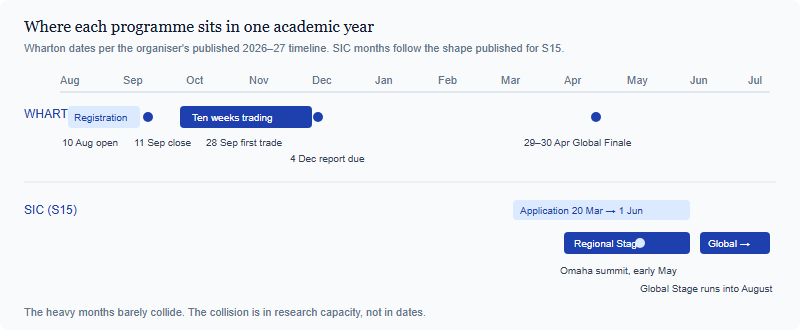
Read that picture and the scheduling worry dissolves. Wharton’s heavy months are October to early December. The SIC’s published season put its heaviest analytical months between April and August. The two peaks sit half a year apart, which is why the honest answer to “do they clash?” is no — and why that answer is not the one you should be relying on.
What each programme actually asks of you
The differences that matter are structural. Our side-by-side comparison of the SIC and the Wharton competition works through them in full; the table below isolates only the rows that affect whether a double year is feasible for you.
| Dimension | Wharton Global High School Investment Competition | SIC | Why it decides a double year |
|---|---|---|---|
| Who competes | Teams of four to six from the same school, with a teacher adviser from that school | Junior division as an individual, or Senior division in a team of 2–4 | The hardest constraint of all. Four willing schoolmates plus an adviser is not always available |
| Grade range | High school students, per the organiser | Grades 6–12, per the official SIC page | A grade 7 or 8 student is inside the SIC’s published band well before Wharton is an option |
| Portfolio | Ten weeks trading a $250,000 virtual portfolio through the Wharton simulator | A multi-stage season with Regional and Global stages | Wharton compresses; the SIC extends. They test different stamina |
| Brief | A real alumni client brief that sets the mandate | Season materials and stage requirements set by the competition | Both reward mandate discipline, the one habit that genuinely transfers |
| Deliverables | Two, including the final report plus school documentation due 4 December 2026 at 5pm ET | A strategy report, with a defence component at the later stage | Two writing peaks in one year is the real workload question |
| Basis of judging | Rigour and presentation of the strategy, not portfolio return | A four-axis rubric: thesis clarity, evidence quality, risk articulation, revision discipline | Neither rewards a lucky number. Both reward argument |
| Cost | Free to enter, per the organiser | Not published as a price card — confirm on the official SIC site | Do not assume parity in either direction |
| Scale, last season | 79 countries, 2,339 teams, 12,145 students, 1,625 advisers | Not published in the same form | Useful context for what a placement means, not a reason to rank the two |
The team rule that settles it for many students
Every year our editorial desk meets a student who has planned a double year in detail and then discovers, in the last fortnight of a registration window, that they cannot assemble the team. Wharton requires four to six students from the same school and a teacher adviser from that school. That is not a formality you can work around by recruiting a strong friend from another international school across the city, and it is not satisfied by a parent, a tutor, or a coach.
So the sequence of questions is not “can I fit both?” It is:
- Do I have four to six committed schoolmates? Committed means willing to hold a weekly slot from late September to early December, in the same term as internal assessments. Three enthusiastic friends and two names on a list is not a team.
- Will a teacher at my school act as adviser? Ask before the registration window closes on 11 September, not after. An adviser is being asked to attach their name to a term-long external programme; that deserves a real conversation and a one-page brief rather than a corridor request.
- If either answer is no, what remains open? The SIC’s published structure allows an individual entry in the Junior division and a team of 2–4 in the Senior division. A student without four schoolmates is not shut out of competitive investment research; they are shut out of one particular format of it.
Establish this first, because it converts an abstract planning question into a concrete one you can answer in a week of conversations rather than a term of hoping.
What transfers between the two, and what emphatically does not
Students overestimate how much of a finished entry can be reused and underestimate how much of the underlying skill carries. The distinction matters, because reusing the wrong things is at best wasted effort and at worst an integrity problem.
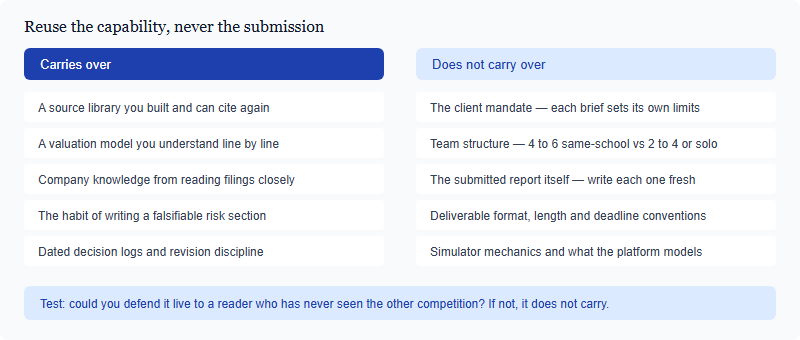
One line in the left column deserves care. Reusing a valuation model you built is legitimate — a spreadsheet is a tool, and rebuilding a discounted cash flow from scratch teaches you little the second time. Reusing paragraphs of analysis across two entries is a different act entirely, and each competition sets its own rules on originality and on the use of AI tools. Wharton’s published position on AI is a useful illustration of the standard being applied: tools may be used for brainstorming, AI-generated work may not be submitted as your own, and any AI-derived material must be cited like any other source. Read the equivalent rules for each programme you enter and follow them separately rather than assuming they are identical.
What a double year actually costs
Here is the part planning documents leave out. Two seasons do not cost twice one season — they cost more, because the second one arrives when your enthusiasm has already been spent and your school year has not become easier.
The load concentrates in two writing peaks. The first lands in the three weeks before 4 December, which for many international-school students overlaps end-of-term assessments and, for grade 12 students, early-round university deadlines. The second lands during the SIC’s later stages, which last season fell across the summer. Between those peaks sits January to March: a stretch with no live competition and every excuse to let the research habit lapse.
Three profiles, from what our desk sees:
- Do both. A grade 10 or 11 student, not in an exam year, with a stable team already assembled and a teacher adviser who has said yes. The autumn contest teaches compression; a longer season teaches depth. That order is genuinely useful.
- Do one properly. A grade 12 student facing application deadlines in the same term as the Wharton report, or a student whose team exists mainly on paper. One defensible entry beats two rushed ones by a wide margin under any rubric that scores argument rather than participation.
- Start with the SIC. A grade 8 or 9 student, or any student without four schoolmates. The published grade band starts at 6, an individual entry exists in the Junior division, and school affiliation for grades 6–9 is a consent letter rather than a recruitment problem. Our overview of what the SIC is sets out the season shape.
A sequencing plan that survives a moving calendar
Because next season’s SIC dates are set by the competition, a plan pinned to specific SIC dates is a plan that breaks. Anchor to the Wharton dates, which are published, and treat the SIC portion as a sequence of readiness states rather than a diary.
| Period | Anchor | What to have finished |
|---|---|---|
| Now to 11 September | Wharton registration closes 11 Sep, 5pm ET; all student team accounts created by then | Team of four to six confirmed, adviser agreed, accounts created. If this fails, stop planning a double year and plan a good single one |
| 15–27 September | Application invitation 15 Sep; first trading day 28 Sep | Mandate read and translated into written constraints; benchmark named; research roles assigned |
| Late September to November | Ten-week trading window | A dated decision log with a stated reason per trade. This is the asset you will still be using in July |
| Mid-November to 4 December | Report and school documentation due 4 Dec, 5pm ET | Report drafted with a week of slack. Treat 4 December as the day you upload, not the day you finish writing |
| December to February | No live competition | Read one company properly every fortnight; keep the source library alive; resist starting a third programme in the gap |
| Whenever the SIC window opens | Dates set by the competition — confirm on the official SIC site | Consent and division paperwork already prepared, so enrolment costs a day rather than a month |
| SIC Regional and Global stages | Season dates set by the competition | A fresh thesis on a fresh mandate, written against the four-axis rubric |
Notice the December-to-February row, the one most plans omit. A double year is won or lost in the quiet stretch, not in either peak. Students who keep reading through the gap arrive at the next season with a live source library and a model they still remember building. Students who stop arrive in spring having to relearn their own spreadsheet, which is the most demoralising way to start a long project.
Finally, resist treating one programme as practice for the other. Both judge the quality of an argument rather than a return, and both are structured so that a thoughtful entry from a student who did only that one competition can score well. Our axis-by-axis breakdown of the SIC rubric describes what either kind of assessor looks for: a claim you can state, evidence you can source, a risk you can name, and a record showing you changed your mind when the facts changed.
Frequently asked questions
Do the two seasons overlap?
Barely. The Wharton trading window and report deadline fall in autumn; the SIC season published for S15 ran spring into summer.
Can I submit the same company analysis to both?
No. Each competition sets its own mandate and originality rules. Reuse your skills and source library, and write each submission fresh.
I cannot find four schoolmates. What are my options?
Wharton requires a same-school team of four to six with a teacher adviser. The SIC publishes an individual Junior division and a Senior team of 2 to 4.
Does entering both look better to universities?
Depth reads better than count. One well-defended entry showing evidence of revision is stronger than two rushed ones.
Published by the SIC editorial desk, operated by Hanlin Education for China-based international-school students. Official rules are set by the competition and change yearly — confirm current details on the official SIC site. Errors reported to this desk are corrected within 7 working days.