A competition window of a few weeks contains far too little data to prove an analyst is good. What it can show is whether you understand your own result. Decompose the return into market, sector, stock selection, currency and timing; identify what the platform did to your numbers; then write the section honestly rather than triumphantly.
The short-window problem, stated without flinching
A ten-week trading window — the length the Wharton competition runs, not SIC's five-month season — is roughly fifty trading sessions. Over that span, the variation in equity returns is dominated by things nobody in your team controls: the direction of the broad market, a sector rotation, a single earnings surprise, a policy announcement. The contribution of research quality is real but small, and it is buried under noise you cannot dig out with fifty observations.
This is not a discouraging fact; it is a liberating one. It means the number at the top of your portfolio screen is not a verdict on you. It also means that a team finishing well ahead of the market has not proved skill, and a team finishing behind has not disproved it. Both statements are uncomfortable and both are true, and being willing to say them in writing is itself a signal of analytical maturity.
It is also why the competitions that matter judge the reasoning rather than the return. When a programme states that judging rests on the rigour and presentation of the strategy rather than portfolio performance, it is not being generous to weak teams. It is being statistically literate. A ranking built on fifty days of simulated returns would mostly rank luck.
So the question your performance section should answer is not did we win? It is: do we know why the number is what it is, and would that reasoning survive a different ten weeks?
What your result is actually made of
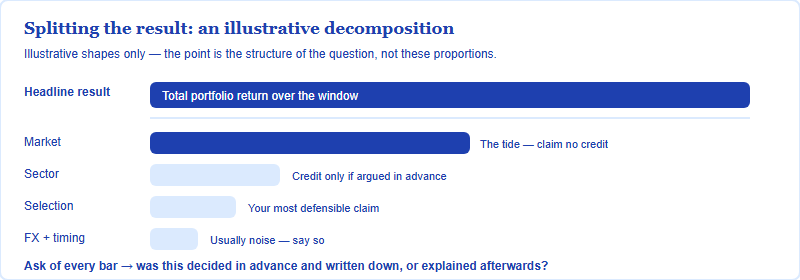
Any portfolio return can be split into components. You do not need institutional software to do this — a spreadsheet and some care will produce a decomposition good enough to reason with, provided you label it as approximate.
| Component | What it captures | How much credit you can claim | Rough calculation |
|---|---|---|---|
| Market | The return you would have got holding the benchmark at your average invested level | None. This is the tide. | Benchmark return over the window × your average invested share |
| Cash drag or lift | The effect of not being fully invested | Only if your cash policy was written in advance | Uninvested share × the benchmark return you forwent |
| Sector allocation | Being overweight sectors that happened to lead | Partial, and only if you argued the overweight beforehand | (Your sector weight − benchmark weight) × that sector's return |
| Stock selection | Your names beating their own sector | The most defensible claim you have | Your holding's return − its sector return, weighted |
| Currency | Exchange-rate moves on non-home-currency holdings | None unless the currency view was part of the thesis | Local return versus reporting-currency return |
| Timing | When you entered and exited, apart from what you held | Least defensible over a short window | Your realised return versus buy-and-hold from day one |
Run this once and the conversation inside your team changes. The most common discovery is deflating and extremely useful: most of the result came from the market and from one or two positions, and the careful work on the other holdings barely registered. That is a genuine finding, and reporting it is worth more than a paragraph of self-congratulation.
The second most common discovery is that a position looked brilliant for a reason unrelated to the thesis. You bought a company for its margin recovery; the stock rose because its whole sector re-rated on an interest-rate move. You were right about the direction and wrong about the mechanism. That is not a win, and pretending otherwise is exactly what an experienced reader is watching for.
Platform artefacts that quietly flatter or punish you
A simulator is a model of a market, and every model leaves things out. Before you attribute a result to your own judgement, work out what the platform did on your behalf. The specifics vary by platform and by season, so read your own competition's rules and simulator documentation rather than assuming — and where the rules are unclear, ask the organiser rather than guessing.
| Artefact | Question to answer for your platform | Which way it usually distorts |
|---|---|---|
| Fill price | Do orders fill at the closing price, at the next open, or intraday? | Close-price fills remove slippage and make active trading look cheaper than it is |
| Spread and commission | Are transaction costs modelled at all? | Zero-cost trading flatters high-turnover strategies |
| Liquidity and size | Can you buy more of a small company than the market would really supply? | Makes illiquid names look investable at a size they are not |
| Dividends and corporate actions | Are dividends credited? How are splits and spin-offs handled? | Uncredited income penalises income-oriented mandates unfairly |
| Currency conversion | What rate and what timing are used for non-home-currency holdings? | Silently adds an unintended currency bet to your result |
| Shorting, leverage, derivatives | Permitted? At what cost? With what limits? | Free or costless shorting misprices the true risk of the position |
Two paragraphs in your report acknowledging the relevant artefacts will do more for you than any amount of return-boasting. It shows you know the difference between a simulation and a market, which is precisely the distinction a professional reader cares about. It also inoculates you against the worst question in a defence session, the one that begins with the observation that your strategy assumes costless trading.
Separating what you knew from what you found out
Hindsight contaminates every performance section written from memory. The only reliable defence is a contemporaneous record: a dated log in which each decision carries the reason you held at the time, not the reason that became obvious later. If you already keep a weekly log, your attribution work is mostly reading it back.
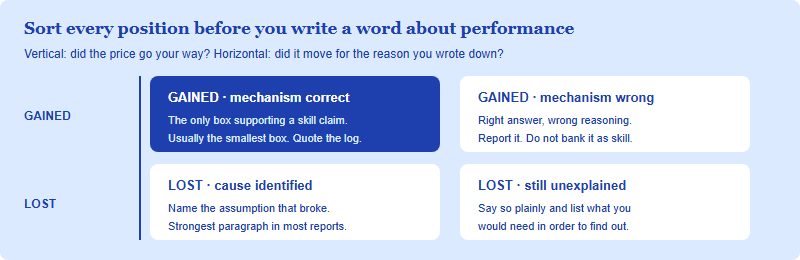
When you write, sort every outcome into one of four boxes:
- Right for the stated reason. The thesis played out through the mechanism you named. This is the only box that supports a claim of skill, and it is usually the emptiest.
- Right for another reason. The position gained, but through a channel you did not identify. Report it as such; it is evidence about the market, not about you.
- Wrong, and you learned why. The thesis failed and you can name the assumption that broke. Judges value this box highly, because it is where analytical progress actually shows.
- Wrong, and still unexplained. The position lost and you cannot account for it. Say so. Unexplained is an honest category, and claiming otherwise invites a question you cannot answer.
Counting the entries in each box gives you the one performance statistic that survives a short window: your mechanism hit rate — how often the thing you predicted was the thing that actually happened. That measure is far more informative than a return figure, and it maps directly onto the way the SIC rubric examines whether evidence supported the thesis and whether the thesis updated as the facts moved.
Writing the section, in five paragraphs
A performance section that reads well is short, sequenced and unflattering in the right places. A reliable structure:
- The number and its yardstick. State the result against the benchmark you named at the start — not one selected afterwards — and state the window length in the same sentence, so the reader knows you know what fifty sessions can prove.
- The decomposition. Present the components, labelled approximate, and say plainly which part you can and cannot claim credit for.
- Two positions in detail. One from the mechanism-correct box, one from the loss-with-identified-cause box. Two worked examples beat eight thin ones.
- The artefacts. Name the simulator limitations that materially touched your result, and how the result would plausibly differ under real costs.
- What you would do differently. One or two changes to process, not to picks. Saying you would have bought a different stock is hindsight; saying you would have set a position cap before entering is a process improvement.
Notice what this structure refuses to do. It does not open with the return. It does not compare you to teams whose portfolios you cannot see. It does not attribute a market-driven gain to research. Those refusals are the point: they are what mark the difference between a student reporting a score and an analyst reporting a result. If you are new to how this fits into the wider process, our overview of the Student Investment Challenge is the place to start — and the current requirements for any given season are set by the competition, so confirm them on the official SIC site.
Frequently asked questions
Will admitting our return was mostly market-driven hurt us?
No. Judging weighs rigour, and correctly identifying the source of your return is rigour of exactly the kind assessors look for.
Do I need special software for attribution?
No. A spreadsheet handles a simplified decomposition. Label it approximate and explain the method you used.
What if I did not keep a log during the season?
Reconstruct only what you can evidence from dated notes or messages, and say which parts are reconstructed. Do not invent past reasoning.
Which benchmark should I compare against?
The one you named at the start of the season and justified against the mandate. Changing it afterwards is visible and costly.
Published by the SIC editorial desk, operated by Hanlin Education for China-based international-school students. Official rules are set by the competition and change yearly — confirm current details on the official SIC site. Errors reported to this desk are corrected within 7 working days.