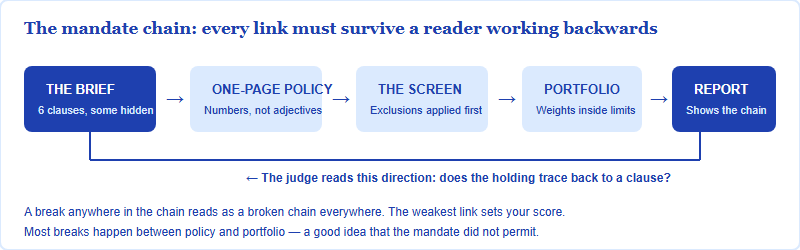
Where a competition sets a client brief — as the Wharton competition does — that brief is a mandate, not a topic prompt. Before you research a single company, extract six things from it: objective, horizon, risk tolerance, liquidity needs, exclusions and benchmark. Write them on one page as testable constraints. Every later decision either obeys that page or is documented as a deliberate exception.
Why strong entries fail on the mandate, not the maths
In this desk's own coaching experience, reading student submissions, a pattern emerges. The valuation work is usually adequate. The company research is often genuinely good. What sinks otherwise strong entries is a quieter failure: the portfolio does not do what the client asked for.
A brief describes a capital-preservation client approaching a large expense in three years. The team, excited by their research, builds a concentrated position in a pre-revenue growth name with a five-year catalyst path. The analysis may be excellent. The answer is still wrong, because the answer was to a question nobody asked. A judge does not have to fault your modelling to mark you down; they only have to notice that your portfolio ignores the mandate you were given.
This is a different decision from choosing what your thesis defends — a single company, a sector, or a macro view. That choice sits downstream. The mandate constrains every version of it equally: whichever subject you pick, the brief still dictates the horizon you must respect, the risk you may take, and the yardstick you will be measured against.
The professional version of this document is called an investment policy statement, and real managers write one before they buy anything. You should too. It takes forty minutes and it prevents the most expensive category of error available to a student analyst.
The six clauses every brief contains, even when it does not name them
Briefs vary in length and formality. Whatever the wording, six things are always in there — sometimes explicitly, sometimes buried in a sentence about the client's circumstances. Your first job is to find all six and write them down in your own words.
| Clause | What the brief may actually say | What it rules out | What it rewards |
|---|---|---|---|
| Objective | Grow capital / preserve capital / generate income | Treating every mandate as total-return maximisation | A stated goal your holdings visibly serve |
| Horizon | A named date, a life event, or a phrase such as long-term | Theses whose catalyst arrives after the client needs the money | Catalyst timing mapped against the client's clock |
| Risk tolerance | Comfort with drawdown, described in words not numbers | Concentration that contradicts a stated low tolerance | Translating vague words into a number you commit to |
| Liquidity | Known withdrawals, cash needs, or none stated | Illiquid or thinly traded positions in a cash-needy mandate | A cash policy written before the market moves |
| Constraints and exclusions | Sectors, ethics, geography, instrument types | Screening the whole market when the brief narrowed it | A screen that starts from the excluded list |
| Benchmark | Named index, peer group, or an absolute target | Comparing yourself to whatever flatters you afterwards | A yardstick chosen in week one and never changed |
Two of these deserve particular attention because students consistently underweight them.
Risk tolerance is usually given in words, and words are not testable. A brief that says the client would be uncomfortable seeing large swings has told you something real, and your job is to convert it into a number you will actually be bound by — a maximum single-position weight, a maximum sector weight, a drawdown level at which you would rebalance. You are not pretending the number came from the client. You are stating your interpretation, so that a reader can check whether you honoured it.
The benchmark must be chosen before you know how you did. Choosing a yardstick after the fact is the oldest self-deception in investing, and it is instantly visible to an experienced reader. Pick it in week one, write down why it fits the mandate, and live with it.
From clause to testable constraint: the translation step
A constraint is only useful if a third party can check whether you broke it. Adjectives cannot be checked; thresholds can. The translation step turns the client's language into rules that make your later decisions falsifiable.
| Brief language | Weak restatement | Testable constraint | How a reader checks it |
|---|---|---|---|
| Cannot afford a large loss | We will manage risk carefully | No single position above a stated share of the portfolio; a stated trailing-drawdown level triggers a documented review | Reads the weights table and the review log |
| Needs the money in about three years | We take a medium-term view | Every thesis names a catalyst expected inside the horizon, or is explicitly flagged as a longer-dated exception with a reason | Checks whether stated catalysts fall before the date |
| Prefers to avoid certain industries | We considered ethical factors | A written exclusion list applied before screening; every candidate checked against it and the check recorded | Looks for an excluded name in the holdings |
| Wants steady income | We like quality companies | A stated minimum share of holdings that distribute income, with the payout record and coverage cited | Counts income-paying names and their coverage |
| Wants to beat the market | We aim to outperform | One named benchmark, chosen in week one, with the reason it matches the mandate | Compares the stated benchmark to the one used later |
Note what this does to your research. Once the exclusion list and the horizon exist on paper, your screen starts smaller and your reading is faster. Constraints do not just protect you at the judging table; they cut the work.
Mandate drift, and the three checks that catch it
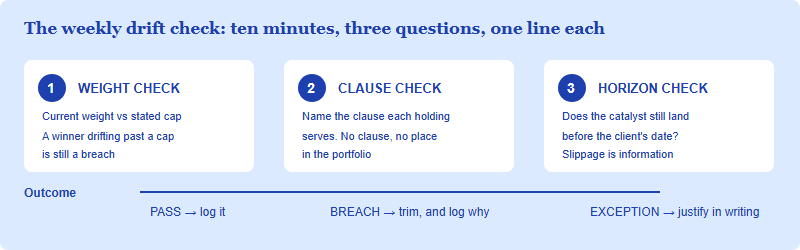
Drift is what happens when a portfolio slowly stops matching its policy, one reasonable-seeming decision at a time. Nobody decides to violate the mandate. A position runs up and quietly becomes an oversized weight. A name is added because the research was interesting rather than because the client needed it. A benchmark stops being mentioned because it stopped being flattering.
Three lightweight checks catch nearly all of it:
- The weight check. Once a week, list current weights beside your stated limits. Passive drift — a winner growing past its cap — is still a breach, and the honest response is either to trim or to document why you are allowing it.
- The clause check. For each holding, name the clause it serves. Any holding that cannot be traced to a clause is a candidate for removal, however good the underlying research.
- The horizon check. For each thesis, ask whether the catalyst still lands before the client's date. Catalysts slip. When one slips past the horizon, that is new information, not an inconvenience.
Record each check with a date and a one-line outcome. This costs perhaps ten minutes a week and produces something far more valuable than the time it takes: evidence that your revisions were disciplined rather than reactive. That evidence is exactly what the SIC rubric is looking for when it asks whether a thesis updated on schedule as facts changed.
Where the policy earns marks in the written report
The one-page policy does not usually appear as a section headed “our policy”. It shows up as a quality that runs through the whole document: your report answers the client's question rather than the question you found most interesting.
Concretely, three moments in the report are where the work pays off. The opening, where restating the mandate in your own words in two or three sentences signals immediately that you read it as a mandate. The holdings discussion, where each position is introduced by the clause it serves before the valuation appears — the client needs income within three years, therefore this name, and here is the evidence. And the revision narrative, where you show a constraint doing real work: a position you trimmed because it breached a cap you set yourself, a candidate you rejected because it failed the exclusion list, a thesis you dropped when its catalyst slipped past the horizon.
That third moment is the most persuasive paragraph available to a student analyst, because it is the one thing that cannot be produced by hindsight. It proves the constraints existed before the outcome did. For readers coming to this fresh, our overview of what the Student Investment Challenge is sets out what SIC actually asks entrants to produce; where a competition does set a client brief, its requirements are set by that organiser, so read the live version on the organiser's own site rather than any summary, including this one.
Frequently asked questions
What if the brief does not state a benchmark?
Then choosing one is your decision. Name it in week one, justify the fit to the mandate, and never quietly change it later.
Is it acceptable to break my own constraint?
Yes, if you document the exception and the reasoning at the time. An undocumented breach is what damages you, not the exception.
How long should the policy page be?
One page. Six clauses, each with a number or a rule a reader could test. If it runs longer, you are drafting the report instead.
Does this replace choosing a company or sector thesis?
No. The mandate constrains whichever subject you choose; picking the subject is a separate decision made after the policy exists.
Published by the SIC editorial desk, operated by Hanlin Education for China-based international-school students. Official rules are set by the competition and change yearly — confirm current details on the official SIC site. Errors reported to this desk are corrected within 7 working days.