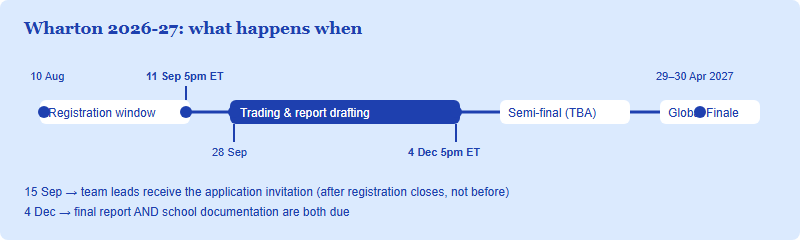
The organiser has published the 2026-27 Wharton Global High School Investment Competition calendar. Registration opened on 10 August 2026 and closes on 11 September 2026 at 5pm ET, with all student team accounts created by that point; team leads receive the application invitation on 15 September, trading begins 28 September, and the final report is due 4 December 2026 at 5pm ET.
The published 2026-27 timeline, date by date
Most students read a competition calendar as a list of dates. It is more useful to read it as a list of preconditions: each date is really a statement about what must already exist by the time it arrives. Below is the organiser's published 2026-27 timeline for the Wharton Global High School Investment Competition, with the precondition attached to each entry.
| Published date | Milestone | What must already exist |
|---|---|---|
| 10 August 2026 | Registration opens | Nothing yet — but this is when a serious team starts recruiting an adviser |
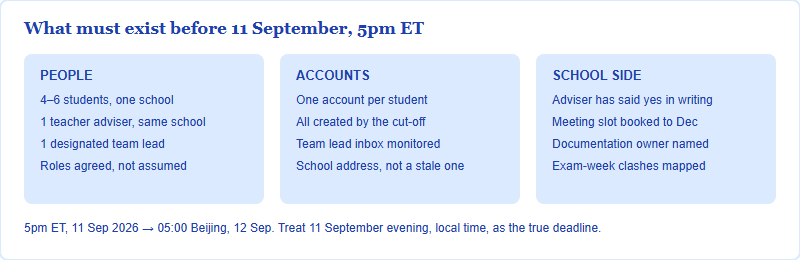
| 11 September 2026, 5pm ET | Registration closes; all student team accounts created by then | A named adviser, four to six students from your school, and a created account per student |
| 15 September 2026 | Team leads receive the application invitation | One student clearly designated as team lead, reachable at a monitored address |
| 28 September 2026 | First trading day | A read of the client brief and an agreed decision process — not yet a finished strategy |
| 4 December 2026, 5pm ET | Final report and school documentation due | The written deliverable, plus whatever the school has to sign or supply |
| To be announced | Top 50 semi-finalists named; online semi-final held | A team still able to meet after exams and speak to its own report |
| 29–30 April 2027 | Global Finale at Wharton, Philadelphia | Travel feasibility discussed with families months earlier, not in April |
Two structural points fall out of that table immediately. First, registration closes before the application invitation goes out — the 11 September cut-off and the 15 September invitation are two separate steps, in that order. A team that assumes it can simply apply in mid-September has misread the sequence and will find the door shut. Second, the gap between the 28 September first trading day and the 4 December report deadline is where the entire season actually happens, and it lands squarely on top of the autumn term.
A 5pm ET deadline is not a 5pm deadline where you live
Both hard deadlines in this calendar are stated in Eastern Time, and both matter to students working from China, Singapore or the Gulf. Eastern Time is not a fixed offset: the United States is on daylight time in September and standard time in December, so the two deadlines do not convert identically.
| Deadline (as published) | US clock in force | Beijing time equivalent | Practical meaning |
|---|---|---|---|
| 11 Sep 2026, 5pm ET — registration closes | Daylight time, UTC−4 | 05:00 on 12 September | Your last usable working evening is 11 September in China. Do not plan to finish on the day itself. |
| 4 Dec 2026, 5pm ET — final report | Standard time, UTC−5 | 06:00 on 5 December | Lands the morning after a school Friday, so the real cut-off is Friday night your time. |
The operational lesson is unglamorous: treat the deadline as the evening before in your own time zone. A team that files at what feels like a comfortable margin, then discovers a school signature is missing at four in the morning local time, has no recovery path. This is the same discipline this desk applies to its own submission windows, and the same reason we tell students to confirm current SIC dates directly on the official SIC channels rather than relying on last season's article.
The team structure the calendar quietly assumes
The 2026-27 competition is built for teams of four to six students from the same school, with a teacher adviser from that same school. Entry is free. That one structural sentence rules out several arrangements students routinely propose to us:
- Cross-school teams assembled from friends at three different international schools. The same-school requirement is not a formality to negotiate around.
- A tutor or external mentor as the adviser. The adviser is a teacher at your school. What outside preparation help is permitted alongside that adviser is set by the organiser — confirm it on the organiser's own site.
- A solo entry. The floor is four students. If your school has three interested students, recruiting the fourth is a September task, not an October one.
- A team of eight so nobody feels excluded. Six is the ceiling. Deciding who is in is a real and uncomfortable conversation that has to happen before 11 September.
Scale gives some sense of what you are joining: the organiser reports that last season drew 2,339 teams and 12,145 students from 79 countries, supported by 1,625 advisers. That is a large field, and it is worth being honest with yourself about the difference between having entered and having advanced. For the fuller structural comparison — what each programme is actually built to test — we keep that in our side-by-side of SIC and the Wharton competition.
Ten weeks of trading, two deliverables — and why the scoreboard is not the score
The competition gives each team a virtual portfolio of $250,000 to run through the organiser's simulator over roughly ten weeks, against a real alumni client brief, producing two deliverables. That last clause is the part most readers skim, and it is the part that decides outcomes.
Judging is not on portfolio return. It is on the rigour and presentation of the team's strategy. Read that twice, because it inverts the intuition almost every new team arrives with. A team that beats the market on an unexplained thesis loses to a team that underperforms on a defensible one. The simulator produces a number; the number is evidence about your process, not a substitute for it.
This is the strongest reason a SIC-trained analyst is well prepared for the autumn. The habits SIC rewards — stating a thesis a non-expert can follow, sourcing claims to primary filings, naming what would have to be true for the thesis to fail, and revising on a schedule when the facts change — are precisely the habits that survive a ten-week drawdown intact. If that framing is new to you, the SIC rubric explainer is the fastest way to see what rigour is actually scored on.
The practical translation for the autumn: keep a dated decision log from the first trading day. Every position gets a written reason at entry and a written reason at exit. When you sit down in late November to write the report, you will either have ten weeks of reasoning to draw on, or you will have a spreadsheet of trades and a fortnight in which to invent a narrative around them. Judges can tell the difference, and so can anyone who asks you a follow-up question.
The AI rule, stated plainly
The organiser's position on AI tools is explicit and worth copying into your own team charter: tools may be used for brainstorming; AI-generated work may not be submitted as your own; and any AI-derived material must be cited like any other source. The third clause is the one teams overlook. Citing it like any other source means an AI-suggested figure gets the same treatment as a figure from a filing — you trace it, you verify it against the primary document, and you attribute it. An unverified number that came from a chatbot and then fails in front of a judge damages the whole submission, not only that line.
Our editorial position on this site is the same one we apply to SIC work: use the tool to argue with, not to write for you. Ask it to attack your thesis, list the counter-evidence, or find the question you have not asked. Then go and check what it told you.
Fitting this around a SIC season without letting either slide
SIC and the Wharton competition are different animals — a season-long research process versus a ten-week portfolio sprint — and this desk deliberately does not publish SIC dates by copying anyone else's calendar. Confirm the current SIC season dates and requirements on the official SIC channels; nothing on this page should be read as a SIC deadline.
What we can say is how to think about the load. The autumn Wharton window is compressed and team-dependent: it needs a fixed weekly meeting, a shared decision log, and one person who owns the December documentation. Season-long research work is individual or small-team and stretches over months, which means it flexes around exam weeks in a way a live trading window does not. If both sit in your year, protect the compressed one and flex the elastic one — not the reverse.
| Question to settle before you commit | Green light | Red flag |
|---|---|---|
| Do we have four to six committed students at one school? | Named, and each has said yes in writing | Some of the finance club will probably join |
| Do we have a teacher adviser at that school? | Agreed, with a recurring meeting slot booked | We will ask someone in October |
| Can we meet weekly from late September to early December? | A fixed slot that survives mock exams | Whenever everyone is free, which is never |
| Who owns the report and the school documentation? | One named student, one named adviser | We will all write it together |
| Are we entering to learn a process or to win? | Process — which is also what is scored | Return-chasing, which the judging explicitly does not reward |
One last framing point. Doing two competitions badly reads worse on your record than doing one well, and no admissions reader is counting entries. If you are still deciding what either programme is for, start with what the Student Investment Challenge actually is, and choose deliberately rather than out of fear of missing out.
Frequently asked questions
Does the Wharton competition cost anything to enter?
No. The organiser states entry is free. Whether any travel to an in-person finale is funded, subsidised or borne by families is not something we can confirm — check the organiser's own site.
Can my team include students from another school?
No. Teams are four to six students from the same school, with a teacher adviser from that same school.
If we beat the market, do we advance?
Not necessarily. Judging is on the rigour and presentation of your strategy, not on portfolio return.
Are SIC deadlines the same as these dates?
No. These are the Wharton organiser's published dates only. Confirm current SIC dates on the official SIC channels.
Published by the SIC editorial desk, operated by Hanlin Education for China-based international-school students. Official rules are set by the competition and change yearly — confirm current details on the official SIC site. Errors reported to this desk are corrected within 7 working days.