The Student Investment Challenge S16 season gives participants US$100,000 in virtual principal and describes simulated trading in real US and Hong Kong markets. According to the supplied S16 season note, the simulation includes shorting, leverage and position management. That makes short selling more than a theoretical topic for Junior Division participants, who trade individually online, and for Senior Division participants, who combine online simulated trading with an investment strategy report.
Most preparation focuses on finding a long idea or writing the report. Far fewer students practise the short-specific survival question: if this trade moves against me, how quickly does it damage the portfolio, and what rule forces me to cover before the damage becomes structural? This article addresses that question directly. It does not state official platform rules or claim a required scoring method. It teaches the mechanics and gives you a pre-trade checklist you can adapt to the simulation interface you actually see.
What Shorting Changes: Loss Is Not Bounded at -100%
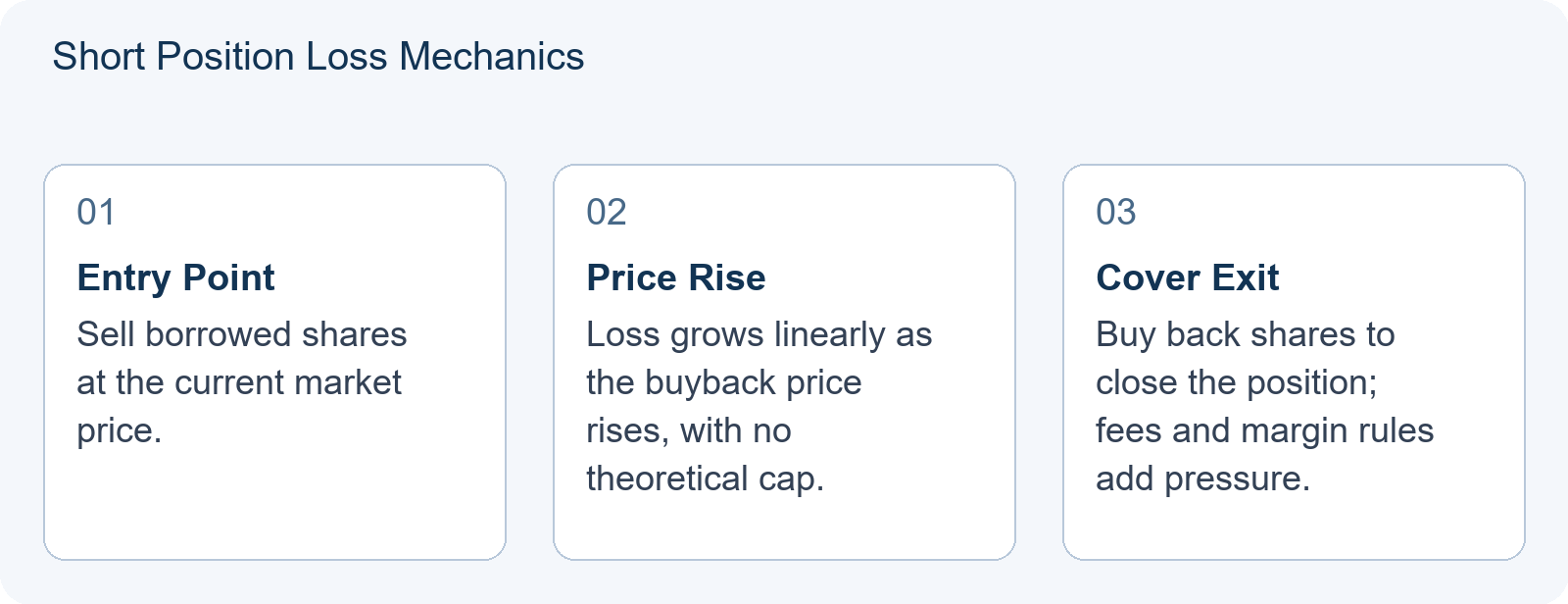
A long position has a defined worst case. If you buy a stock and it falls to zero, you lose the capital committed. A short position removes that floor. You borrow shares, sell them, and later buy them back. If the buyback price is lower than the sale price, you profit. If the buyback price is higher, you lose.
The asymmetry matters because the stock price has no mathematical upper bound. Suppose you short 100 shares at $100, receiving $10,000 of sale proceeds before costs. If the stock rises to $200, you must buy back 100 shares for $20,000. The gross loss is $10,000, or 100% of the initial sale proceeds. If the stock rises to $300, the buyback costs $30,000 and the gross loss is $20,000, or 200% of the initial proceeds. The loss is not capped at the amount you first put at risk. That is why short sizing should usually be more conservative than long sizing, even when the thesis feels compelling.
For a Senior Division report, this mechanical asymmetry also creates a narrative obligation. A short thesis needs a defined breakpoint. If your report says a company is overvalued but never states what price or evidence would prove you wrong, the risk section is incomplete. The existing page The SIC Risk Section: What Would Have to Be True for Your Thesis to Lose is a useful companion because it forces you to write the loss condition before the position is opened.
Margin, Borrow Cost and Squeeze Risk
Short selling adds costs and constraints that long positions do not have. In a real short sale, the broker lends you shares. The lender may charge a borrow fee. That fee can accrue daily, and it may be calculated on the market value of the borrowed shares, not merely on your original sale price. If the stock rises, the borrowed exposure becomes more valuable, and the carrying cost can rise with it. In many real brokerage accounts, short proceeds are held as collateral and cannot simply be spent as free cash.
Margin is the second pressure point. Your short account has equity equal to the account value minus the current market value of the borrowed shares, or liability. If the share price rises, the liability grows and equity shrinks. If equity falls below the broker’s maintenance requirement, the broker can issue a margin call. If you cannot add funds, the broker may buy back shares to close the position. In a simulation, the exact trigger and response depend on the platform. The supplied S16 note says shorting and leverage are part of the experience, but it does not publish a borrow-fee schedule or margin-call penalty schedule. Treat those as variables to verify in your simulation interface, not as assumptions to bury in a spreadsheet.
Squeeze risk is the third pressure point. A short squeeze occurs when a heavily shorted stock rises and shorts rush to buy back shares at the same time. That buying pressure can push the price higher, which triggers more covering, which pushes the price higher again. Fundamentals may not change at all. The stock can move violently simply because the short side is crowded and the borrow supply is tight. A student who shorts a crowded name without checking borrow availability and liquidity is taking a mechanical risk that a long investor does not face in the same way.
Worked Teaching Illustration: Sizing a Short With Stop and Borrow Cost
This is a hypothetical teaching illustration, not official scoring guidance, not a platform rule, and not a guaranteed outcome. It uses simple round numbers so the arithmetic is checkable.
Imagine a student allocates $10,000 of a $100,000 virtual portfolio to short a stock trading at $100 per share. They sell 100 shares. For the illustration, assume an annualised borrow fee of 5%, charged on the initial $10,000 proceeds for 30 days. This is a simplifying assumption. If the platform charges on current market value, the cost would be higher when the stock rises.
- Initial short sale: 100 shares at $100 = $10,000 proceeds before costs.
- Borrow cost for 30 days: $10,000 x 5% x 30/365 = $41.10, rounded to the nearest cent.
- Favourable move to $80: Buyback = 100 x $80 = $8,000. Gross profit = $2,000. Net profit after the assumed borrow cost = $2,000 – $41.10 = $1,958.90. That is about 19.59% on the allocated $10,000.
- Adverse move to $120: Buyback = 100 x $120 = $12,000. Gross loss = $2,000. Total loss after the assumed borrow cost = $2,041.10. That is about 20.41% on the allocated $10,000, or about 2.04% of the $100,000 portfolio.
- Severe adverse move to $150: Buyback = 100 x $150 = $15,000. Gross loss = $5,000. Total loss after the assumed borrow cost = $5,041.10. That is about 50.41% on the allocated $10,000, or about 5.04% of the total portfolio.
The sizing lesson is simple but often ignored. A short position that is 10% of the portfolio can survive a 20% adverse move with a 2% portfolio hit. A short position that is 25% of the portfolio would take a 5.10% portfolio hit on the same move if sized proportionally. At 50%, the same move becomes a roughly 10.2% portfolio event before any margin interaction. The stop price determines the loss per share; the position size determines whether that loss is survivable.
Catalyst Calendar: When a Short Thesis Can Break
A short thesis is usually based on overvaluation, deteriorating fundamentals, accounting quality, or a catalyst that should force repricing. The danger is that price can remain irrational longer than a simulated portfolio can remain solvent. Earnings dates, guidance updates, product launches, regulatory decisions, sector rotations and macroeconomic surprises can all break a short thesis before its fundamental logic plays out.
Before entering a short, build a catalyst calendar. Mark the dates when new information is likely to arrive. Ask whether your thesis depends on a slow decay of value or on a specific event. If a sector is rallying, shorting a weak company inside that sector can be especially dangerous because beta and sentiment may overwhelm company-specific weakness. A short position needs a path to being right, not just a reason to dislike the company.
When Shorting Contaminates Your Report Thesis
Senior Division participants are judged on both simulated trading and an investment strategy report. A short trade that contradicts the report narrative can look like inconsistency unless the report explains why the contrarian position exists. If you write a bullish sector thesis and also short a major company in that sector, the report should separate the sector view from the single-name short case.
The cleaner approach is to apply the same evidence standard to shorts that you apply to longs. Use the framework in SIC Investment Thesis: Identify the Evidence That Would Change Your Mind to state the exact metric, event or price level that would invalidate the short. Examples might include debt-to-equity rising above a threshold, revenue growth falling below a stated level, or a buyback announcement changing the share-supply picture. The report should show that the short has a falsifiable thesis, not merely a pessimistic mood.
Pre-Trade Short Checklist for SIC
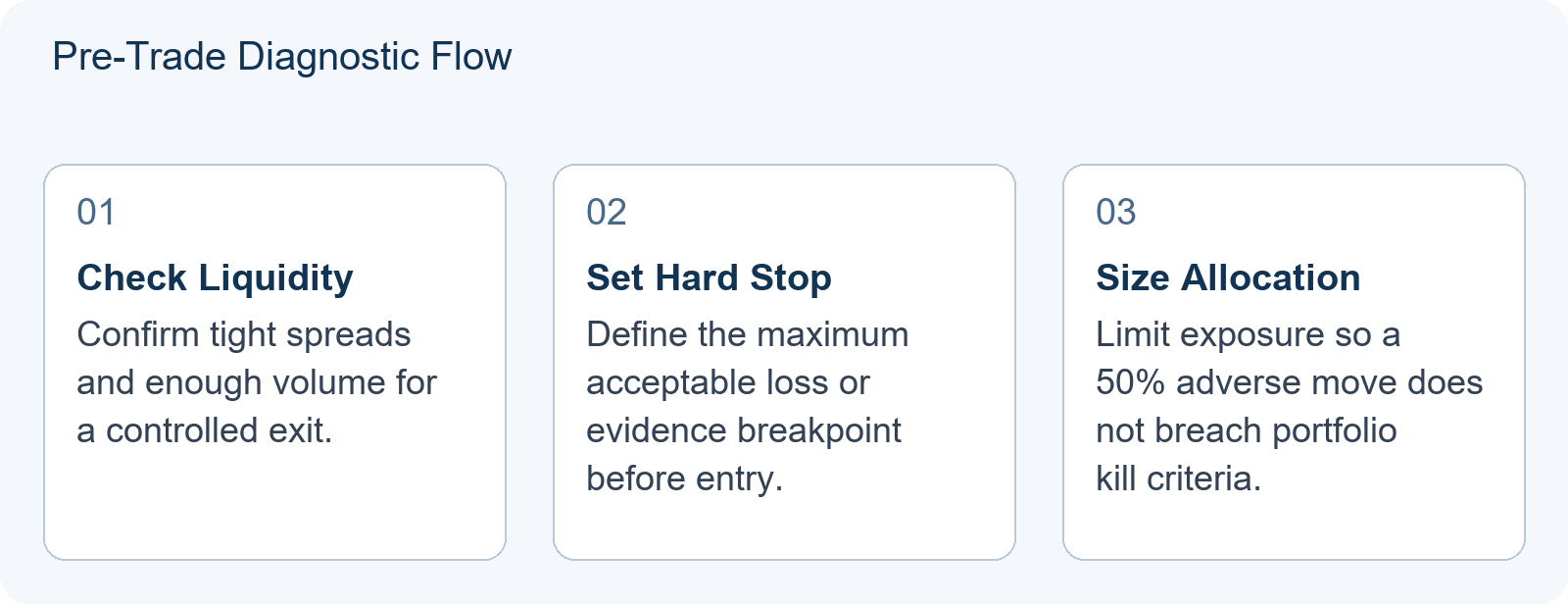
Run this diagnostic before every simulated short. It is a teaching checklist, not an official scoring rubric.
- Liquidity check: Is the stock liquid enough that bid-ask spreads and buyback slippage will not distort the result? Illiquid names are harder to exit under stress.
- Borrow availability: Are shares available to borrow? A crowded short can be expensive or impossible to maintain, and it raises squeeze risk.
- Stop-loss defined: Write the exit price or evidence breakpoint before entry. A mental stop is not a process during a fast move.
- Position size: Can the portfolio survive a 50% adverse move in the short without breaching your own kill criteria? If not, the position is too large.
- Thesis alignment: Does the short fit the portfolio and, for Senior Division, the report narrative? If not, either document the independent rationale or drop the trade.
- Catalyst review: What scheduled events could force a violent repricing? If you cannot name one, your risk plan may be underdeveloped.
If Shorting Is Disabled or You Choose Not to Short
You do not need to short to build a coherent SIC portfolio. The supplied S16 note describes shorting as part of the simulation experience, not as a mandatory trade for every participant. If the platform disables shorting, or if you decide that the mechanics are outside your current process, a long-only portfolio with disciplined sizing, diversification and cash management can still be defensible. The important point is to make the choice explicit.
Short-term simulations contain a great deal of noise. The existing page Ten Weeks Is Not an Investment Horizon: Attribution, Noise, and Writing an Honest Performance Section is useful here: it reminds readers that a short trading window can reward luck and punish process, or the reverse. If you avoid shorts, explain in the report that this was a deliberate risk-control decision, not an admission that you saw no opportunities. Judges and reviewers can respect a constrained strategy if it is executed consistently.
Using Support Without Outsourcing Judgment
Hanlin’s published SIC preparation material describes team formation and course support for students who want structured help. The useful version of that support is not a list of stocks to short. It is a pressure test of your process: Can you define borrow cost assumptions, margin triggers, stop criteria and position limits before the trade is live? Can you explain why a short belongs in the portfolio rather than merely sounding clever?
If you seek a consultation, bring your own short-risk log. Show the proposed position size, stop level, catalyst dates, worst-case loss as a percentage of the portfolio, and the evidence that would make you cover. A mentor can challenge those assumptions far more productively than they can replace them. The goal is to leave the conversation with a tighter process, not with borrowed conviction.
Bottom Line
SIC simulation short selling changes the risk problem because losses are not capped at the amount initially committed, borrow and margin mechanics can compound pressure, and squeeze risk can break a thesis before fundamentals matter. The disciplined response is smaller sizing, explicit stops, catalyst awareness and report consistency. Whether you are in the Junior Division trading individually or the Senior Division pairing trades with a strategy report, the short-specific question is always the same: if this goes wrong, what rule protects the portfolio?
Frequently Asked Questions
Can I lose more than my initial investment in a short position?
Mechanically, yes. Unlike a long position, a short position has no built-in cap at 100% of the capital committed. If you short $10,000 of stock and the buyback price doubles, the gross loss equals the initial proceeds, before costs. If the buyback price triples, the gross loss is 200% of the initial proceeds. Exact simulation liquidation rules depend on the platform, so use stops and conservative sizing.
Do borrow fees apply in the SIC simulation?
The supplied S16 operator note says the simulation includes shorting and leverage, but it does not publish an official borrow-fee schedule in the available source. Treat carrying costs as a real possibility, verify the platform interface, and include a fee assumption in your own risk log rather than assuming shorting is costless.
Is short selling required for a strong SIC result?
No. The S16 format describes shorting as part of the simulated trading environment, not as a mandatory trade for every participant. A long-only portfolio can be a deliberate risk-management choice if the report explains the constraints and shows disciplined position sizing.