The SIC rubric does not ask you to list risks. It asks a sharper question, published on the official competition page as the risk-articulation probe: what would have to be true for the thesis to lose? That is a falsification test, and it is worth a quarter of your score. A generic paragraph about market volatility answers a different, easier question — and judges can tell.
What “risk articulation” is actually asking
Per the official S15 format, entries are scored on four axes of equal weight: thesis clarity, evidence quality, risk articulation and revision discipline. Our breakdown of the SIC rubric covers how the four interact; this article is about the third one alone, because it is the axis where strong students most often lose marks by writing something that looks complete.
The distinction that matters is between describing risk and specifying falsification. Describing risk sounds like: “competition in this industry is intense, which may pressure margins.” Specifying falsification sounds like: “my thesis depends on gross margin holding above its current level while volumes grow; if the next two quarterly filings show margin declining while volumes are flat, the pricing-power claim at the centre of this thesis is wrong.” The first sentence is true of almost every company and tells a reader nothing. The second one can be checked, and it commits you.
This design is deliberate. In a competition scored on process rather than outcome — the official page states Junior entries are judged on thesis logs rather than portfolio NAV — the risk section is where a judge finds out whether you understand your own argument. Outcome-ranked formats measure the result instead, which is why the two structures reward different writing; our SIC vs Wharton comparison sets out what each measures. If you are still deciding whether to enter, start with what the SIC is. Rules and rubric wording change by season — confirm current details on the official SIC competition page.
Five families of risk, and where the evidence lives
Students who write thin risk sections usually have a coverage problem before they have a writing problem: they name two business risks and stop. Working through five families is a mechanical way to find the risks you have not thought about, and it forces you back into primary sources rather than headlines.
| Risk family | The question it answers | Where the evidence usually lives |
|---|---|---|
| Business / operating | Can the company keep doing the thing my thesis depends on? | Segment disclosures, capacity and volume data, customer-concentration notes, competitor filings |
| Financial | Does the balance sheet survive a bad two years? | Debt maturity schedule, interest cover, covenant language, cash-flow statement |
| Valuation / expectations | How much of my thesis is already in the price? | Multiple history, peer multiples, the assumptions inside your own model |
| Structural / governance / regulatory | What could change the rules, ownership or share structure I am buying? | Risk-factor section of the annual filing, ownership disclosures, regulator announcements |
| Thesis-specific | Which single assumption of mine is doing the most work? | Your own model — the input that moves your conclusion most when you change it |
The fifth family is the one that separates a competent report from a memorable one, and it cannot be copied from a filing. Take your valuation or your central claim, change one assumption at a time by a realistic amount, and see which change breaks the conclusion. The assumption that breaks it fastest is your real risk, whatever the risk-factor section says. Writing that sentence — “this thesis is, in the end, a bet on X” — is the single highest-value sentence in most student reports.
Tripwire or kill criterion? The observability test
Once you have a list, sort it on two dimensions: how much damage the risk does if it happens, and how early you could observe it. Those two questions decide what each risk becomes in your report — a weekly tripwire, a pre-committed exit rule, a sizing decision, or a line you should cut.
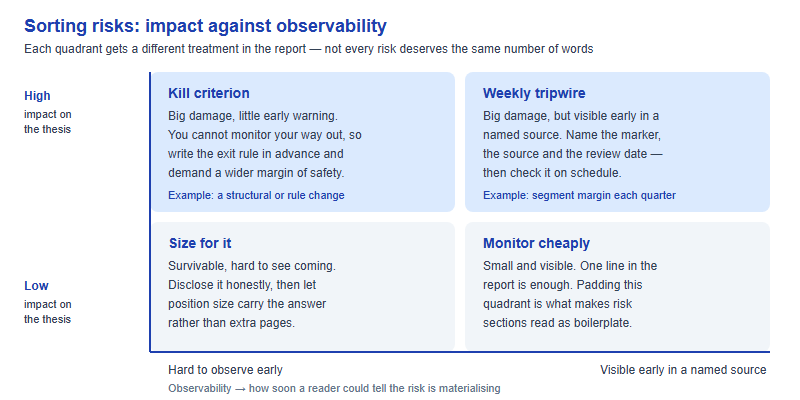
Two practical consequences follow. First, most of your risk words should go to the top half of the matrix; a report that spends equal space on every risk signals that you have not judged which ones matter. Second, the top-right quadrant is what connects the risk section to the rest of your season: each tripwire becomes a line you check in your weekly log, which is how the risk axis and the revision-discipline axis reinforce each other instead of living in separate documents.
Write each risk as five fields, not a bullet
A risk bullet is a category. A risk entry is an argument. Our editorial desk uses five fields, which fit comfortably in one short paragraph or one table row each, and which force out the vagueness that costs marks.
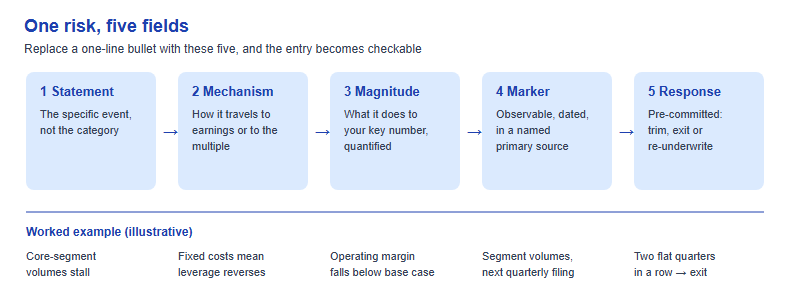
Field 3 is where most reports quietly give up. “This could materially affect profitability” is not a magnitude; it is a shrug in formal clothes. You do not need precision you cannot support — you need a stated, sourced sensitivity: if this input moves by a realistic amount, here is what happens to the number my thesis rests on. Showing the arithmetic also protects you when the defence asks how bad that would be, because you can answer with a figure rather than an adjective.
| Boilerplate version | Why it scores badly | Rewritten as a risk entry |
|---|---|---|
| “Increased competition may pressure margins.” | True of nearly every company; no mechanism, no magnitude, nothing to check | “A new entrant discounting in the core segment would force price matching. Because roughly two-thirds of this segment's costs are fixed per the segment note, a price cut passes almost fully to operating profit. Marker: average selling price disclosed in the next two quarterly filings.” |
| “Macroeconomic conditions may be unfavourable.” | Unfalsifiable; applies to the whole market rather than to this thesis | “My revenue case assumes the end market keeps growing. If the published industry volume series prints two consecutive declines, the growth pillar fails and I re-underwrite rather than wait.” |
| “Regulatory risk exists in this industry.” | Names a category, not a rule, a body or a date | “The specific exposure is the licensing regime described in the risk-factor section of the annual filing. I cannot observe this early, so I treat it as a kill criterion and require a wider margin of safety instead of monitoring it weekly.” |
| “The stock may be volatile.” | Confuses price movement with the thesis being wrong | Cut it, and replace it with the assumption in your own model that breaks the conclusion fastest. |
What to cut, and a pre-submission check
A strong risk section is usually shorter than a weak one. Three well-specified risks with markers and magnitudes beat eleven categories. Cut anything that is true of the entire market, anything you copied from a filing without connecting it to your own claim, and any risk you could not recognise if it happened.
Two further habits are worth building. First, avoid the reassurance reflex — the sentence pattern “however, we believe the company is well positioned to manage this” appended to every risk. It converts a risk section into a sales page, and it is the fastest way to signal that you do not really believe your own list. Second, do not hide the risk section at the back as an appendix nobody reads; in a rubric where risk articulation carries equal weight with clarity and evidence, burying it is a scoring decision, not a formatting one.
- Can a reader restate, in one sentence, the single assumption this thesis most depends on?
- Does every risk have a mechanism — how it actually reaches earnings or the multiple?
- Is at least one magnitude quantified with arithmetic a reader can follow?
- Does every top-half risk name an observable marker, a source and a review date?
- Have you written at least one explicit kill criterion, in advance, in a form you cannot argue your way out of?
- Have you deleted every risk that applies equally to the whole market?
If a box will not tick, the gap is usually in the research rather than the writing — the valuation frameworks and past cases in the S15 participant kit are the place to go back to.
One caution to close on. Nothing here is investment advice, and none of it guarantees a result in the competition or anywhere else; the examples are illustrative constructions, not views on any security. What a disciplined risk section does buy you is the ability to be wrong in public, on the record, with a plan — which is exactly the behaviour the rubric was written to find.
Frequently asked questions
How much of the SIC score is risk articulation?
The official S15 rubric lists four axes of equal weight, one of which is risk articulation. Confirm current weightings on the official SIC competition page.
How many risks should a report include?
The organiser sets no number we can quote. Three fully specified risks with markers and magnitudes usually read stronger than a long uncosted list.
What is a kill criterion?
A condition you write in advance that, if met, means you exit rather than reinterpret. It is most useful for damaging risks you cannot observe early.
Does admitting a serious risk weaken my pitch?
Not under a rubric that scores risk articulation directly. An unacknowledged risk that a judge spots is far more damaging than one you priced openly.
Published by the SIC editorial desk, operated by Hanlin Education for China-based international-school students. Official rules are set by the competition and change yearly — confirm current details on the official SIC site. Any error will be corrected within 7 working days.