The SIC rubric probe for thesis clarity, published on the official competition page, is blunt: can a non-expert reader understand your investment thesis in two sentences? For students writing in a second language that is not a style preference — it is a quarter of the score, decided at sentence level. The good news is that analyst English is a narrow, learnable register, not general fluency.
Why sentence craft is a scoring variable here
Two features of the SIC format make writing unusually load-bearing. First, the deliverable is written: Senior Division teams of 2–4 students submit a single investment strategy report, typically 15–30 pages per the official format, while Junior entrants file a weekly thesis log. Second, the four judging axes carry equal weight, and one of them is clarity itself. A reader who cannot follow your argument cannot credit your evidence — unclear writing quietly damages more than one axis.
The word “non-expert” in the rubric probe is the instruction most students miss. It rules out the two directions ESL writers commonly drift toward: over-simple sentences that state facts without an argument, and over-decorated sentences borrowed from bank research that use jargon as a substitute for reasoning. If you are new to the format, our overview of what the SIC is explains the structure, and our walkthrough of the SIC rubric covers the four axes. Because the deliverable is a written argument rather than a ranked return, writing craft is a scoring variable in a way it is not in outcome-ranked formats — our SIC vs Wharton comparison sets out the difference in design. Rules change by season; confirm current requirements on the official SIC site.
One reframe before the techniques. Your English does not need to sound native. It needs to be precise, verifiable and calibrated. Those three qualities are achievable in a term of deliberate practice, and they matter more to a judge than idiom ever will.
The two-sentence test
Write your thesis in exactly two sentences before you write anything else, and rebuild the report around them. Six things have to fit: what the business does, what you claim about value, the mechanism that delivers it, the evidence that supports it, the marker that would confirm or deny it, and the horizon.
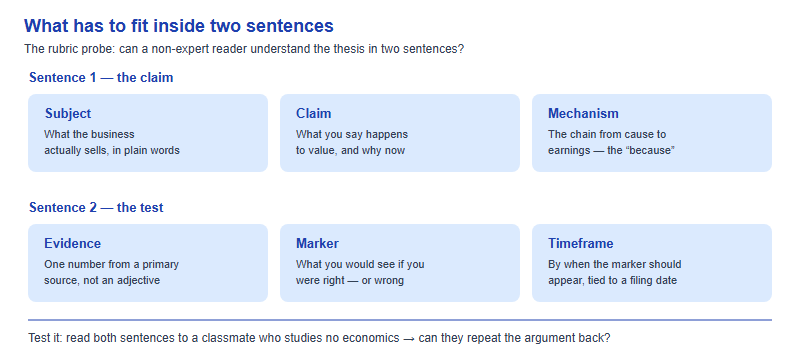
Compare a typical first draft — “This company has good development prospects and its performance is excellent, so I believe the share price will rise in the future” — with a version carrying the same six elements: “The company operates budget hotels under franchise contracts, so growth costs it little capital, and I think the market is still pricing it as an owner of buildings rather than a fee collector. Franchised rooms grew faster than owned rooms in the last two annual filings; if that mix keeps shifting through the next two reporting periods, margins should follow.” Same student, same idea; the second version is checkable. Note that neither sentence needs an advanced word. For more of what that looks like in scored work, the Hall of Fame publishes excerpts from past entries the judging desk selected as illustrative of what the rubric rewards, each with the lead judge's note on what distinguished it.
Six patterns that leak into analyst English
These are the patterns our desk edits most often in drafts from Chinese international-school students. None of them is a grammar error — that is exactly why spellcheck does not catch them and why they survive into final reports.
| Pattern | Why it costs marks | Rewrite |
|---|---|---|
| Scene-setting openers: “With the rapid development of the economy…” | Spends your first sentence on something no reader disputes, and delays the claim | Delete it. Open on the subject and the claim: “The company earns two-thirds of revenue from franchise fees.” |
| Appeal to consensus: “As we all know…”, “It is well known that…” | Substitutes assumed agreement for evidence — the opposite of the evidence-quality axis | Replace with a source: “The annual filing reports X, which means…” |
| Unquantified praise: “performance is good”, “profitability is strong” | An adjective a judge cannot verify; two students could mean opposite things | Name the metric and the level: “operating margin has stayed within a narrow band for three years” |
| Heavy nominalisation: “made an improvement in the reduction of costs” | Buries the action in nouns and doubles the sentence length | Use the verb: “cut costs”. Ask what is happening and who is doing it. |
| Actor-free passives: “it is believed that the growth will be continued” | Hides whether this is your view, management's guidance or a third party's estimate | Name the actor: “Management guides to…” or “I estimate…” |
| Intensifier stacking: “very huge potential”, “extremely obvious advantage” | Reads as persuasion rather than analysis and weakens genuinely strong points | Cut every intensifier, then check whether a number can do the work instead |
A single edit fixes a surprising share of these: for every sentence, ask “who did what, and how do I know?” If the sentence cannot answer both halves, it is decoration. In a 15- to 30-page report, cutting decoration is also how you make room for the analysis judges are actually scoring.
Calibrated hedging: say how sure you are, and why
ESL writers tend to hedge in one of two failing modes: absolute claims that cannot survive scrutiny (“the stock will rise”), or fog so thick the reader cannot tell what is being claimed (“it may possibly perhaps be somewhat affected”). Analyst English hedges precisely: the strength of the verb should match the strength of the evidence, and the source of the claim should be visible.
| Evidence you have | Language to use | Example sentence |
|---|---|---|
| Reported in a primary source | Flat statement + citation | “Revenue rose in the year to the latest annual report; franchise fees were the larger contributor.” |
| Your own calculation from reported data | “I calculate” / “on my figures” | “On my figures, the franchise segment contributes most of group operating profit.” |
| Management's stated plan | “Management guides to” — never as your own forecast | “Management guides to further openings this year; I have not assumed all of them.” |
| Your judgement, with reasoning | “I expect… because…” | “I expect mix to keep shifting because the last two filings show the same direction.” |
| Genuinely uncertain | State the uncertainty and what would resolve it | “I cannot verify unit economics from public disclosure; the next annual report may separate the segments.” |
Two rules keep this honest. Never upgrade a hedge between drafts — if week 4 says “I expect”, week 9 should not say “clearly” unless new evidence arrived, and if it did, cite it. And never promise outcomes: a report that says a stock “will” deliver a return is making a claim no student, teacher or professional can support, and it undercuts the analytical voice the rubric rewards.
Words that get misused, and a 20-minute self-edit pass
Finance vocabulary is unforgiving because near-synonyms in everyday English are distinct quantities here. These six pairs account for most of the confusion we see in student drafts.
- Revenue vs income vs profit — revenue is sales; income and profit refer to what is left after specified costs. Say which line you mean.
- Margin vs markup — margin is expressed against sales, markup against cost. They are different numbers for the same transaction.
- Growth vs growth rate — an absolute increase versus a percentage. “Growth slowed” can be true while sales still rise.
- Guidance vs forecast vs estimate — guidance comes from the company, a forecast is someone's projection, an estimate is yours. Attribute each.
- Valuation vs price — price is what it trades at; valuation is what your analysis concludes. Collapsing the two erases your argument.
- Volatility vs risk — price movement is not the same as the chance your thesis is wrong. The rubric asks about the second.
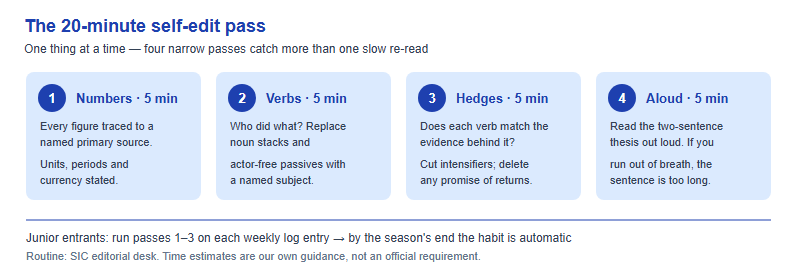
Two habits make the passes stick. Give the draft to someone outside economics — a friend studying history, or a parent — and ask them to say the argument back to you; that is the rubric's non-expert test, run for free. And build a personal error log: three columns for the sentence you wrote, the correction, and the pattern name. Most students find the same four or five patterns repeat, which means the list of things to fix is short and finite. The other half of learning the register is reading it — the reading list in the S15 participant kit is deliberately short, and one book read closely teaches more than ten skimmed.
Finally, a word on drafting tools. Whatever help you use for language, the analysis, the numbers and the judgement must be yours, and every figure must be traceable to a source you opened yourself. Submission and originality rules are set by the organiser and change by season — check them on the official SIC competition page before you rely on any workflow. The strongest sentence in a student report is almost never the most sophisticated one; it is the one a judge can check.
Frequently asked questions
Does weaker English lower my SIC score?
Clarity is one of four equally weighted axes, and the probe asks whether a non-expert can follow your thesis in two sentences. Precision matters more than native idiom.
Should I use technical finance vocabulary?
Only where it is the most precise word available. Jargon used to sound professional usually hides the mechanism a judge is looking for.
How long should my thesis statement be?
The official rubric probe references two sentences, so treat that as the design target for your core claim, then support it in the body.
How do I stop translating from Chinese sentence by sentence?
Draft the two-sentence thesis in English first, then expand. Starting in English at claim level prevents most structural transfer.
Published by the SIC editorial desk, operated by Hanlin Education for China-based international-school students. Official rules are set by the competition and change yearly — confirm current details on the official SIC site. Any error will be corrected within 7 working days.