SIC Senior teams close the Global Stage with one deliverable beyond the report. The official competition page specifies “an end-of-stage 20-minute video defense or written addendum.” The page presents the two as alternatives and does not publish a scoring preference between them, so the choice should follow how your team argues best. This guide covers the decision, the twenty-minute structure, and a build calendar.
What the official page publishes — and what it does not
Start by separating documented facts from assumptions, because most defense mistakes are built on a format the competition never described. Three lines on the official SIC competition page are load-bearing for Senior teams this month:
- The Senior deliverable is “a single investment strategy report — typically 15–30 pages — defending one company, sector, or macro position. Plus an end-of-stage 20-minute video defense or written addendum.”
- The Global Stage runs 2026.07–2026.08, roughly six weeks, described as the “final submission round. Junior participants file a portfolio review with written reflection; Senior teams submit the final strategy report and defense.”
- Scoring is the same Four-Axis Rubric that governed the whole season — Thesis Clarity, Evidence Quality, Risk Articulation, Revision Discipline — at equal weight.
Now the honest gaps. The page does not publish whether the video is watched live or reviewed as a recording, what file format or hosting method to use, whether judges ask follow-up questions, whether every team member must appear, or any length limit for the written addendum. Do not fill those gaps by copying a different competition’s rules — a habit our editorial desk sees repeatedly when students import mental models from ranked, live-pitch formats. Confirm the current submission mechanics on the official SIC site before you build to a specific spec. What you can build to with confidence is the standard the program has published all season: the four axes, explained in our walkthrough of the SIC rubric.
One framing sentence from the competition page is worth taping above your desk while you build this: “What advances an entry isn’t the year’s return — it’s the year’s thinking, defended in writing.” The defense is not a victory lap for a position that went up. It is the last, most compressed demonstration of process.
Video or addendum? Match the format to how your argument works
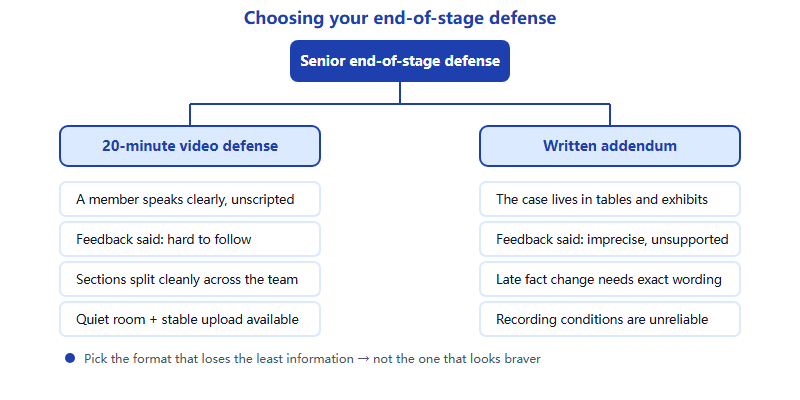
Teams tend to assume the video is the braver, higher-status option. That is a status judgment, not a scoring one. The right question is narrower: which format transmits your specific argument with the least loss? A thesis that lives in a sensitivity table loses information when spoken aloud. A thesis that depends on the sequencing of a story loses information when flattened into a document a reader may skim.
| If this is true of your team | Better fit | Why |
|---|---|---|
| At least one member can speak clearly and unscripted for several minutes in English | Video | Spoken emphasis carries which claim is load-bearing; a document makes every sentence look equally weighted |
| The core of the case is a table — peer multiples, a sensitivity grid, a scenario matrix | Addendum | Numbers read on screen are hard to hold in memory; a reader can re-scan a table |
| A material fact changed in the final fortnight and the wording must be exact | Addendum | Precision under time pressure is easier to control in text than in a take you must re-record |
| Draft-review feedback said the argument was hard to follow | Video | Forces you to say the thesis in two sentences, out loud, with nowhere to hide |
| Draft-review feedback said the argument was imprecise or unsupported | Addendum | Lets you attach the source line for each claim rather than asserting it verbally |
| Recording conditions are unreliable — shared dorm room, weak upload, exam week | Addendum | A rushed, muddy recording damages Thesis Clarity even when the analysis is strong |
| The team is four people who each own a genuinely distinct section | Video | Section handoffs demonstrate a real division of research labour |
Structuring twenty minutes so every axis gets its evidence
Twenty minutes is not long. Read aloud at a comfortable pace, it is roughly 2,400–2,700 words — a small fraction of a 25-page report. That arithmetic settles the design question: a video defense cannot summarise the report, so stop trying. It must do something the report cannot, which is to show a reader which parts of the argument you consider load-bearing and how you handle pressure on them.
Because the rubric weights four axes equally, an unstructured twenty minutes almost always over-serves the thesis and under-serves revision. Allocate minutes deliberately.
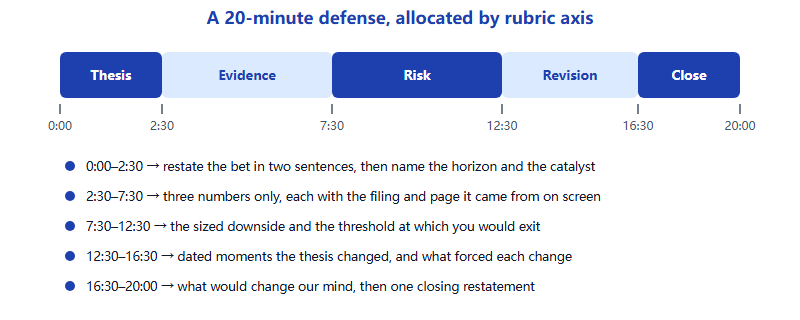
Two disciplines make this structure survive contact with a camera. First, the three-number rule: in five minutes of evidence you can genuinely defend about three figures. A team that flashes fourteen numbers has demonstrated collection, not judgment, and Evidence Quality is judged on whether a claim traces to a primary source, not on volume. Second, the dated revision: the Revision Discipline axis asks whether the thesis updated when facts changed, and a spoken defense is the cheapest place in the entire season to prove it. “On 12 May the margin print came in 180 basis points below our model, so we cut the position and rewrote section four” is worth more than any adjective about rigour.
If you choose the written addendum
An addendum is not a summary of the report either. If it repeats the report, it adds nothing a judge did not already read fifteen pages ago. Treat it as the document your report could not contain, because a report is a finished argument and an addendum can be a candid one. The official page does not publish a length limit, so keep it tight and confirm the current specification rather than guessing at a page count.
- One-page thesis restatement. The two-sentence version, then the horizon and catalyst. If this page is hard to write in August, the thesis was never as clear as the report made it look.
- A revision changelog. A dated table: what changed in the world, what changed in the thesis, and what deliberately did not change and why. This is Revision Discipline rendered as evidence rather than assertion.
- The strongest counter-argument, stated in its best form. Not the weak version you can knock down. Then your answer, and the honest residual — the part of the objection you cannot fully rebut.
- Your falsification line. A numeric threshold and the action it triggers, restated so a judge does not have to hunt for it in the risk section.
The addendum has one structural advantage the video cannot match: you can attach the exact source line beside each claim, which is precisely what the Evidence Quality axis rewards. If your team’s weakness this season was sourcing rather than storytelling, this is the format that repairs it.
Recording, delivery and a ten-day build calendar
Most SIC Senior teams at international schools in China are arguing in a second language against a clock. That is a solvable production problem, not a talent problem, and it is solved before the record button, not during.
- Script only the first ninety seconds and the last sixty. Openings and closings are where nerves distort delivery; the middle is better from bullet notes, because reading aloud from a full script flattens emphasis and makes every claim sound equally important.
- Slow down to roughly 120–130 words per minute. Non-native listeners and native listeners both parse a measured pace better, and it buys you natural pauses at section boundaries.
- Never apologise for your English on camera. It reframes the judge’s attention from your argument to your accent. Competence is demonstrated by precision, not by fluency.
- Let the screen carry the numbers. Say “gross margin fell to 38.4 percent in the second quarter” once, with the figure visible and its source labelled. Do not read tables aloud.
- Record a silent test first. Play back thirty seconds and check room echo, keyboard noise, and whether the slide text is legible at small sizes. Audio quality damages perceived clarity more than video quality does.
The ten-day build calendar. The Global Stage is a roughly six-week submission window, and the defense is the piece teams habitually leave for the final weekend. Work backwards instead.
| Day | Task | Output that proves it is done |
|---|---|---|
| 1–2 | Freeze the report. List the three claims a hostile reader attacks first | A three-line attack list, agreed by the whole team |
| 3 | Build no more than ten slides — one claim per slide, source line in the footer | Slide deck where every number shows its filing |
| 4 | Untimed dry run, audio only, no slides | You discover which section you cannot explain without reading |
| 5 | Cut to the minute allocation; target 18:30–19:30 recorded | A timed running order with buffer |
| 6 | Rebuild the weakest segment — usually revision, occasionally risk | At least two dated revision moments you can name from memory |
| 7 | Full take. Watch it back on mute | If the slides alone convey the thesis, clarity is holding |
| 8 | Re-record. Keep the better take, do not chase a perfect one | A finished file, not a fifth attempt |
| 9 | Export, check audio levels, upload | Submission confirmed, not scheduled |
| 10 | Buffer for time zones and platform trouble | Nothing left to do on deadline day |
Before you submit either format, run one final audit against the axes: can a non-expert state your bet after the first two minutes; does every number on screen name its source; is there one numeric threshold at which you would exit; and can you point to a dated moment the thesis changed? If any answer is no, the fix is in the defense, not in another revision of page nineteen. New readers should start with our overview of what the SIC is and how the season is structured, and if you are weighing SIC alongside a ranked, portfolio-based format, our SIC versus Wharton comparison explains why the deliverables differ so sharply.
Frequently asked questions
Does choosing the written addendum score lower than the video?
The official page lists them as alternatives and publishes no scoring preference between them. Confirm current rules on the official SIC site.
How long should the recording actually be?
Twenty minutes, per the official competition page. Aim for 18:30–19:30 recorded so an overrun never costs you the closing section.
Do Junior Division participants film a defense too?
No. The Global Stage line for Junior is a portfolio review with written reflection; the defense belongs to Senior teams.
Must every team member speak on camera?
The official page does not require it. Split by section if voices are strong; otherwise one clear speaker beats four unclear ones.
Published by the SIC editorial desk, operated by Hanlin Education for China-based international-school students. Official rules are set by the competition and change yearly — confirm current details on the official SIC site. Errors are corrected within 7 working days.