The SIC is open to students in grades 6–12 worldwide, in either the Junior (individual) or Senior (team of 2–4) division. Per the official competition page, school affiliation is “required for grades 6–9 (consent letter); optional for 10–12,” parent consent is “required for all participants under 18,” and prior competition history is “not required.” The rest of enrolment is paperwork and timing.
What the official page actually requires
Eligibility questions attract more bad information than any other part of a competition, usually because someone answers from memory of a different programme. So here is the published bar, quoted rather than paraphrased, with the practical reading beside each line.
| Requirement | What the official page states | What it means in practice |
|---|---|---|
| Grade band | Grades 6–12, for both divisions | A middle-school student is genuinely eligible, not merely tolerated. The lower bound is real, not decorative |
| Geography | Worldwide | There is no residency or nationality condition published on the competition page |
| School affiliation | “Required for grades 6–9 (consent letter); optional for 10–12” | Younger applicants must be connected to a school that signs; older applicants may enter without one |
| Parent consent | “Required for all participants under 18” | Applies across both grade bands, including grade 12 students who are still 17 |
| Prior competition history | “Not required” | A first competition is an acceptable first competition. No qualifying event gates entry |
| Division | Junior individual, or Senior team of 2–4 | Both bands can choose either division; grade does not force the division |
Two of those rows deserve emphasis because they quietly remove barriers students assume exist. First, the grade floor of 6 is unusually low for an investment programme, and it is applied to both divisions — a grade 7 student is not restricted to a junior track by rule. Second, “prior competition history: not required” means the SIC is not structured as a downstream event that harvests winners from an upstream qualifier. If you are new to the format, our overview of what the SIC is explains why a five-month rubric-judged programme is built this way.
The grades 6–9 rule, decoded
The single line that generates the most questions is the split at grade 9. Read literally: a student in grades 6, 7, 8 or 9 must have school affiliation evidenced by a consent letter; a student in grades 10, 11 or 12 may have one but does not need it. The competition page does not publish a template for that letter, a named signatory role, or a required set of clauses, so treat the following as editorial guidance from our desk rather than as rules, and confirm the current format on the official site.
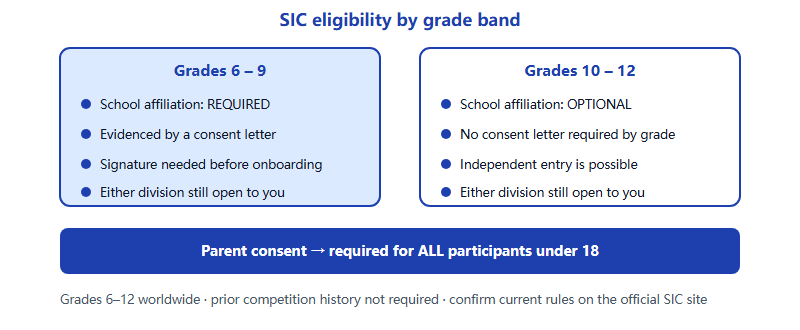
In the enrolments our desk supports at international schools in China, the consent letter is rarely refused — it is simply slow. The bottleneck is almost never the substance. It is finding the right signatory during a busy term, and the fact that a school office asked to endorse a five-month external academic programme reasonably wants to know what it is endorsing before it signs. Three habits shorten that cycle considerably:
- Approach the office with a one-page brief, not a request. State the programme name, that it runs across a defined season with a Regional and a Global stage, the weekly time commitment for your division, and what the school is being asked to attest to. A named administrator can act on one page; they cannot act on “can you sign something for a competition?”
- Identify the correct signatory before you draft anything. At most international schools this is a head of year, a university-counselling lead, or a department head — not a subject teacher, however supportive.
- Start before the window opens, not after. A signature that takes two weeks is harmless in February and expensive in the final fortnight of an application window.
One caution for grade 9 students specifically: the boundary sits exactly at your grade, and grade labels differ across curricula. A student in Year 10 of a British-system school, an IGCSE cohort, or a Chinese school’s international division may map to grade 9 or grade 10 depending on the convention used. Do not assume the mapping is in your favour — ask which grade you are treated as, and prepare the consent letter anyway if there is any ambiguity. An unused letter costs nothing; a missing one costs a season.
What the SIC does not require
Because entry barriers are often imagined rather than published, it is worth being explicit about what is absent from the eligibility rows. The official page does not condition entry on prior competition history. It publishes no requirement for a prior finance or economics course, and the programme’s own materials position it as an academic research programme rather than a proving ground for students who already trade. It does not gate the Senior division by grade — the team size is 2 to 4 regardless of band.
This matters for a specific student profile our editorial desk meets often: the strong grade 8 or 9 humanities student who reads company filings for fun but has never taken an economics class and assumes a finance programme is closed to them. On the published requirements, it is not. The Four-Axis Rubric — Thesis Clarity, Evidence Quality, Risk Articulation, Revision Discipline — rewards argument construction and source discipline rather than prior market exposure, which our breakdown of the SIC rubric covers axis by axis.
Two things the page does not settle, and which you should therefore confirm directly rather than infer: programme fees, which are not published as a price card on the competition page, and the precise submission mechanics of the platform onboarding step. Neither should be guessed at from what another programme charges or uses.
The application window and the onboarding sequence
The S15 application stage ran “2026.03.20 — 2026.06.01 · ~10 weeks,” described on the official page as an inquiry window in which “advisors walk you through eligibility, division selection, consent paperwork, and platform onboarding.” That sentence tells you something structurally important: enrolment is a guided sequence, not a single form submission, and three of its four steps are administrative rather than academic.
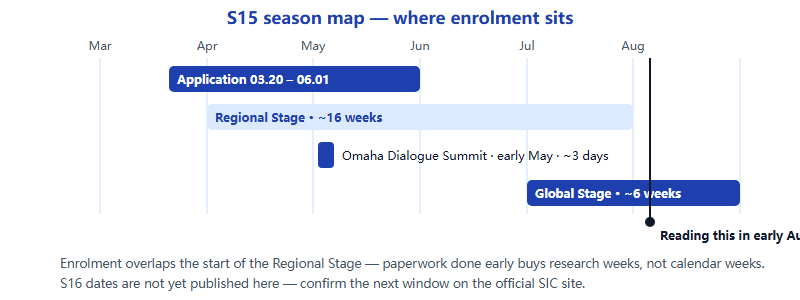
Notice the overlap. The application window closed on 1 June, but the Regional Stage began in April. An applicant who completed onboarding in late March started research alongside a sixteen-week stage; an applicant who finished paperwork in the last week of May entered the same stage with materially fewer weeks of it remaining. Because Revision Discipline is a scored axis, and revision is a function of elapsed time rather than effort, late enrolment does not merely cost convenience — it compresses the one axis that cannot be recovered by working harder in August.
If you are reading this in the second half of 2026, the operative advice is therefore not “apply” but “be ready to apply on day one of the next window.” The next season’s dates are set by the competition and are not something to infer from this season’s calendar; check the official site rather than assuming a repeat.
A paperwork checklist for China-based international-school families
Everything below can be prepared before a window opens, and none of it depends on knowing next season’s dates.
| Item | Who owns it | Do it by | Failure mode if left late |
|---|---|---|---|
| Confirm your grade under the programme’s convention | Student | Any time — it decides whether the consent letter applies | Year/grade mismatch discovered mid-application |
| Identify the school signatory by name and role | Student | Term before the window | Request bounces between offices for two weeks |
| One-page brief for the school office | Student | Two weeks before approaching them | Office asks for information you have not assembled |
| School consent letter — grades 6–9 | School | Before the window opens if possible | Signature arrives after onboarding closes |
| Parent consent — all under-18 participants | Parent or guardian | Alongside the school letter | Overlooked by grade 11–12 students who assume it is a junior-only rule |
| Division decision and, for Senior, a committed team of 2–4 | Student | Before the window | Team assembled in week three, then a member withdraws |
| Fees and payment logistics | Family | At inquiry — not published as a price card | Assumed from another programme’s cost structure |
A final note on team size, because it is a common cross-programme confusion. The SIC Senior division is a team of 2 to 4. That is not the same shape as other high-school investment programmes — the Wharton Global High School Investment Competition, for example, runs teams of four to six and asks for a different pair of deliverables entirely. If you are choosing between them or planning both, our side-by-side comparison of SIC and Wharton sets out the differences in format and recognition. Recruit to the rules of the programme you are actually entering.
Frequently asked questions
Can a grade 7 student really enter the SIC?
Yes. The official page lists grades 6–12 for both divisions, with school affiliation and a consent letter required for grades 6–9.
Do grade 11 and 12 students need parent consent?
Yes, if they are under 18. The requirement is published by age, not by grade, so a 17-year-old in grade 12 is included.
Is a teacher recommendation or prior competition record needed?
The official page states prior competition history is not required. Grades 6–9 need school affiliation with a consent letter.
Can I still apply for the current season in August?
The S15 application window ran 20 March to 1 June 2026. Confirm the next season’s window on the official SIC site.
Published by the SIC editorial desk, operated by Hanlin Education for China-based international-school students. Official rules are set by the competition and change yearly — confirm current details on the official SIC site. Errors are corrected within 7 working days.