Once the Global Stage submission closes, the season produces one more document that most participants underuse. Per the official competition page, “all participants who complete the Global Stage receive a Season Participation record, including a personalized rubric report on their final submission.” That per-axis report is the most useful thing the season gives you — provided you read it as a diagnosis rather than a verdict.
What arrives, and what each recognition tier actually encodes
The SIC publishes three recognition tiers, and the wording matters more than the ranking instinct suggests. Quoted from the official competition page:
| Tier | Official description | What the wording tells you about your axis profile |
|---|---|---|
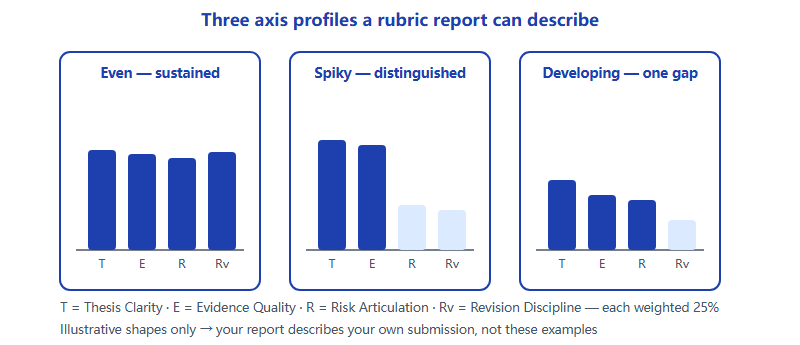
| Featured Cohort | “Entries demonstrating sustained excellence across all four rubric axes. Featured Cohort submissions are eligible for publication (with permission) in the SIC Hall of Fame, and for use by participants in their university applications.” | An even profile. The operative words are “sustained” and “all four” — this tier is not awarded for one brilliant axis |
| Honorable Mention | “Entries showing strong rubric performance with one or two axes that distinguished them — sharp thesis, exceptional evidence sourcing, or particularly disciplined revision history.” | A spiky profile. Genuine strength, concentrated. The tier itself is telling you which shape to fix |
| Season Participant | “All participants who complete the Global Stage receive a Season Participation record, including a personalized rubric report on their final submission.” | Completion plus the diagnostic document. Note this is issued for completion, not withheld as a consolation |
Read together, the three descriptions reveal that SIC recognition is a shape judgment, not a position on a leaderboard. The published tier descriptions are worded as criteria rather than as a ranking, and the page does not publish a cap on how many entries can hold a tier — confirm current recognition rules on the official SIC site. This is the structural point our overview of what the SIC is makes at length, and it changes how you should react to your result. An Honorable Mention is not “almost Featured Cohort.” It is a specific statement that one or two axes carried the work and the others did not keep pace — which is an actionable finding, not a near miss.
Reading the report without flattering yourself
The failure mode here is predictable: students read the compliments carefully and skim the criticisms, then conclude the weak axis was a presentation problem. Force the opposite reading. Take each comment and ask which of the four published rubric questions it answers, because the rubric questions are blunt enough to remove ambiguity:
- Thesis Clarity — can a non-expert reader understand your investment thesis in two sentences?
- Evidence Quality — do claims rest on primary sources rather than blog summaries or analyst headlines?
- Risk Articulation — what would have to be true for the thesis to lose?
- Revision Discipline — did the thesis update when facts changed, or did it quietly rationalise?
Then translate. Feedback is usually written about a symptom; the fix belongs to a cause, and the two are often on different axes.
| What the report says | Axis it is really about | The underlying cause, in most cases |
|---|---|---|
| “The argument was difficult to locate” | Thesis Clarity | The thesis was still being discovered while the report was being written — it was never compressed to two sentences before drafting |
| “Support was thin in places” | Evidence Quality | Secondary sourcing. A claim traced to coverage of a filing rather than to the filing itself |
| “Risks were acknowledged but not sized” | Risk Articulation | No numeric threshold. “Competition may intensify” with no level at which the position would be exited |
| “The position changed but the reasoning did not” | Revision Discipline | Trades were logged, reasoning was not — the log recorded actions instead of updated beliefs |
| “Strong analysis, hard to follow” | Thesis Clarity, not writing style | Structure, not vocabulary. The load-bearing claim sits on page nine instead of page one |
| “Conclusions outran the evidence” | Evidence Quality and Risk Articulation together | Conviction was expressed as certainty; the counter-case was never stated in its strongest form |
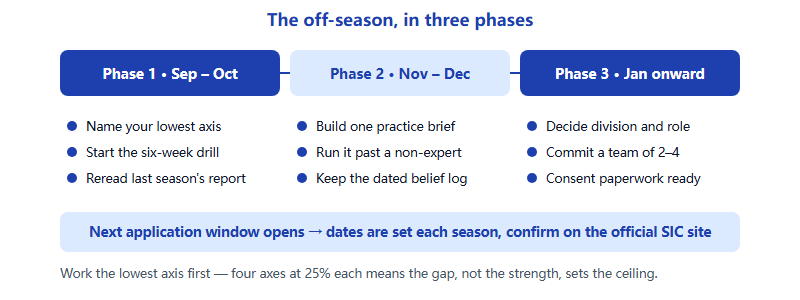
One rule saves a lot of wasted effort in the off-season: fix the lowest axis, not the most interesting one. With four axes at 25% each, a participant who is already strong on evidence gains far less from more sourcing practice than from the six weeks that would move a weak revision record. Our axis-by-axis walkthrough of the SIC rubric is the reference to keep open while you triage.
Turning the weakest axis into an off-season drill
A diagnosis without a drill is a feeling. Each axis has a practice that produces an artifact — something that exists at the end and can be checked — and artifacts are what make an off-season programme survive September’s coursework.
| Weakest axis | Six-week drill | Artifact it produces |
|---|---|---|
| Thesis Clarity | One company per week, two sentences only: the bet, the horizon, the catalyst. Read each aloud to someone outside finance | Six two-sentence theses and a note on which ones your reader could repeat back |
| Evidence Quality | Take three claims a week from any article you read and trace each to the primary filing, page and line | A source ledger of eighteen claims with document, page and date — and a count of how many failed to trace |
| Risk Articulation | For every thesis you write, state one numeric threshold and the action it triggers, before you write anything positive | A kill-criteria sheet where each line is a number and a consequence, not an adjective |
| Revision Discipline | Keep a dated belief log on two positions: what you believed, what arrived, what changed, and what deliberately did not | A twelve-week changelog showing at least two documented reversals with reasons |
Deciding the next season deliberately
A rubric report is also a division and role decision, and it should be made in October rather than in the first week of an application window. Three questions settle most of it.
- Did the format fit the way you work? A Junior participant whose weakest axis was Revision Discipline may find the weekly thesis log was the right instrument and the problem was cadence, not division. A Senior team member who never owned a section outright often has an axis profile shaped by someone else’s habits rather than their own.
- Was the weak axis yours or the team’s? In a team of 2–4, sourcing discipline is usually owned by one person. If the report criticised evidence and you never touched the citations, the honest next step is to take that role rather than to change division.
- Do you have a second season of genuine curiosity in you? The programme runs across roughly five months. Returning because a tier felt unfinished is a weaker motivation than returning because a thesis you abandoned still bothers you — and it shows in the work.
A note on what a second season does and does not do. Per Hanlin, and de-identified: across seasons S4 to S13, students our desk has coached have taken strategy-division team golds and silvers, U-FEB Quiz medals, and have repeatedly advanced from the qualifying round to the global round; in S8 two of our teams advanced and came away with four global golds, a silver and a bronze. Two caveats belong beside that record. First, results vary, and nothing here is a prediction about any individual entry. Second, season structures and recognition categories are set by the competition each season and should not be assumed constant — the categories above are historical, and the S15 tiers are Featured Cohort, Honorable Mention and Season Participant. Confirm current-season recognition on the official site rather than assuming continuity. What the record does illustrate is a pattern worth planning around: sustained multi-season participation, with a specific weakness worked on between seasons, is a more common route to strong outcomes than a single heroic effort.
Finally, if your off-season plan involves a second programme, keep the two straight. The Wharton Global High School Investment Competition is a different competition run by a different organisation, with teams of four to six and two deliverables — an investment policy statement and a comprehensive report — and its published guidance is explicit that success is not determined by portfolio performance. Our desk has separately supported a team that reached the global semi-final there in 2023 (per Hanlin; results vary). The calendars differ, which is why some students run them in sequence; the formats differ more than the calendars do, as our SIC versus Wharton comparison sets out.
What to keep from this season
Before the files scatter across three laptops and a shared drive nobody renews, archive four things while they still make sense to you: the final submission itself; the rubric report; your own one-page account of what you would do differently, written within a fortnight while the reasons are still specific; and the dated revision log, which is the only artifact that gets harder to reconstruct with time. The official page notes that Featured Cohort submissions are eligible for publication in the SIC Hall of Fame with permission, and for use by participants in their university applications — but the version of your work that is most useful later is the one annotated with what you now think was wrong. That annotation is the thing a thoughtful reader, and your next season’s self, will actually find valuable.
Frequently asked questions
Who receives a personalised rubric report?
Per the official page, all participants who complete the Global Stage receive a Season Participation record including a personalised rubric report.
Is Honorable Mention a near miss for Featured Cohort?
No. The published wording describes one or two distinguishing axes, whereas Featured Cohort describes sustained excellence across all four.
Can several entries hold the same recognition tier?
The published tier descriptions are worded as criteria rather than as a ranking, and no cap is published. Confirm current recognition rules on the official SIC site.
Which axis should I work on between seasons?
The lowest one. All four axes carry 25 percent, so the weakest axis, not the strongest, sets your ceiling.
Published by the SIC editorial desk, operated by Hanlin Education for China-based international-school students. Official rules are set by the competition and change yearly — confirm current details on the official SIC site. Errors are corrected within 7 working days.