In the SIC Junior Division the weekly thesis log is the artefact judges actually read — the official competition page states entries are judged on the thesis logs rather than on portfolio NAV. That single design choice changes what a good week looks like: not a green number, but a documented, dated record of what you believed, what you checked, and what you changed.
What the log is, and what it is not
Per the official S15 format, a Junior entrant manages a simulated equities-and-ETFs portfolio across the programme window and files a weekly thesis log to the SIC programme desk. The log is not a trading diary, not a market commentary, and not a place to explain why the market was “irrational” this week. It is the running evidence file for one question the rubric asks directly: when facts changed during the season, did the thesis update on schedule?
That question is one of four judging axes — thesis clarity, evidence quality, risk articulation and revision discipline — each carrying equal weight in the published S15 rubric. If you are new to the format, our overview of what the SIC is covers the structure, and our walkthrough of the SIC rubric covers how the four axes interact. This article is about the one axis you cannot write at the end: revision discipline is the only score you build week by week, in real time, and it is impossible to reconstruct honestly in the final fortnight.
This is also the clearest structural difference between the SIC and returns-ranked formats. A competition that scores portfolio performance measures the outcome; a rubric that scores revision discipline measures the process that produced it. If you are weighing formats, our SIC vs Wharton comparison sets out what each design rewards. Season-specific rules change — confirm the current log requirement, frequency and submission route on the official SIC competition page before you build a routine around it.
The five blocks of an entry that scores
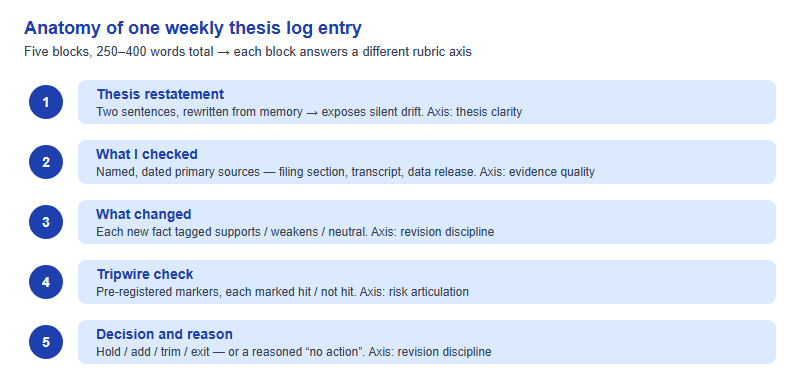
The organiser sets the submission requirements; what follows is our editorial desk's working template for the content inside an entry, built to map onto the four rubric axes rather than to fill space. Five blocks, roughly 250–400 words in total, is enough. Longer entries usually score no better because they bury the one sentence that matters.
| Block | What goes in it | Rubric axis it feeds |
|---|---|---|
| 1. Thesis restatement | Your current thesis in two sentences, rewritten from memory — not copy-pasted from last week | Thesis clarity |
| 2. What I checked | The specific sources opened this week: a filing section, a transcript, an industry data release — named, dated | Evidence quality |
| 3. What changed | New facts, and whether each one supports, weakens or is neutral to the thesis | Revision discipline |
| 4. Tripwire check | The pre-registered markers you said you would watch, each marked hit / not hit | Risk articulation |
| 5. Decision and reason | Hold, add, trim, exit — or explicitly “no action, and here is why that is the disciplined choice” | Revision discipline |
Block 1 is the block students skip, and it is the most diagnostic. Rewriting the thesis from memory every week surfaces drift: if week 9's restatement quietly contains a different reason for owning the position than week 2's, you have changed your mind without noticing. Judges reading a season of entries can see that drift instantly. Owning it in block 3 turns a weakness into evidence of revision discipline; hiding it turns it into an inconsistency the reader finds for you.
Pre-register your checks so “on schedule” means something
The rubric wording is precise: did the thesis update on schedule. A thesis that changes the week after the evidence arrived is disciplined; one that changes three weeks later, once the share price has moved, is reactive. The way to make your updates defensible is to decide in advance what you will look at and when — before you know what it will say.
Write this into your first two entries as a monitoring plan. For each pillar of your thesis, name one observable marker, one source and one review date. If your thesis rests on margin expansion, the marker is gross margin in the next quarterly filing, the source is the filing itself, and the date is the scheduled reporting week. Then every week, block 4 becomes a two-minute check rather than an open-ended browse.
- Scheduled markers — quarterly results, annual reports, regulatory filing dates, scheduled industry data releases.
- Continuous markers — a competitor's pricing, a product launch, a management change; checked weekly at a fixed time.
- Threshold markers — the level at which you said you would act, written as a number before the week begins.
Pre-registration also protects you from the most common scoring failure in a log: retro-fitting. When a position falls, it is tempting to write “as I expected, sentiment weakened.” If that expectation is nowhere in weeks 1 to 6, the claim is unsupported, and it damages the evidence-quality axis as well as the revision one. Your earlier entries are dated; treat them as a record you cannot edit.
The two hardest weeks: nothing happened, and you were wrong
Most students write good entries in weeks with news. The differentiating entries are the other two kinds.
A quiet week is not an empty entry. “No news” is itself information when you have a monitoring plan: it means the markers you pre-registered did not move, so the thesis stands unchanged for a documented reason. That is a stronger entry than a page of price commentary. Use quiet weeks to deepen the evidence base — read one section of the filing you have been avoiding, or build the peer comparison you have been meaning to build.
Being wrong is the entry that earns the most credit and gets written the worst. The disciplined version separates three questions: what did I get wrong, was the reasoning wrong or only the timing, and what does that imply for the position now. Vagueness here is expensive, because the rubric asks judges to look for updates on schedule, not for confidence.
| Situation | Weak entry | Entry that scores |
|---|---|---|
| Quiet week | “Nothing much happened this week. The stock was flat. Still holding.” | “Both scheduled markers were untouched this week: no filing due, no competitor pricing change. Thesis unchanged. Used the time to read the segment note in the annual report; segment margin disclosure confirms pillar 2.” |
| Bad news arrives | “The market overreacted. Long-term story intact.” | “Guidance was cut on volumes, not price — that hits pillar 1 directly. Tripwire A hit. Reasoning on pricing power holds; volume assumption was too high. Trimming rather than exiting, and here is the revised assumption.” |
| Thesis broken | “I will wait and see what happens next quarter.” | “The kill criterion I wrote in week 2 has been met. Exiting. What I got wrong was the durability of the cost advantage; the mechanism I described was never visible in the filings, only in press coverage.” |
| Position is up | “Up 12% — thesis working.” | “Price moved on a sector re-rating, not on any pillar of my thesis. None of my markers has confirmed yet, so I am not treating this as evidence I am right.” |
Notice the pattern in the right-hand column: every entry distinguishes between the price moving and the thesis being confirmed. That distinction is the whole point of a process-scored competition, and it is the habit judges can see most clearly across a season of dated entries.
Fitting it into three to five hours a week
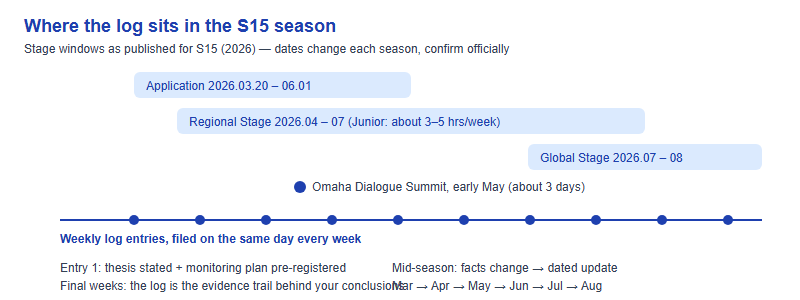
The official competition page estimates about 3–5 hours per week for Junior entrants during the Regional Stage, which in S15 ran across roughly April to July 2026, with the Global Stage in July–August. That is a realistic budget alongside IB or A-Level coursework only if the log is a routine rather than a weekly improvisation.
A workable split within four hours: 90 minutes reading one primary source properly, 45 minutes on the tripwire check and any market data, 45 minutes writing the entry, and 30 minutes on the longer-term research item you are chipping away at — a chapter from the reading list in the S15 participant kit, for example. Fix the same slot each week — a Sunday evening in Shanghai or Beijing catches the previous week's US closes and any weekend filings, and it means “on schedule” is a calendar fact rather than an intention.
Senior teams: one shared log, several voices
Senior Division teams of 2–4 students produce a single investment strategy report — typically 15–30 pages per the official format — at an estimated 5–8 hours per week per member. Teams are not required to keep a Junior-style log, but the ones that do arrive at the report with the arguments already fought out and the sources already gathered.
The practical version for a team: one shared document, one named owner per thesis pillar, and one weekly entry written by a rotating author who must summarise the others' findings rather than only their own. Rotation matters because it forces every member to be able to explain the whole thesis in their own words — which is what the defence is for. The official competition page describes the Senior deliverable as the strategy report plus an end-of-stage 20-minute video defence or written addendum; confirm the current format there before you rehearse for one of those rather than the other. Because members may attend different schools and live in different countries, the shared log also becomes the team's memory: it settles “who checked that, and when” without anyone relying on chat history.
One closing point on honesty. A log is only useful as evidence if it is contemporaneous. Backfilling six weeks of entries the night before a deadline produces text that reads uniform, undated in substance, and suspiciously certain — and it forfeits the one axis that rewards students who simply showed up every week and told the truth about what they found.
Frequently asked questions
Is the Junior Division scored on portfolio returns?
The official competition page states Junior entries are judged on the thesis logs rather than portfolio NAV. Confirm current scoring on the official SIC site.
How long should one weekly entry be?
The organiser sets the requirement. Our editorial desk finds 250–400 words across five blocks is enough; extra length usually buries the key sentence.
What do I write in a week with no news?
Record that your pre-registered markers did not move, state that the thesis is unchanged for that reason, and use the time to deepen one piece of evidence.
Does admitting I was wrong hurt my score?
The rubric asks whether the thesis updated on schedule when facts changed, so a documented, dated correction is evidence of revision discipline, not a penalty.
Published by the SIC editorial desk, operated by Hanlin Education for China-based international-school students. Official rules are set by the competition and change yearly — confirm current details on the official SIC site. Any error will be corrected within 7 working days.