Analysing a US-listed Chinese company for the Student Investment Challenge (SIC) means doing everything you would for any stock — then adding three layers most beginners miss: the corporate structure behind the shares you buy, the regulatory oversight on both sides of the Pacific, and the currency gap between where the company earns and how the stock is priced. For China-based students these companies feel familiar, which is exactly why the extra risk deserves care.
Why this matters for China-based students
If you grew up using the apps these companies make, they are a natural place to look for a thesis — you understand the product, the users, and the competition better than most. That is a genuine edge, and it is the kind of first-hand insight a good pitch is built on. But familiarity with the product is not the same as understanding the security you would actually be buying, which is often not a direct share in the business at all.
One caution before you start: never assume a given company is eligible for the competition. Which securities you may use, and any market or listing restrictions, are set by the organiser and change from season to season — confirm the eligible universe on the official SIC site. If you are new to the format, our overview of what the SIC is covers the basics; this article is about the specific homework these particular companies demand.
What an ADR actually is
Most Chinese companies you see quoted on US exchanges trade as American Depositary Receipts (ADRs), not as their home-market shares. An ADR is a certificate issued by a US depositary bank that represents a set number of the company’s underlying shares, held by the bank abroad. It trades on a US exchange in US dollars, which is what lets a student in a US-market competition access a Shanghai- or Shenzhen-linked business without a foreign brokerage account.
| Term | What it means |
|---|---|
| ADR | A US-traded certificate representing shares in a non-US company, priced in US dollars |
| Sponsored ADR | Created with the company’s involvement; generally comes with fuller disclosure |
| Unsponsored ADR | Created by a bank without the company; often thinner information |
| ADR ratio | How many home-market shares one ADR represents (it is not always one-to-one) |
| Depositary bank | The US bank that issues the ADRs and holds the underlying foreign shares |
Two practical details matter for a pitch. The ADR ratio changes how a per-share figure translates, so make sure any valuation you quote is on the same basis as the price you compare it to. And a sponsored ADR usually gives you more reliable filings to work from than an unsponsored one — a small check that can save you from building analysis on thin information.
The VIE structure: you may not own what you think
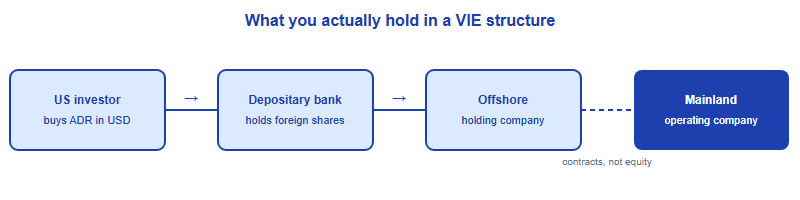
Here is the layer that surprises people. In several sectors, foreign ownership of mainland Chinese companies is restricted, so many well-known firms use a structure called a variable interest entity (VIE). Instead of buying equity in the operating business, foreign investors buy shares in an offshore holding company — often registered in the Cayman Islands — which controls the mainland operating company through a web of contracts rather than direct ownership.
The economic exposure is designed to pass through, but the legal ownership is indirect. Structures differ between companies and the regulatory treatment of VIEs can evolve, so do not generalise: read the specific company’s filings for how its structure is described, and treat the current legal and policy status as something to verify rather than assume. The point for your thesis is not to fear the structure, but to understand it and price the added uncertainty honestly.
The extra risk layers to price in
A disciplined pitch on one of these companies does not stop at the business and the valuation. It adds a short, honest section on the layers that are specific to this class of stock. You do not need to resolve every question — you need to show you have seen them and adjusted your required margin of safety accordingly.
| Extra layer | What to check | Why it matters for your thesis |
|---|---|---|
| Corporate structure | Does the filing describe a VIE or direct ownership? | You may hold economic exposure, not the assets themselves |
| Audit and listing oversight | Current audit-inspection and US listing status | Can affect whether the ADR keeps trading in the US |
| Home-market regulation | Sector policy and its direction | A policy shift can reset the entire investment case |
| Currency (FX) | Reporting currency versus the ADR’s US-dollar price | Earnings in one currency, priced in another, adds FX risk |
| Disclosure and governance | Filing quality, ownership, related-party dealings | Information gaps raise the margin of safety you should demand |
On oversight specifically, US-listed Chinese companies have at times faced questions over audit-inspection access and the possibility of delisting. The status of these issues can change with policy on both sides, so treat it as something to verify against current, credible sources rather than a fixed fact to state. The analytical move is the same either way: identify the risk, size it, and let it widen the discount you require before the pitch makes sense.

Dual listings: a detail worth checking
One factor that can change the risk picture is whether the same company also carries a secondary or dual listing on another exchange, most commonly Hong Kong. A number of larger US-listed Chinese firms have added a Hong Kong listing in recent years, which can give shareholders an alternative venue for their holding if US trading were ever disrupted. Whether a specific company has this, and exactly how a conversion between listings would work, is company-specific and can change — so check the filings rather than assuming.
For your pitch, the point is simple: a home-region listing does not remove the underlying business or regulatory questions, but it can soften the pure “what if the ADR stops trading in the US” risk. Noting whether it exists, and treating it as a mitigant rather than a cure, shows a reader you have thought a level deeper than the headline listing.
How to analyse one anyway
None of this means avoid these companies — it means analyse them with eyes open. The strongest pitches on US-listed Chinese firms pair genuine product insight with a clear-eyed account of the structure. A workable sequence looks like this:
- Start with the business, exactly as you would anywhere — the product, the market, the financials, and a valuation.
- Read how the shares are structured, using the company’s own filings, so you know whether you are buying equity or contractual exposure.
- List the extra risks from the table above and, for each, note what you would monitor as an early warning.
- Widen your margin of safety to reflect the added uncertainty, rather than pretending it is not there.
- State the risks in the pitch, because a judge trusts the analyst who names them far more than the one who omits them.
That last step is where the marks are. Our breakdown of the SIC rubric shows how examiners reward a candid treatment of risk, and because the SIC rewards reasoned theses over raw returns — a distinction our comparison of the SIC and the Wharton competition draws out — a well-handled risk section on a company you genuinely understand can be a real edge.
Frequently asked questions
Can I pitch a US-listed Chinese company in the SIC?
Only if it is within the eligible universe for that season. Rules on eligible securities are set by the organiser — confirm on the official SIC site.
What is a VIE in simple terms?
A structure where foreign investors hold an offshore company that controls a mainland business by contract, not by direct equity ownership. Check each filing.
Why does currency matter for an ADR?
The company often earns in its home currency while the ADR is priced in US dollars, so exchange-rate moves affect your return on top of the business itself.
Should the extra risk stop me pitching one?
Not necessarily. It should widen your required margin of safety and appear openly in your risk section, where it strengthens the pitch.
Published by the SIC editorial desk, operated by Hanlin Education for China-based international-school students. Official rules are set by the competition and change yearly — confirm current details on the official SIC site. Any error will be corrected within 7 working days.