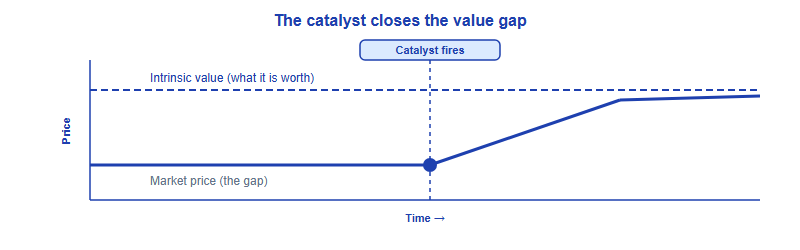
A catalyst is the specific event that makes the rest of the market see what you already see — the earnings surprise, product launch, or corporate change that closes the gap between a company’s price and its value. For the Student Investment Challenge (SIC), a pitch without a catalyst is only half an argument: it explains why a stock is mispriced, but not why that gap will actually close. This guide covers what catalysts are, the main types, and how to time one.
Cheap is not a thesis
Plenty of stocks are cheap for good reason, and plenty stay cheap for years. Value investors have a grim phrase for the trap: the value that never gets recognised. A strong pitch answers two questions, not one. First, why is this company worth more than the market is paying? Second — and this is the part beginners skip — what will make the market change its mind, and roughly when?
That second question is the catalyst. It converts a static observation (“this looks undervalued”) into a dynamic argument (“this is undervalued, and here is the event that should re-rate it”). If you are still learning how the pitch fits together, our overview of what the SIC is gives the frame; think of the catalyst as the hinge the whole thesis swings on.
The main types of catalyst
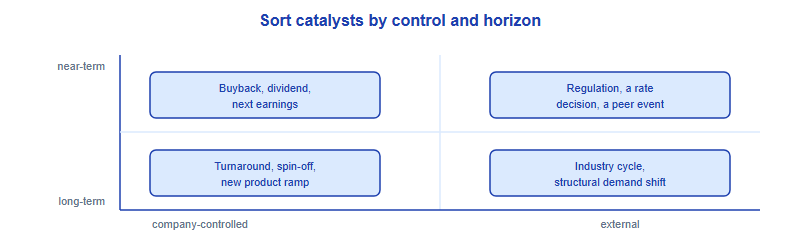
Catalysts come in recognisable families. Some are company-specific and inside management’s control; others are external and simply have to be waited for. Knowing the type helps you judge both how likely it is to fire and how long you might wait.
| Catalyst type | Example trigger | Typical horizon | How reliable |
|---|---|---|---|
| Earnings-driven | Results that beat or miss expectations | Recurring, near-term | Scheduled, but outcome uncertain |
| Product or business | New product, market entry, big contract | Months to years | Depends on execution |
| Management or strategy | New leadership, cost programme, turnaround | Medium term | Hard to time precisely |
| Corporate action | Buyback, dividend change, spin-off, merger | Often defined dates | Clearer once announced |
| External or macro | Rate shift, regulation, industry cycle | Unpredictable | Outside the company’s control |
The most persuasive pitches usually rest on a company-specific catalyst you can research and reason about, rather than a macro event nobody can time. A share buyback with a stated size, a spin-off with a rumoured timeline, or a cost programme with quarterly milestones gives your reader something concrete to track. “Rates might fall next year” is a hope, not a catalyst.
How to find a catalyst
Catalysts are found in the same places a good thesis is built. Company filings and investor presentations often flag upcoming events — a capital-return plan, a restructuring, a product roadmap. Earnings-call transcripts reveal what management is promising and when. Industry news and the company’s own calendar of scheduled events point to dates worth circling. The skill is not spotting that something might happen, but identifying an event concrete enough that you can explain why it should move the price.
A practical test: could you write the catalyst as a single, checkable sentence with a rough date attached? “The company plans to complete a spin-off of its slower division, which should let the market value the faster-growing part on its own multiple” is a catalyst. “Sentiment should improve” is not. If you cannot name the event, you probably do not have one yet.
It also helps to keep a running watchlist of the specific events you are waiting on, with the date or window beside each one and the single figure or announcement that would confirm or kill it. This turns a vague sense that “something should happen” into a short, trackable list, and it forces an honest question every time you add a name: if you cannot fill in the event and roughly when, the idea is not ready to pitch. Reviewing that list as new filings and news arrive is how you notice early that a catalyst is on track — or quietly slipping.
Anatomy of a catalyst-driven pitch
To see how the pieces fit, walk through a hypothetical — the numbers and company here are illustrative only, invented to show the shape of the argument, not a real recommendation. Suppose a mid-sized firm trades below what your analysis says it is worth because the market lumps its fast-growing division in with a struggling legacy business. On its own, that is just a “looks cheap” observation. The catalyst is what turns it into a thesis.
Imagine management has signalled a plan to spin off the legacy division. Now you can build the full argument: the parts are worth more separately than together; a spin-off would let the market value the growth business on its own, higher multiple; and there is a stated intention with a rough timeline you can track. You would then state your evidence (the announcement, the segment financials), your rough horizon, and — crucially — the risk that the spin-off is delayed or cancelled. That single structure, observation plus trigger plus timeline plus risk, is what separates a pitch from a hunch.
- Observation — why the market price understates the business today.
- Trigger — the specific event expected to close the gap.
- Timeline — roughly when, and whether it fits your window.
- Risk — what would stop the trigger, and what you would watch for.
Framed this way, the catalyst does not just support the thesis — it organises it. This is also why judges can follow a catalyst-led pitch so easily: our comparison of the SIC and the Wharton competition notes that a thesis-driven format rewards exactly this kind of structured, event-anchored reasoning over raw trading activity.
Timing the catalyst to the competition
A catalyst that fires the day after judging closes does nothing for your result. This is where timing becomes part of the analysis. Match the horizon of your catalyst to the window you are working within — and because SIC schedules and deadlines change from season to season, confirm the current dates on the official SIC site before you build a plan around them.
Within that window, a useful habit is to hold a mix. A near-term catalyst gives your thesis a chance to play out inside the competition; a longer-term one shows depth and can anchor the “why this is a good business” half of your argument even if it will not resolve in time. What you want to avoid is a pitch whose entire case depends on a single event with an unknown date. If the trigger slips, the whole thesis stalls with it.
Catalyst risk: when the trigger does not fire
Good analysts state the risk to their own catalyst, and doing so makes a pitch stronger, not weaker. Every catalyst can disappoint: earnings can miss, a product can slip, a deal can collapse, a regulator can say no. Name that risk explicitly, and where you can, explain what you would watch for as an early sign the thesis is breaking.
This honesty is exactly what examiners reward. Our breakdown of the SIC rubric shows why a pitch that anticipates its own weak points scores better than one that pretends there are none. A catalyst you have stress-tested reads as conviction; a catalyst you have assumed reads as hope.
Frequently asked questions
Does every SIC pitch really need a catalyst?
Strong ones usually do. A catalyst explains why a mispricing will close, turning a static observation into a thesis with a path and a rough timeline.
What if my catalyst has no fixed date?
Say so honestly and give a range. Pair an open-ended catalyst with a nearer, more defined one so the thesis does not hang on one uncertain event.
Are macro catalysts weaker than company ones?
Usually, because nobody can time them. Company-specific triggers you can research and track tend to make a more defensible pitch.
Should I mention what could stop the catalyst?
Yes. Naming the risk to your own trigger, and what you would watch for, strengthens the pitch rather than weakening it.
Published by the SIC editorial desk, operated by Hanlin Education for China-based international-school students. Official rules are set by the competition and change yearly — confirm current details on the official SIC site. Any error will be corrected within 7 working days.