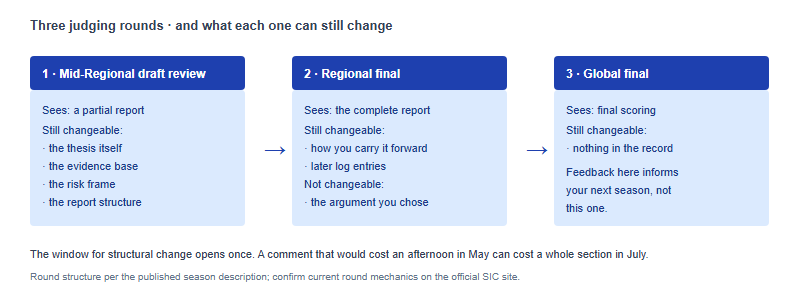
SIC judges across three rounds: a mid-Regional draft review, the Regional final, and the Global final. Only the first sits early enough for feedback to change anything structural. Most Senior teams treat it as a progress check and send their tidiest pages. That wastes it. The draft review is the one moment where being visibly unfinished is worth more than looking polished.
What the draft review is, and what it is not
The Senior Division deliverable is a 15–30 page strategy report, and the published season structure attaches a mid-stage draft review to it during the Regional Stage — the April-to-July window that also carries weekly check-ins and mentor office hours. It sits between entry and the Regional final.
That position determines everything about how to use it. At the mid-point, your thesis is still changeable, your subject is still changeable in principle, and your evidence base is still being built. By the Regional final, the report is what it is. By the Global final, only presentation and defence remain movable. Feedback that arrives at the draft review can rewrite your argument; identical feedback arriving six weeks later can only tell you what you got wrong.
It is also, and this matters, a formative round rather than a ranking exercise. SIC publishes non-ranked recognition tiers — Featured Cohort, Honorable Mention, Season Participant — and states that multiple entries can share a tier in a season. Nobody is being sorted at the mid-point. That should change what you are willing to expose.
What to submit when the report is not finished
The instinct is to send your three strongest pages and hide the rest. Resist it. A reviewer who reads three excellent pages can only tell you those three pages are excellent. What you want back is a diagnosis, and a diagnosis needs symptoms.
A useful draft-review package for a Senior team usually contains five things:
- The thesis in two sentences, written on its own line at the top. The Thesis Clarity axis asks whether a non-expert can understand the bet in two sentences; give the reviewer exactly that and see whether they read it back the way you meant it.
- Your completed sections, whatever they are. Not necessarily the first sections — whichever ones are genuinely done.
- Section headings with one-line summaries for everything not yet written. This is the highest-value part of the package and almost nobody includes it. It lets a reviewer flag a structural problem in a section that does not exist yet, which is enormously cheaper than flagging it after you have written it.
- Your source log, even in rough form. Evidence Quality is judged on primary sources a reader can reach quickly; a reviewer scanning your links can tell you in one minute that half your citations are secondhand summaries.
- A short list of your own open questions. Three is a good number. See the next section.
Sending an incomplete package with the gaps labelled is not a confession of weakness. It is the specific behaviour the Revision Discipline axis exists to reward: you are demonstrating that your work has a trajectory and that you know where it is thin.
The integrity boundary: what a mentor may and may not do
Before you write your questions, understand the line the programme draws. SIC’s published academic-integrity position is explicit: mentors may suggest stronger thesis framing, flag weak sections for you to rewrite yourself, and give written rubric feedback, but they cannot author submission content. Separately, cross-team sharing of drafts or thesis content between registered Senior teams is prohibited.
This is not bureaucratic decoration — it directly shapes which questions are worth asking. A question whose honest answer would be a paragraph of your report is a question the reviewer cannot answer. A question about whether your framing holds, or where a better source might live, is exactly what the channel is for.
| Instead of asking | Ask | Why the second version works |
|---|---|---|
| "Is this a good company to pick?" | "My thesis rests on pricing power surviving the next contract cycle. Is that the load-bearing assumption you would attack first?" | Asks about your reasoning, not for a decision. The reviewer can answer without writing your argument. |
| "Can you check my valuation?" | "I used a multiple-based approach because the cash flows are lumpy. Does that choice need more defending than I gave it in section 4?" | Surfaces a methodological judgement you already made, so feedback lands on your justification rather than your arithmetic. |
| "What risks should I include?" | "My three risks are competitive, regulatory and input-cost. Which of these have I written as a slogan rather than as a falsifiable threshold?" | You supply the content; the reviewer critiques its specificity, which is precisely what Risk Articulation scores. |
| "Is the writing okay?" | "Read only page 1. What do you think I am claiming, and in which direction?" | Turns a vague request into a comprehension test with a right answer you can compare against your intent. |
| "Can you send me a strong report to model?" | "Which primary-source document types would a professional analyst read for this sector that I appear to have missed?" | The first request runs into the cross-team sharing prohibition; the second stays firmly inside "pointing to sources". |
Triaging what comes back
Feedback arrives as a list. Teams typically work down it in order, which means they spend their first evening on whichever comment appeared first rather than whichever comment costs the most to ignore. Sort it instead.
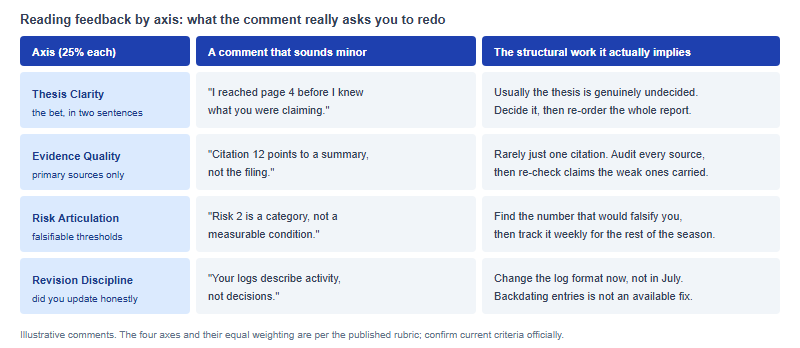
Every comment is either structural — it means some work has to be re-run — or cosmetic, meaning it can be fixed inside an hour without touching your analysis. Structural comments are rarer, less pleasant, and worth roughly ten times as much. The sorting question is simply: if I fix this properly, does any other part of the report have to change? If yes, it is structural. Do those first, in the weeks when you still have room, and leave the cosmetic list for the week before submission when your brain is tired anyway.
Turning the review into scored evidence
Here is the part teams miss entirely. The draft review is not only an input to your report — handled properly, it becomes evidence for the Revision Discipline axis, which is worth a full quarter of the rubric.
Revision Discipline asks whether you updated your analysis when circumstances changed. Receiving a serious critique of your thesis is a change in circumstances. So the week after your feedback arrives, your log entry should record three things explicitly: what the review challenged, what you decided to do about it, and what you decided not to do and why.
That third item carries more weight than it looks. A team that writes "the reviewer questioned our margin assumption; we re-checked three years of segment disclosure, concluded the assumption holds for the reasons below, and did not change it" is demonstrating exactly the judgement the axis tests. Revision discipline is not the same thing as compliance. Changing everything you are told to change, without stating why, reads as an absence of conviction rather than the presence of rigour — which is consistent with the programme’s own statement that advancement turns on the clarity and articulation of the thesis rather than on portfolio growth.
The failure mode on the other side is quieter: teams who accept a critique, silently rewrite the thesis to match, and leave no trace that the original ever existed. That produces a report whose argument and log disagree about when things were decided — a seam a careful reader will find.
Junior entrants: the same mechanism, different shape
The Junior Division is an individual track built on weekly thesis logs and a simulated portfolio rather than a long report, so there is no 15–30 page draft to submit. The equivalent channel is the weekly check-ins and mentor office hours that run through the Regional Stage.
The technique transfers almost unchanged. Bring one written question rather than a general request for guidance. Bring the position you are least confident about rather than your best week. Afterwards, write the outcome into the log the way a Senior team would — challenged, decided, declined, with reasons. A Junior log showing a student change their mind for a stated reason is doing the same work as a Senior team’s revision record.
One structural point is worth noting. A formative mid-season round is not a universal feature of student investment programmes. Programmes built around a fixed trading window — the shape discussed in the side-by-side comparison — do not necessarily include a moment where a judge tells you your argument is unclear while you can still fix it. If your season offers one, using it as a status update rather than a stress test is the expensive choice.
Frequently asked questions
Does the draft review count towards my final score?
It is published as the first of three judging rounds across the season, alongside the Regional final and the Global final. Confirm how it is weighted, and what it feeds into, on the official SIC site.
How complete should my report be when I submit it?
Complete enough to show your thesis and your evidence standard. Label unwritten sections with one-line summaries rather than omitting them.
Can a mentor rewrite a paragraph for me?
No. The published integrity policy allows mentors to suggest framing, flag weak sections and give rubric feedback, but they cannot author submission content.
Can I show my draft to a friend on another Senior team?
No. Cross-team sharing of drafts or thesis content is prohibited; collaboration is limited to registered team members.
Published by the SIC editorial desk, operated by Hanlin Education for China-based international-school students. Official rules are set by the competition and change yearly — confirm current details, round mechanics and integrity requirements on the official SIC site. Any error identified here is corrected within 7 working days.