Many Student Investment Challenge (SIC) participants treat the simulated trading phase as a standalone game of picking winners. They log into the platform, deploy part of their US$100,000 virtual principal, and track the resulting profit and loss. When it comes time to prepare the Senior Division investment strategy report, however, they find themselves staring at a spreadsheet of numbers with no narrative. The core problem is not poor stock selection; it is the absence of a structured SIC trading journal that captures the reasoning behind each decision.
A screenshot of a green P&L column proves you made money. It does not prove you understood why. For Senior Division teams of 2-4 students, evaluation combines online simulated trading with a written investment strategy report, so judges look for the link between your thesis and your actions. If you cannot reconstruct your thought process from a trade six weeks ago, your report will lack depth. This article proposes a competition-relevant journal format designed to turn raw execution data into defensible report evidence.
Why P&L Screenshots Are Weak Evidence
In financial analysis, outcome bias is a significant risk. A student might buy a stock because of a rumour, watch it rise due to unrelated market news, and then claim their thesis was correct. Conversely, a well-researched position might drop because of macroeconomic noise, leading a student to abandon a sound strategy prematurely. Without a contemporaneous record, these distinctions blur. By the time the report deadline arrives, only the number is left, and the number cannot speak.
The SIC Junior Division focuses on individual participation and online simulated trading, emphasising the experience of market volatility. Junior participants do not advance to the Global Stage research track, so their journal is primarily a personal learning tool. Senior Division teams operate differently: their evaluation combines simulated trading with an investment strategy report, and they must demonstrate a coherent logic an outside reader can follow. A robust journal acts as an audit trail for that logic, separating luck from skill and providing the raw material for attribution analysis later in the season.
The same US$100,000 virtual principal is at stake in both divisions. What changes is the demand for evidence. A Junior participant can finish the season with a strong balance and a personal lesson; a Senior team cannot finish the season with a strong balance and nothing to explain it. The journal is what closes that gap.
The Five Fields Every SIC Trade Entry Needs
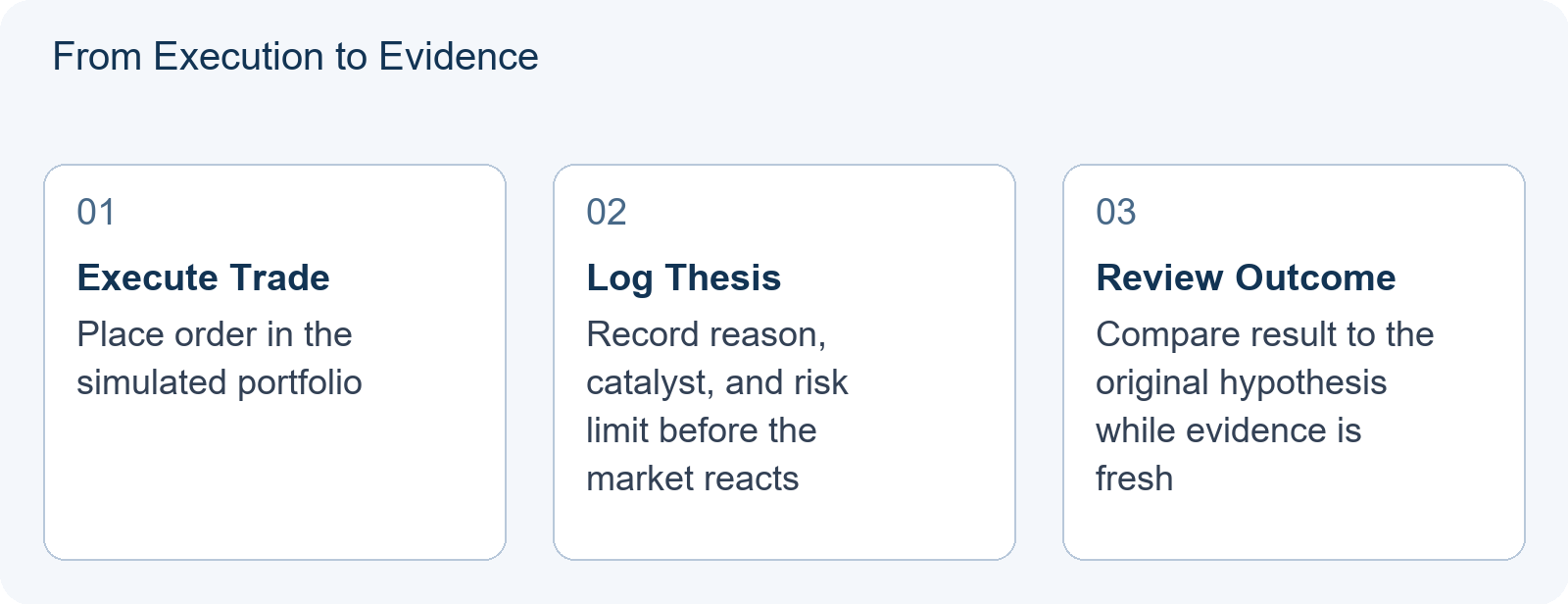
To create useful evidence, a journal entry must be more than a timestamp and a ticker symbol. We recommend five specific fields for every material trade executed during the simulated trading window. These fields force you to articulate your logic before the market reacts, and they map cleanly to the sections of a Senior strategy report.
- Pre-Trade Thesis: A one-sentence summary of why you believe the asset is mispriced relative to peers, history, or an intrinsic valuation anchor.
- Expected Catalyst: The specific event or data point you expect to move the price: earnings, product launches, regulatory rulings, index inclusion, or a scheduled disclosure.
- Position Size and Risk: How much of the portfolio you allocated, plus your stop-loss, trim level, or exit condition. This is where discipline becomes visible on paper.
- Post-Trade Review: Did the thesis hold? Did the catalyst arrive as expected? Note deviations immediately, while the evidence is still fresh.
- Link to Report Section: Which part of the final strategy report will this trade support: valuation methodology, ESG materiality, sector analysis, risk register, or performance attribution.
This structure ensures that every click has a purpose. It transforms passive observation into active research and gives the writer of the report a shortcut back into the team’s original reasoning.
Worked Teaching Illustration: A Simulated Position
Note: The following is a hypothetical teaching illustration built for this article. It is not an actual contest problem, past submission, or official scoring guidance.
Imagine a Senior team analysing a renewable energy company aligned with the S16 theme of AI+ESG Investing. They decide to buy shares after noticing the company’s carbon footprint data is improving faster than its peers’. Their journal entry might look like this.
| Field | Journal Entry Example |
|---|---|
| Pre-Trade Thesis | Company X is undervalued because its ESG score improvement is not yet reflected in its price-to-earnings ratio versus Industry Peer Y. |
| Expected Catalyst | Upcoming quarterly sustainability report showing reduced Scope 3 emissions. |
| Position Size and Risk | Allocated 5% of portfolio (US$5,000). Exit if emissions data misses internal expectations by more than 10%. |
| Post-Trade Review | Report released; emissions fell 8% year on year; share price rose 2% on the day. Thesis partially validated; the peer comparison still holds. |
| Link to Report | Supports the materiality of ESG factors section; illustrates how non-financial metrics can drive valuation. |
This single entry now provides concrete evidence for the report. The team can cite the initial hypothesis, the observed outcome, and the adjustment they made. It shows readers that they were testing a theory, not gambling. The same format works for a losing trade: if the catalyst fails and the exit condition triggers, the journal records the disciplined decision rather than hiding it.
Junior Use: Solo Reflection and Discipline
For Junior Division participants, who compete individually, the primary goal is building financial literacy and emotional resilience. Junior students trade the same virtual principal but do not advance to the Global Stage research track, so they are not drafting a formal report. That does not make journaling irrelevant. It simply changes the audience from a judging panel to the student themselves and, optionally, a mentor.
Junior students should focus on the Post-Trade Review and Risk fields. Did you panic-sell when the market dipped? Did you over-concentrate a position because a story sounded convincing? Did you stick to a plan when a small drawdown tested it? Recording these behavioural responses helps students see their own psychology in writing. Over weeks, patterns appear: hesitation, FOMO, over-trading, or premature profit-taking. Each of those is a real lesson that a P&L column alone will not surface.
Because Junior participation is individual, the journal also becomes a mentorship artefact. A parent or coach reviewing the entries can give targeted advice on position sizing and patience, rather than guessing from a final balance. That is a quieter but real return on the same journaling habit that Senior teams turn into a scored deliverable.
Senior Use: Converting Entries into Report Exhibits
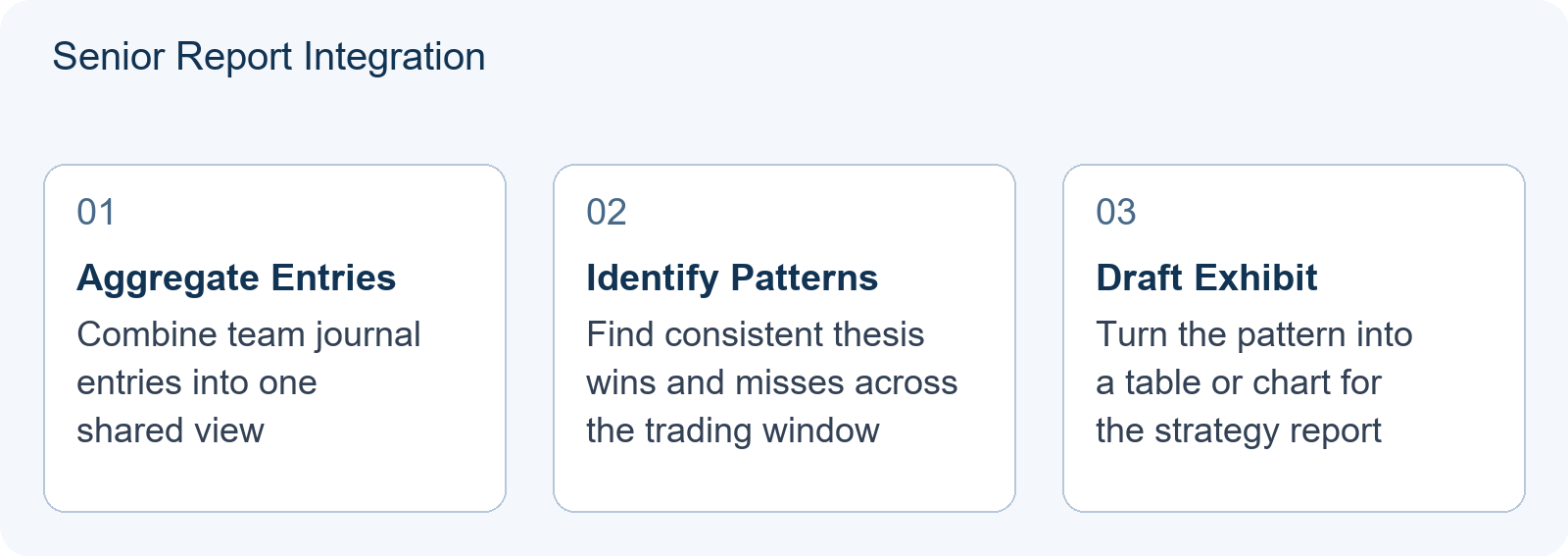
Senior teams have a distinct advantage: they can aggregate their journals. When writing the strategy report, individual entries become exhibits. Instead of saying “we believed in clean energy”, a team can present a table summarising all ESG-related trades, their outcomes, and the common threads in the underlying thesis. Exhibits that carry an argument tend to score better than exhibits that merely decorate one.
This aggregation also supports the kill-criteria discussion. In your report, you can define what would have caused you to abandon a sector, a name, or a theme. By referencing your journal, you show that those exit conditions were set before the pressure arrived, not retrofitted after a loss. That level of detail distinguishes a strong report from a generic one and aligns with the CEE-endorsed academic framing of the competition.
Attribution is the second place the journal pays off. If you want to write honestly about performance, you need to know which trades were thesis bets and which were liquidity or hedging moves. Teams that skip the journal tend to over-attribute gains to signal and losses to noise. Teams that keep one can distinguish the two, which is exactly what a well-structured performance section needs.
Weekly Review Cadence Without Over-Documenting
Students often fear that journaling will consume too much time. The antidote is efficiency. Do not write essays for every trade. Use bullet points. Establish a weekly review where the team meets to update the shared journal, flag divergences from plan, and roll forward the thesis. This aligns with the discipline described in The SIC Weekly Thesis Log: How to Turn Revision Discipline Into a Scored Asset, where revision becomes a scored asset rather than a chore.
During these reviews, ask three questions: Did our thesis change? Did we stick to our risk limits? What did we learn about the company, the sector, or ourselves? If a trade was small and insignificant, summarise it in one line. If a trade was pivotal, expand the entry and connect it to the report section it will support.
For teams thinking ahead to performance writing, it is also worth reading Ten Weeks Is Not an Investment Horizon: Attribution, Noise, and Writing an Honest Performance Section. A short trading window is noisy, and a journal is the only place where the difference between noise and signal can be kept straight. Likewise, teams drafting the loss-case discussion should pair the journal with The SIC Risk Section: What Would Have to Be True for Your Thesis to Lose, which frames exit conditions as a natural extension of the pre-trade thesis.
Template Excerpt: A Teaching Resource
Below is a simplified template excerpt for preparation. This is a suggested tool for organising thoughts, not an official requirement from the SIC organisers.
Date:        [YYYY-MM-DD]
Ticker:      [SYMBOL]
Action:      [Buy / Sell / Hold / Trim]
Thesis:      [One sentence on the value gap]
Catalyst:    [Specific event expected]
Risk Limit:  [Stop-loss %, trim condition, or time stop]
Outcome:     [Price move + reason, in one or two lines]
Report Link: [Which report section this supports]
Teams should adapt this to their workflow. Some prefer spreadsheets; others use Notion, Trello, or a shared document. The medium matters less than the consistency of the fields. Agree on definitions for “Catalyst” and “Risk” before the season starts, so the final report assembly does not stall on interpretation.
Common Pitfalls to Avoid
Three mistakes show up repeatedly once teams start journaling.
First, writing thesis statements that sound deep but are unfalsifiable. “The company has a strong brand” is not a thesis; “the market is under-pricing a forthcoming pricing-power reset” is. If the entry does not give you something concrete to check later, rewrite it.
Second, backfilling entries after the outcome is known. The value of a journal comes from the timestamp. If you only write entries after a move, you are writing history, not evidence. Keep the weekly cadence even in quiet weeks; a bare “no change to thesis” entry still protects the record.
Third, treating the journal as one person’s job. On a Senior team of 2-4 students, the shared journal should have a rotating editor or an explicit owner, but the analysis must come from the analyst who made the call. When the writer of the report later needs to explain the trade, the entry should sound like the person who actually made the decision, not a committee paraphrase.
Questions Students Often Ask
Do I need to journal every single trade? Not necessarily. Focus on trades that represent significant thesis bets, sector shifts, or risk-management decisions. Minor rebalancing can be summarised in a weekly line.
Is this journal required for the Junior Division? It is not a formal submission requirement for Junior participants, but it is a practical way to learn faster and to give a mentor something concrete to react to.
How does this help a Senior report? It provides verifiable evidence of the analytical process: the original thesis, the expected catalyst, the risk limit, and the observed outcome. That evidence is exactly what attribution, kill-criteria, and exhibit-building sections of a strategy report draw on.
Preparing the Evidence Behind the Report
If you are unsure whether your current journal captures enough depth for a Senior strategy report, review your last three entries against the rubric expectations. Look for gaps in causal explanation. Are you describing events, or are you explaining why you expected them to move the price?
Frequently Asked Questions
Do I need to journal every single trade?
Not necessarily. Focus on trades that represent significant thesis bets, sector shifts, or risk-management decisions. Minor rebalancing can be summarised in a weekly line.
Is this journal required for the Junior Division?
It is not a formal submission requirement for Junior participants, but it is a practical way to learn faster and to give a mentor something concrete to react to.
How does this help my Senior report score?
It provides verifiable evidence of your analytical process, letting you demonstrate discipline and logical consistency in attribution, kill criteria, and report exhibits.