The Student Investment Challenge (SIC) S16 season theme is AI+ESG Investing. A supplied 2027 SIC season note published on 17 September 2026 states that the theme encourages students to explore how artificial intelligence can empower environmental, social and governance investment evaluation. The same note states that Senior Division evaluation combines online simulated trading with an investment strategy report. For Senior teams, the theme is therefore not a slogan to mention in the introduction. It is an evidence problem: can you show that AI helped you identify, structure or test ESG information that mattered to an investment decision?
Many teams answer that question poorly. They mention AI, paste a chatbot summary, and assert that ESG is important. That is decorative AI use. This article offers a practical alternative: a method for load-bearing AI use, a clearly labelled teaching illustration of an AI-assisted supply-chain screen, a primary-source verification method, and a way to turn the signal into a falsifiable thesis. It does not claim an official scoring preference or a new rubric rule. The aim is to help you write a report that a skeptical reader can follow and reproduce.
What S16 Actually Asks: AI+ESG as an Evidence Problem
ESG data is messy. Financial statement data arrives in structured tables. ESG information arrives as sustainability reports, news stories, regulatory notices, NGO publications, earnings-call comments, and supplier disclosures. No student team can read every relevant document manually across a broad investment universe. That is where AI and natural language processing (NLP) can be genuinely useful. They can screen large text sets, extract entities, group similar documents, flag sentiment changes, or compare language across filings.
The core question for your Senior report is not ‘Do I like this company’s ESG score?’ It is ‘How did I use AI to find or test a material ESG signal faster, more consistently, or more transparently than manual review alone?’ If your only AI step is retrieving a third-party ESG rating, you have not shown AI empowerment. You have outsourced judgment. A stronger approach is to define a narrow ESG question, use AI to screen for evidence, and then verify the evidence against primary documents.
Useful narrow questions include: Does water scarcity risk affect a specific production region? Are labour disputes appearing more often in a supplier network? Is board turnover concentrated in committees that oversee risk? Has management language on emissions shifted between two annual reports? Each question can be turned into a searchable query, and each answer can be checked in a filing, registry, or official report.
Diagnostic: Is Your AI Use Load-Bearing or Decorative?
Before writing your methodology section, run this diagnostic. Load-bearing AI changes the scale or structure of your research. Decorative AI merely adds technical vocabulary.
| Question | Decorative use | Load-bearing use |
|---|---|---|
| What did AI change? | It rephrased a definition of ESG. | It reduced 500 documents to 12 relevant passages. |
| Can you show the input? | No data source is named. | You name the news database, filing set, or transcript corpus. |
| Can you show the query? | You only remember a general prompt. | You save the prompt, keywords, date range, and filters. |
| How was the output checked? | You trust the model. | You verify flagged items against primary sources. |
If your current workflow fails more than one of these tests, simplify your claim. A clear keyword search with documented dates and sources is more credible than an exaggerated claim about machine learning. For broader integrity context, see Using AI on a SIC Brief: What the Integrity Policy Allows, and Why the Rubric Punishes Shortcuts. The key lesson is that transparency matters more than sophistication.
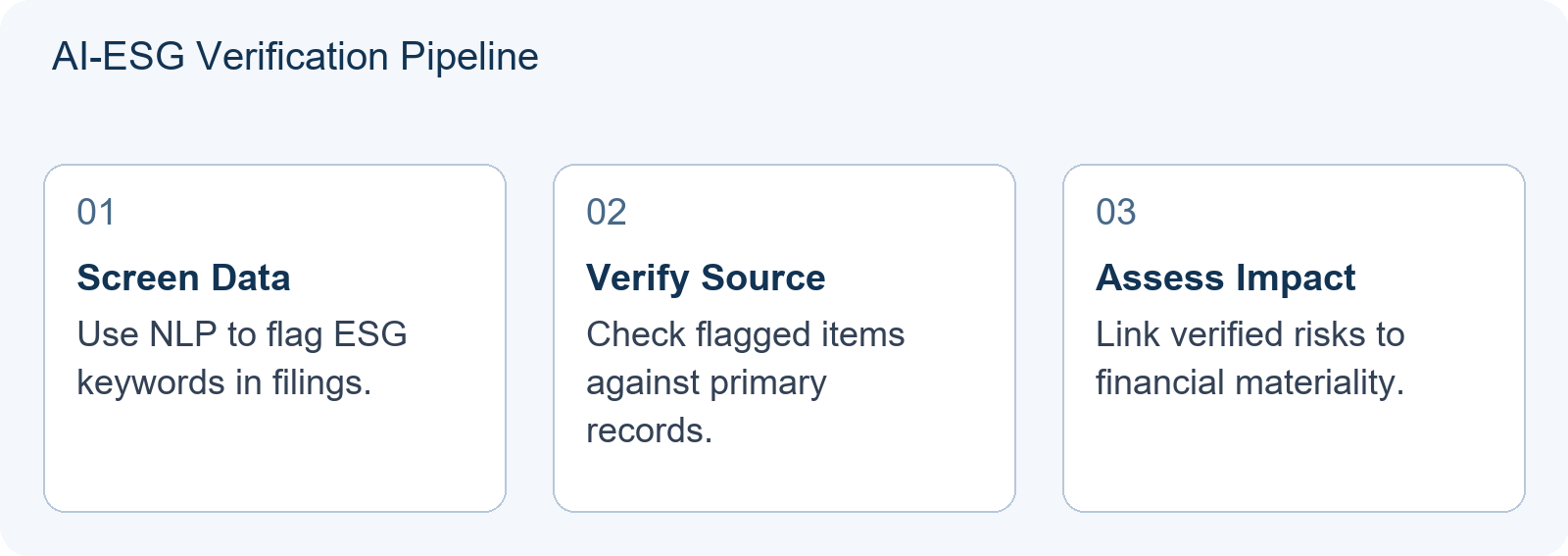
Worked Teaching Illustration: AI-Assisted Screening of Supply-Chain Controversy Risk
Note: This is a hypothetical teaching illustration, not an actual contest problem or official scoring example.
Imagine a Senior team studying a hypothetical consumer electronics company called Northstar Devices. The team asks a specific ESG question: ‘Does a labour controversy at a Tier 2 supplier threaten Northstar’s holiday production and revenue?’ This is narrow enough to screen and important enough to model if verified.
The team uses a Python NLP library such as spaCy or NLTK to process a news archive covering the last 12 months. The query combines the company name with terms including ‘supplier’, ‘labour dispute’, ‘wage arrears’, ‘factory closure’, and ‘safety violation’. The raw search returns 120 headlines. A simple relevance filter reduces that to 12. The AI-assisted triage flags three items for human review.
The first item is about a competitor, so the team discards it. The second is a false positive: the word ‘fine’ referred to ‘fine-tuning’ a production line, not a regulatory fine. The third is a genuine report of a safety violation at a Tier 2 supplier. The team verifies it by checking a local government safety registry, a regional news report, and the company’s published supplier list. The registry confirms the violation and names the supplier. The news report confirms the date. The supplier list confirms that the supplier provides a component used in a product line that generates about 20% of Northstar’s annual revenue.
Now the team tests materiality with simple arithmetic. If Northstar’s annual revenue is $12 billion, a product line representing 20% of revenue equals $2.4 billion. If a one-quarter disruption affects that line, lost revenue is roughly $600 million. At a 35% gross margin, the gross-profit impact is about $210 million. Against a hypothetical $10 billion market capitalisation, that is about 2.1% of market value. The figure is not catastrophic, but it is large enough to model. The team now has a verified signal, not a headline.
The lesson is not that AI found the answer. The lesson is that AI made the search tractable. Humans verified the source and judged materiality.
From AI Output to Primary-Source Verification
AI models can hallucinate, misread context, or amplify a false headline. Any AI-generated signal must be traced back to a primary or authoritative source. In the illustration, the signal was a news item. The verification was a government registry and a supplier list. In other cases, the verification might be a 10-K, an annual report, a court filing, an environmental agency notice, or an NGO database with named methodology.
Your report should include a verification table. Suggested columns are: Query used, AI output summary, Primary source checked, Date checked, Verification result, and Materiality note. This table does two things. It shows how AI contributed, and it shows where human judgment entered. It also lets a reader audit your process without reading your entire prompt history.
Negative results are still results. If your AI screen finds no credible red flags, document the scope of the search and the limits of your query. Did you search the local language? Did you include subsidiaries or supplier names? Did you check NGO reports against company disclosures? An AI screen that finds nothing in a well-publicised controversy usually means the query was too narrow. That is useful feedback for your method.
This discipline connects to a broader principle discussed in ESG in a SIC Thesis: How to Treat Materiality as a Scored Input, Not a Checkbox (2026). Materiality is not a label you attach to a topic. It is a link between an ESG condition and cash flows, risk, or valuation.
Turning the Signal into a Thesis: Catalyst, Materiality, Kill Criteria
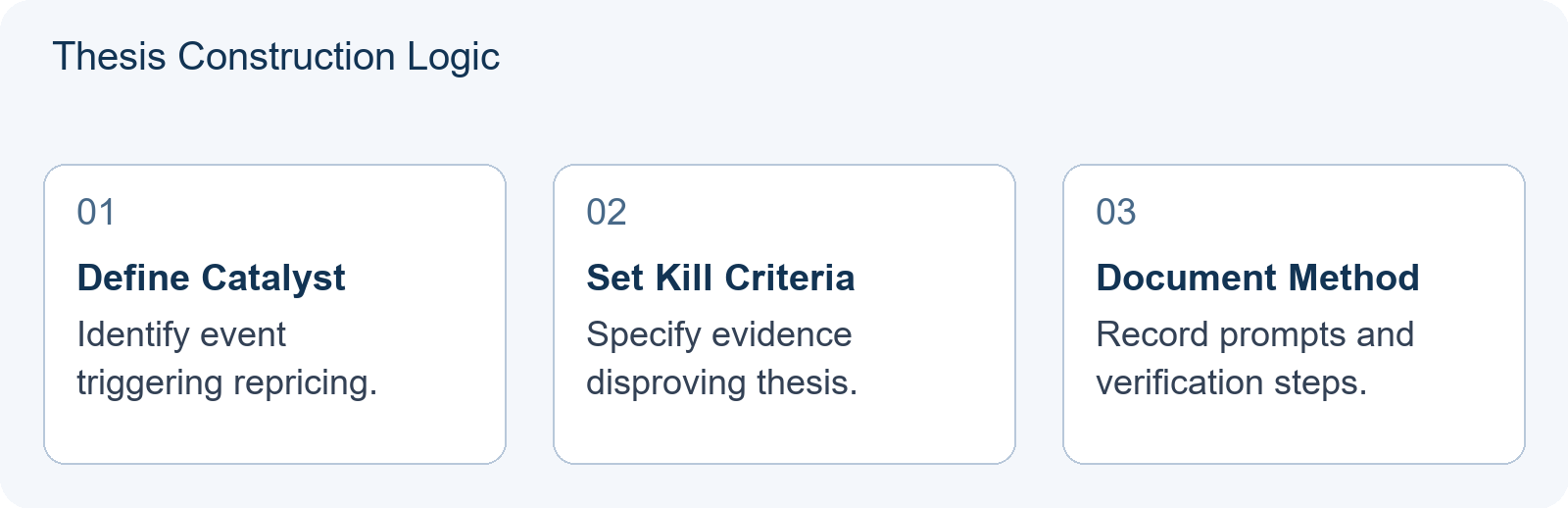
An ESG finding becomes an investment thesis only when it changes expected returns or risk. Use three tests.
Catalyst. What event could cause the market to reprice the stock? In the Northstar illustration, the catalyst might be a regulatory decision on the supplier, a delay in component shipments, or management guidance that holiday production is at risk. Without a catalyst, the signal may remain a known risk that is already priced in.
Materiality. How large is the impact relative to revenue, earnings, or market value? The illustration estimates a $210 million gross-profit impact. If that estimate is reasonable, you must decide whether it is temporary or permanent. A one-quarter disruption is different from a lost customer relationship or a permanent shift to a more expensive supplier.
Kill criteria. What evidence would prove your thesis wrong? For Northstar, kill criteria might include: the supplier resolves the violation within 30 days; Northstar qualifies a second supplier; the affected product line is redesigned to use an alternative component; or the regulatory review closes without a shipment restriction. If any of these occur, your thesis needs revision.
This structure keeps the ESG signal connected to an investment decision. It also prevents confirmation bias. If you cannot state what would change your mind, you are writing a theme, not a thesis. For a fuller method on falsification, see SIC Investment Thesis: Identify the Evidence That Would Change Your Mind.
Common Failure Modes: Greenwashing, AI-Washing, and Unverifiable Prompts
Three failure modes appear often in AI+ESG submissions.
Greenwashing acceptance. Taking corporate sustainability reports at face value. AI can help compare language across years or across documents, but only if you give it specific text to compare. Ask whether reported metrics match external data. Ask whether a target has a deadline, a budget, and a responsible executive.
AI-washing. Claiming advanced machine learning when you used a simple keyword search. Be precise. A regular expression search is valid if you document the pattern and the corpus. Pretending it is a neural network is not. Precision builds credibility.
Unverifiable prompts. Using a tool without saving the prompt, the data source, the date, and the output. If you cannot reproduce the screen, the work appears opaque. Save your prompts and outputs in an appendix. If you used a closed-source model, export or screenshot the relevant results and note the model version and date.
A fourth problem is over-reading a single result. One violation at one supplier rarely justifies a portfolio decision. Look for pattern, scale, and persistence. A single fine may be immaterial. A repeated pattern across several suppliers may point to weak controls.
Pre-Writing Checklist for an AI+ESG Thesis
Before drafting your final report, confirm the following.
- You have defined a specific ESG question, not a general topic.
- You have chosen an AI or NLP method appropriate to the task: keyword extraction, entity recognition, sentiment comparison, or document clustering.
- You have documented the data source, date range, and language coverage.
- You have saved the query, prompt, or code snippet.
- You have verified at least three AI-flagged signals against primary or authoritative sources.
- You have linked each verified signal to financial materiality: revenue, cost, risk premium, or valuation multiple.
- You have stated a catalyst and a kill criterion.
- You have prepared a reproducibility appendix showing the key inputs and outputs.
The S16 registration window closes on 29 November 2026. That makes October and early November a method-building period, not just a writing period. Test your screen, verify a few signals, and revise the query before you lock your report structure.
If you want your AI+ESG thesis question pressure-tested, use the WhatsApp or WeChat QR channels already provided in the site footer and contact page. The goal is not to sound technical. The goal is to make a clear, verifiable investment argument that uses AI where it genuinely helps.
Frequently Asked Questions
Do I need to write my own AI code?
No. You can use existing libraries or platforms, but you must document exactly how you configured them and what data they processed. Transparency is key.
Can I just cite an ESG rating agency?
You can use ratings as a starting point, but the S16 theme emphasizes AI empowerment. Relying solely on third-party scores without independent verification or analysis may be seen as decorative rather than analytical.
What if AI finds no issues?
That is a valid result. Document the scope of your search and the lack of findings. It demonstrates thoroughness. However, ensure your queries were broad enough to catch potential risks.