In the Student Investment Challenge, ESG is not a closing page about values. The official rubric places climate exposure, governance quality and social licence inside Risk Articulation and requires them to be analysed as structural inputs, and the programme has scored ESG analysis explicitly since S13. The practical test is materiality: find the few factors that could move cash flows or the cost of capital, route each into a named valuation input, then size it.
What the official pages actually ask for
Four official pages make the same point in different words. Read them together before you draft a line.
| Official source | What it states | What it means for your draft |
|---|---|---|
| Competition format page, Risk Articulation axis | ESG factors, named as climate exposure, governance quality and social licence, must be analysed as structural inputs, not appended as marketing; ESG treated as a checkbox is listed as losing points | ESG belongs inside your risk and valuation work, not in a separate closing section |
| About page, S13 milestone | The rubric was updated to make ESG factor analysis an explicit, scored input rather than an optional add-on | This is part of what an axis scores, not a bonus paragraph |
| Resources page, research frameworks | ESG materiality analysis means identifying the factors that materially affect long-term cash flows or cost of capital and using them as inputs, not appendices; to be used always for Senior submissions; SASB named as the most common starting point | Senior teams should expect to show materiality work, starting from an industry standard |
| Academic Integrity page, data sourcing | Company-issued sustainability reports are listed among the preferred primary sources; an adapted framework such as an ESG materiality matrix must be cited | Cite the company's own disclosure, and credit any framework you borrow |
One wording note: the Hall of Fame and Mentors pages describe S13 as the season ESG became a scored axis, while the rubric on the format page still lists four equally weighted axes with ESG written into Risk Articulation. Either way, the work is the same. The About page gives two examples that show the intended depth: how climate risk affects a utility's cost of capital, and how governance practices shape execution risk. Both end in something a valuation can use. Neither ends in an adjective.
Junior participants are judged on the same four-axis rubric, but the Resources page says Junior entrants are not expected to author DCF models; the rubric expects thesis-level reasoning, with framework references where appropriate. For a weekly thesis log, the proportionate version is one materiality line when you open a position and a tripwire you check afterwards. Our breakdown of the SIC rubric walks through all four axes.
Filter for materiality before you analyse
A common failure in the drafts our editors read is breadth: a page that lists emissions, diversity, water use, data privacy and board structure for a company where two of those matter and three do not. A list like that is the checkbox the rubric warns against. The fix is to filter hard before writing anything.
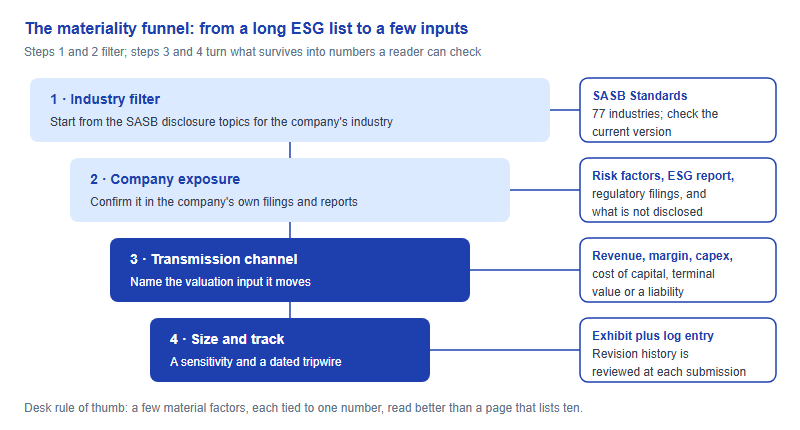
Step one is the industry. The SASB Standards, whose strategic direction now sits with the International Sustainability Standards Board at the IFRS Foundation, include a standard for each of 77 industries. Per the IFRS Foundation, they are designed around the sustainability-related risks and opportunities most likely to affect a company's cash flows, access to finance or cost of capital. That framing sits close to the materiality test on the SIC Resources page, which names SASB as the most common starting point. The Foundation's Materiality Finder lets you look up the disclosure topics for an industry. One caution: in July 2025 the ISSB proposed revisions to a number of SASB Standards, so check that you are reading the current version for your company's industry.
Step two is the company. An industry topic is material to your thesis only if this company is actually exposed. Look for it in the risk factors of the annual report, the sustainability report and any regulatory filings, and note what the company does not disclose. A silence on a topic its industry standard treats as material is itself evidence, and it belongs in your risk section rather than being quietly skipped.
Steps three and four turn what survives into numbers a judge can check.
Five doors into a valuation
A factor is an input only when you can say which part of the valuation it changes. There are five doors. A factor that cannot walk through one of them is context, and context does not earn a paragraph in the risk section.
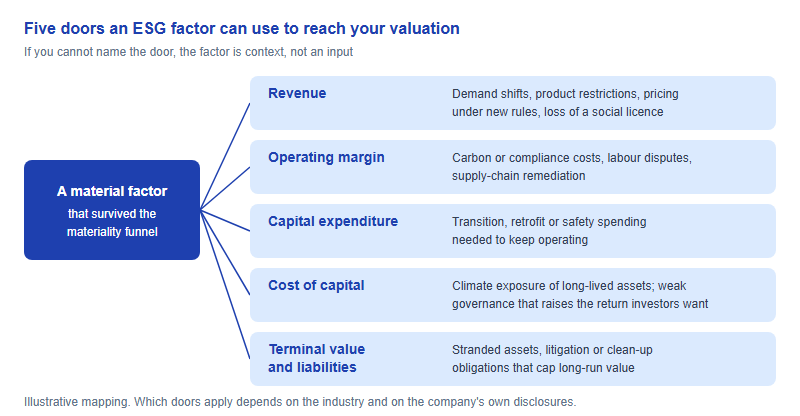
The cost-of-capital door deserves a worked illustration, because it is the About page's own example and it is easy to underestimate. Take a simple perpetuity: a business expected to produce 100 units of free cash flow next year, growing at 2 percent a year and discounted at 7 percent, is worth 100 ÷ (0.07 − 0.02) = 2,000 units. If climate exposure or weak governance persuades you that investors should demand 7.5 percent, the value becomes 100 ÷ 0.055, or about 1,818 units, roughly 9 percent lower after a half-point change. The figures are illustrative, but the lesson holds for any business with long-lived assets, a utility included. Show that sensitivity in an exhibit, and state the evidence behind the higher rate.
The Hall of Fame shows what this looks like at the top of the rubric. Its S14 card for a Senior entry on steel describes a team that treated EU carbon-border policy as a quantifiable cost-of-capital input and built a comparable-company valuation around it. The lead judge's note singled out the evidence: eight primary sources, with every claim traceable to a regulatory document or 10-K passage.
| Pillar | Checkbox version | Structural-input version | Where the evidence lives |
|---|---|---|---|
| Environmental | “The company is committed to reducing emissions.” | “Carbon costs are a named line in our margin forecast; at the carbon price in our bear case, operating margin falls by the amount shown in Exhibit 4.” | Emissions data in the sustainability report; filings on the carbon scheme that applies |
| Social | “The company values its communities.” | “Two of the five largest sites depend on permits due for renewal within three years; we model a delay as deferred revenue and track the renewal filings.” | Risk factors; permit and licensing disclosures |
| Governance | “Management is experienced and the board is strong.” | “The chief executive's bonus pays on revenue growth, not return on capital, which raises the risk of overpaying for acquisitions; we widen the execution-risk case and watch the next deal.” | Pay, board and related-party sections of the proxy statement or annual report |
Governance: the pillar student theses under-use
Governance quality is named in the axis itself, and the About page ties it to execution risk. For most companies a student analyses, it is also the pillar with the best evidence, because it is written down in the company's own documents.
- Incentives. How executive pay is measured tells you what management is paid to maximise. Pay tied to size can reward growth that destroys value.
- Control. Who holds the votes, and whether minority owners can influence the board, sets how much a governance failure can cost an outside shareholder.
- Related-party dealings. Transactions with insiders or affiliated companies are where value can leak before it reaches shareholders.
- Audit signals. A change of auditor, a qualified opinion or a restatement is a governance signal before it is an accounting one.
For a US domestic company, the annual proxy statement carries most of this, including board composition, executive compensation and related-person transactions. A foreign company filing a Form 20-F puts comparable information in its sections on directors and compensation and on major shareholders and related-party transactions. For US-listed Chinese companies, ownership and control deserve extra care, because the security you hold may not be direct equity in the operating business. Weigh that as a governance input with a place in your valuation, not as a footnote.
Ratings, placement and a final check
Treat ESG ratings as opinions, not evidence. The Evidence Quality axis rewards primary sources over second-hand summaries, and a rating is a third party's interpretation, built largely on disclosures you can read yourself. The ratings also disagree: a 2022 study in the Review of Finance by Berg, Kölbel and Rigobon found that correlations between the ESG ratings of six prominent providers ranged from 0.38 to 0.71. If a rating matters to your argument, present it as one outside view and build the analysis on the company's own reports.
In a Senior strategy report, give ESG no page of its own at the end. Put each material factor where it acts: in the risk section, sized and with a threshold, and in the valuation assumptions, with the sensitivity shown in an exhibit. The Resources page reading list also includes a UN PRI handbook, with a pointer to its sections on materiality assessment and engagement. If you are still deciding between divisions, our guide to what the SIC is sets out what each one submits.
In a Junior thesis log, when you open a position, write one line that names the material factor and its door, plus a tripwire. When the tripwire moves, log it like any other revision; the format page notes that revision history is reviewed at each submission.
Before you submit, run five questions over every ESG sentence in the draft:
- Does it name the valuation input it changes?
- Is it sourced to the company's own disclosure or a regulator, not a rating or an article?
- Is at least one factor sized, with a number and a threshold?
- Does anything appear only in a closing paragraph? If so, move it into the analysis or cut it.
- Have you cited any materiality framework or matrix you adapted?
Frequently asked questions
Is ESG a fifth axis in the SIC rubric?
No. The format page lists four equal axes, with ESG written into Risk Articulation as a structural input. Confirm the current rubric wording.
Do Junior participants need an ESG section?
Junior logs use the same rubric but need no DCF models. One materiality line per new position, plus a tripwire, is a proportionate approach.
Can I cite an ESG rating as evidence?
Use it as an outside opinion only. Ratings from major providers diverge, so build the case on company filings and sustainability reports.
Where should I start if I have never done ESG analysis?
Look up the SASB disclosure topics for the industry, then confirm exposure in the risk factors and sustainability report of the company.
Published by the SIC editorial desk, operated by Hanlin Education for China-based international-school students. Official rules are set by the competition and change from year to year — confirm current details on the official SIC site. Errors are corrected within 7 working days.