You can write your SIC submissions in either language. The About page states that submissions can be made in English or simplified Chinese and that the judging rubric is identical in both, so the choice is strategic, not a hurdle. Settle it with three questions: where the work will be read after the season, which language holds most of your primary sources, and in which language every author can write exact, checkable sentences under deadline.
What the official pages say, and what they leave open
Language questions attract confident guesses, so start from what is published. Several official pages cover it, and a few practical points are left for the intake conversation. If you are new to the programme, our guide to what the SIC is explains both divisions first.
| Topic | What the official pages state | What to confirm at intake |
|---|---|---|
| Submission language | Submissions can be made in English or simplified Chinese (About page) | Whether one language must run across every deliverable in your season |
| Judging | The judging rubric is identical in both languages (About page) | Nothing further is published on how judging is organised by language; ask if it matters to you |
| Mentor support | Office hours and submission feedback are available in English and simplified Chinese throughout the season (Mentors page); the Omaha Summit is bilingual (About page) | How to request feedback in the language you prefer |
| Notices and paperwork | Most international communications happen in English; school and parent paperwork is bilingual (About page) | Nothing further; expect programme notices in English |
| Translation tools | Translation between English and Chinese is a permitted AI use, with a one-paragraph AI-use disclosure required in each submission (Academic Integrity page) | Nothing further; the disclosure applies to every submission |
| Senior defense | Senior teams add an end-of-stage 20-minute video defense or written addendum (Competition format page) | Whether the defense or addendum must match the language of the report |
Two things follow. The language decision does not change what is scored, so never choose on the theory that one language is marked more generously; nothing published supports that. And several practical questions are not answered on the public pages, so settle them at intake rather than discovering them in the middle of the Regional Stage. Do not infer the answers from how another programme handles language.
Three questions that decide it
Work through the three questions in the diagram, and be honest about the third.
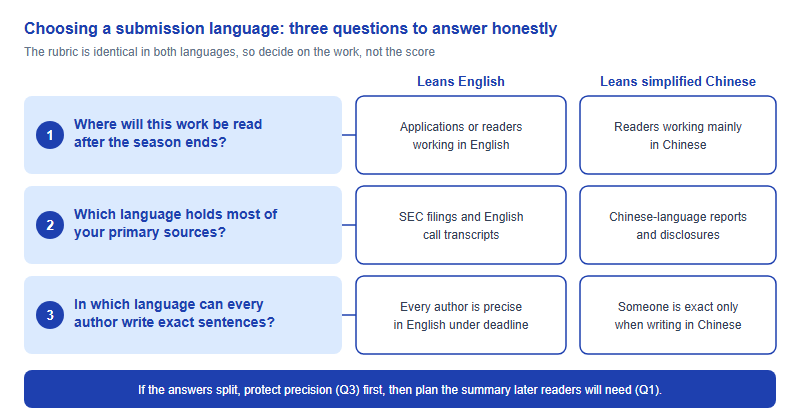
Where will the work be read after the season? Many students in our readership intend to reference SIC work in university applications read in English. The Hall of Fame FAQ lists three ways past participants have done so: linking to a published entry, attaching the submission as supplementary material, or referencing it in an essay, and the program desk can write a verification letter on request. An admissions reader cross-checks the activity line, the essay and anything attached against one another. If your original is in Chinese, the English summary becomes the thing being checked, so it must say exactly what the original says. That is manageable, but it adds a layer of work and a place for a claim to drift.
Which language holds most of your primary sources? SEC filings and most US earnings-call transcripts are in English. For a company listed in mainland China or Hong Kong, check which language version of its reports is fullest before you decide. Each translated quotation must still be cited to the original document and each translated figure re-checked, so a thesis built mainly on sources in one language is cheaper to write in that language.
In which language can every author write exact sentences? The Thesis Clarity axis asks whether a non-expert can understand your thesis in two sentences, and the format page is blunt that vague theses score low even when the position works. The integrity page also reserves the right to ask a participant or team to walk through their reasoning in a brief video or written follow-up, so submit in a language every author can explain without a script. Our breakdown of the SIC rubric covers what each axis rewards.
If the answers split, protect precision first. A clear report in simplified Chinese, backed by a faithful English summary, serves you better than an English report whose central claim is hedged because its author could not state it exactly.
The honest case for each language
| Factor | Leans English | Leans simplified Chinese | Our desk's note |
|---|---|---|---|
| Sources | Mostly SEC filings and English transcripts | Mostly Chinese-language reports and disclosures | Translation takes real time and earns no marks of its own |
| Later readers | Applications or readers working in English | Readers working mainly in Chinese | Plan the summary you will need before the season ends |
| Team | Members at different schools or in different countries, which the format page allows | Every member writes most precisely in Chinese | Choose the language your least confident writer can still be exact in |
| Weekly hours | Every author drafts at speed in English | Drafting in English slows at least one author badly | The format page gives about 3 to 5 hours a week for Junior and 5 to 8 per member for Senior during the Regional Stage |
| Terminology | Terms match the filings word for word | You are ready to keep a fixed glossary | Two renderings of one term in a single report read as carelessness |
| Senior defense | A member can speak clearly for twenty minutes in English | Spoken English is the team's weak point | The written addendum is the other route; confirm the language rule for either at intake |
In the drafts our editors read from China-based students, the costly mistake is rarely picking the wrong language. It is picking late, or switching midway. The format page says revision history is reviewed at each submission, and a thesis log that starts in one language and continues in another is harder for any reader to compare entry by entry, which works against the Revision Discipline axis you are trying to earn. The same page locks track choice when the Application stage closes. Whatever the rule on language turns out to be, treat your choice as locked from the first week of the Regional Stage, and write it into your team's working agreement.
Three layers of language in one season
Most of the confusion goes away once you separate three layers. Only one of them is submitted.
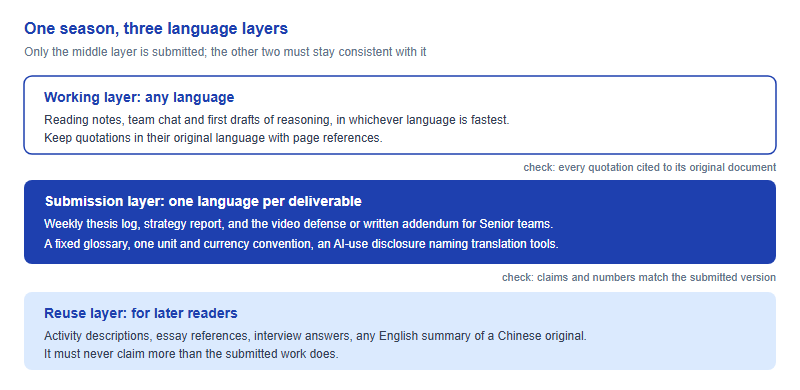
- Working layer. Notes, team chat and early reasoning can be in any language. Keep quotations in their original language with page references, so you cite the source and not your own translation of it.
- Submission layer. One language per deliverable, a fixed glossary for recurring terms, one convention for units and currencies, and an AI-use disclosure that names any translation tool.
- Reuse layer. Activity descriptions, essay references, interview answers and any English summary of a Chinese original. This layer must never claim more than the submission does.
Numbers deserve their own check. Chinese groups large numbers in ten-thousands (wan) and hundred-millions (yi), so unit conversion is a common source of error in translated figures: 3.5 yi is 350 million, not 3.5 billion or 35 million. Currency is the second trap, because a US-listed Chinese company may report in renminbi while its shares trade in US dollars. Put the unit and currency beside every figure in the submitted version, and re-check any number that passed through translation.
Translation without integrity trouble
Translation between English and Chinese is on the integrity policy's list of permitted AI uses, provided it is disclosed. The same page draws three lines that matter more for bilingual writers than for anyone else.
- The thesis must be yours. A tool may translate your reasoning; it may not author it. The policy does not permit asking an AI to write the investment thesis or strategy report.
- Every claim must be verified. Using AI-generated analysis without independently verifying each factual claim and source is not permitted, and a translated sentence is only as reliable as your check of it.
- Someone else's analysis stays theirs. The policy defines plagiarism as presenting another person's words, analysis or work as your own without acknowledgement, and says lightly reworded text without citation still counts. In our reading, translating an analyst's argument and presenting it uncited is the same act in another language.
The disclosure goes at the end of each submission as one paragraph naming the tools used, the purpose and how the output was verified. Name any AI translation or grammar tool explicitly; the policy says submissions without a disclosure are returned for completion.
Before intake, write down your answers to the three questions and take these four to the program desk:
- Must every deliverable in the season use the same language?
- May a Senior team give its video defense or written addendum in a different language from its report?
- How should quotations from sources in the other language be presented?
- Can mentor feedback be requested in a different language from the submission?
Frequently asked questions
Can I write my SIC report in simplified Chinese?
Yes. The About page says submissions can be made in English or simplified Chinese, and that the judging rubric is identical in both.
Is a Chinese-language submission judged more strictly?
The About page states the judging rubric is identical in both languages, and nothing published suggests a different standard for either.
Can mentors give feedback in Chinese?
The Mentors page says office hours and submission feedback are available in English and simplified Chinese throughout the season.
Do I need to disclose using a translation tool?
Yes. Translation is a permitted AI use, but each submission needs a one-paragraph disclosure naming the tools, their purpose and your checks.
Published by the SIC editorial desk, operated by Hanlin Education for China-based international-school students. Official rules are set by the competition and change from year to year — confirm current details on the official SIC site. Errors are corrected within 7 working days.