SIC S16 registration is open from 11 September through 29 November 2026. Before you submit an entry, three decisions will shape your entire season: which division matches your goals, whether the October-to-May stage calendar clears your school exam windows, and whether your team can genuinely engage the AI+ESG Investing theme. This article walks through each decision using the current season briefing.
What the S16 Season Briefing Confirms
According to the Hanlin/organizer briefing, the S16 season follows a three-stage arc. Registration opened on 11 September 2026 and closes on 29 November 2026. The Primary Stage runs online from October through December 2026. The Global Stage follows from December 2026 into February 2027, conducted either online or in person. The season culminates with the Omaha Dialogue Summit, an in-person event in Omaha, United States, scheduled for May 2027.
The briefing describes SIC as suitable for students in grades 6 through 12 and notes that the competition carries certification from the Council for Economic Education (CEE). Participants receive a virtual portfolio of US$100,000 to trade across US and Hong Kong equity markets during the simulated trading phases. The S16 theme is explicitly framed as AI+ESG Investing, asking participants to explore how artificial intelligence can strengthen environmental, social, and governance analysis.
None of these details should be treated as final until the official SIC registration page reflects them. Treat the briefing as a planning reference, not a substitute for the rulebook.
Decision 1 — Junior or Senior: The Advancement Question
The single most consequential choice at registration is the division. The briefing draws a sharp structural line between the two tracks.
The Junior Division is an individual entry. Participants engage in online simulated trading and are assessed on that trading performance alone. The briefing states explicitly that the Junior Division does not advance to the Global Stage. Its stated purpose is experiential: to give a first-time participant hands-on exposure to equity markets, position sizing, and the emotional rhythm of a live portfolio. If a student’s goal is to learn how markets work without the pressure of a multi-month research report, Junior is the designed pathway.
The Senior Division requires a team of two to four students. Assessment combines simulated trading with a written investment strategy report. Crucially, the briefing confirms that Senior teams can advance to the Global Stage and, from there, to the Omaha Dialogue Summit. Teams may be assembled across schools, grade levels, and regions.
The decision is not simply “easier versus harder.” A Junior entrant who later wishes to compete at Global would need to register for the Senior Division in a season that permits it; the current briefing does not publish re-entry rules for future seasons. A student who registers Senior without a confirmed team of at least two risks an incomplete entry. Before 29 November, resolve this: do you want a self-contained trading experience, or are you prepared for the collaborative research workload that unlocks advancement?
For students considering the individual route, our guide on managing a solo simulated-trading portfolio through the Junior Division covers the practical workflow. For those assembling a Senior team, the eligibility and enrolment guide covers grade bands, school-affiliation rules, and the paperwork your organising channel or school may require before a team can be finalised.
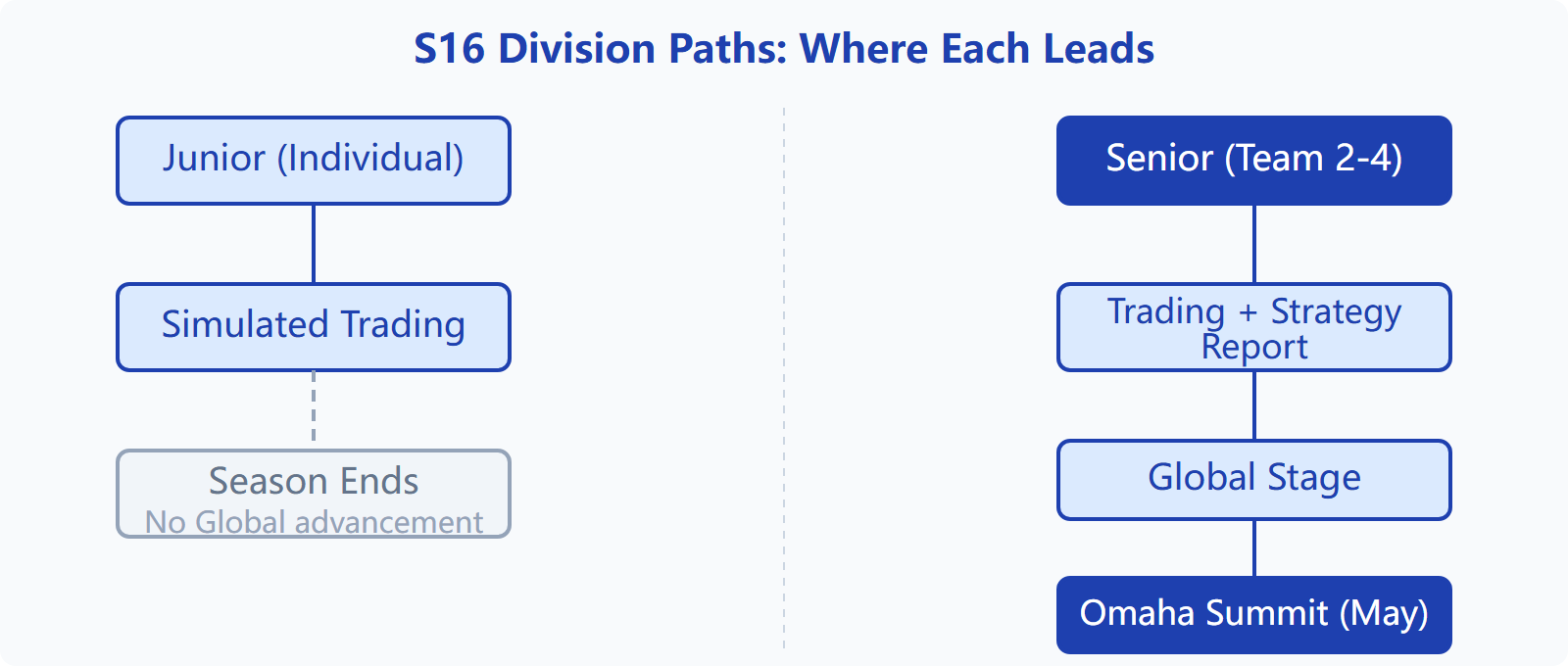
Junior ends after the Primary Stage; Senior can advance through Global to Omaha. Source: Hanlin/organizer S16 briefing.
Decision 2 — Calendar Fit: Mapping S16 Against School Commitments
The S16 calendar stretches across eight months. Registration itself closes in late November, but the working period begins in October and the final event lands in May. If you register without checking the calendar against internal exams, IB mock sessions, AP testing, or A-Level preparation, you may encounter scheduling conflicts midway through the Primary Stage.
The table below maps each S16 phase to the typical academic pressures that overlap it. The stage dates come from the Hanlin/organizer briefing; the exam windows are general patterns and will vary by school.
| S16 Phase | Briefing Dates | Format | Typical School Overlap | Planning Check |
|---|---|---|---|---|
| Registration window | 11 Sep – 29 Nov 2026 | Online | Autumn term; midterms in some systems | Confirm team, any required paperwork, and grade suitability before deadline |
| Primary Stage | Oct – Dec 2026 | Online | End-of-term exams; IB internal assessments; AP unit tests | Check weekly availability against the December exam block |
| Global Stage | Dec 2026 – Feb 2027 | Online or in-person | Winter break; IB mocks; A-Level mocks | Confirm availability across the full window, not just one week |
| Omaha Dialogue Summit | May 2027 | In-person, Omaha, US | AP exams; IB final exams; A-Level exams | Requires travel; check visa lead time and exam clash |
A key planning risk falls in December. The Primary Stage is still active while many schools hold end-of-term examinations, and the Global Stage window opens in the same month. A student who registers in November without checking the December schedule may face a compressed trading period or miss the transition into Global entirely. Our article on fitting five to eight hours a week around IB, AP, and A-Level exam season offers a practical hour-budgeting framework for this exact overlap.
For students also considering the Wharton Global Youth Investment Competition in the same academic year, the sequencing guide for running both competitions addresses how to avoid workload collisions between the two calendars.
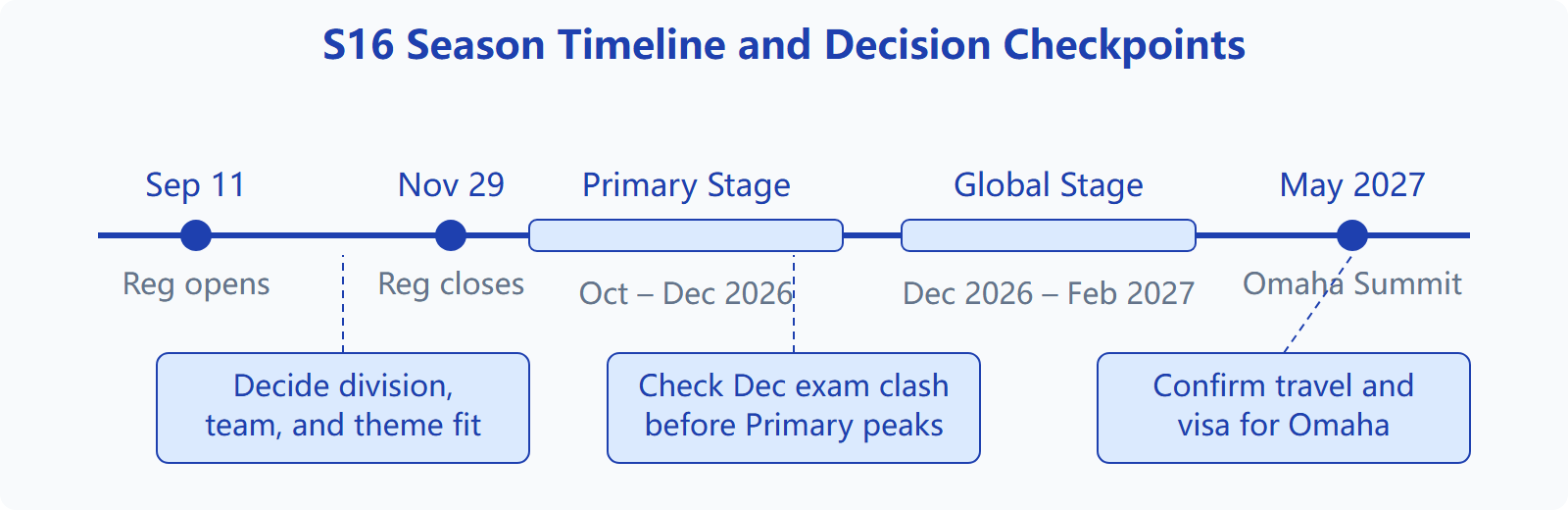
S16 runs September 2026 through May 2027. Three decision checkpoints are marked. Dates per Hanlin/organizer briefing; public confirmation pending.
Decision 3 — AI+ESG Theme Readiness
The S16 theme, AI+ESG Investing, is not a decorative label. The briefing frames it as the season’s analytical spine: participants are encouraged to explore how artificial-intelligence tools can enhance the evaluation of environmental, social, and governance factors in investment decisions. The briefing traces the ESG concept to the 2004 UN Global Compact initiative and positions AI as an accelerating force for data analysis, risk assessment, and investment decision-making within that framework.
For a Senior team, this theme has practical implications before registration closes. A team that registers in November and only begins discussing its thesis in January has lost two months of the Primary Stage. Before committing, a prospective Senior team should honestly assess three capabilities:
- Data literacy. Can at least one team member navigate ESG data sets, sustainability reports, or AI-driven screening tools at a functional level? The briefing does not state that participants must build a machine-learning model. As a preparation choice, teams may find it useful to explore how AI tools inform ESG scoring rather than treating ESG as a static checklist—but this is a suggested approach to engaging the theme, not a stated requirement.
- Thesis scope discipline. “AI+ESG” spans a vast landscape. A team that tries to cover all three ESG pillars across an entire sector will produce a shallow report. Narrowing to one materiality question—how AI improves carbon-disclosure accuracy in the energy sector, for instance—gives the strategy report a defensible focus. Our article on treating ESG materiality as a scored input rather than a checkbox addresses this scoping problem directly.
- Writing and analysis balance. The Senior Division is assessed on both simulated trading and a written strategy report. A team heavy on quantitative skill but weak on structured financial writing will struggle in the report component. Confirm that the team includes at least one member comfortable drafting and revising multi-page analytical prose.
Junior participants are not required to produce a strategy report, so the theme affects them less directly. However, a Junior entrant who wants to return as a Senior in S17 will benefit from using the S16 season to observe how AI+ESG narratives play out in real market data.
Pre-Registration Checklist
Before the 29 November deadline, work through the following items. Each is grounded in the briefing or in structural requirements of the competition format.
- Grade suitability. The briefing describes SIC as suitable for grades 6–12. Cross-grade teams are permitted in the Senior Division. Confirm with your organising channel whether any additional eligibility criteria apply to your specific team members.
- Consent and school paperwork. Check with your organising channel and school whether parental or guardian consent forms, faculty-sponsor sign-off, or other documentation is needed before your entry can be finalised. Requirements vary by school and region, so start this inquiry early; institutional processes can take longer than expected. The eligibility and enrolment guide offers further detail.
- Team composition (Senior only). Confirm two to four members. The briefing allows cross-school, cross-grade, and cross-region teams, but logistics matter: time-zone differences and conflicting school calendars become real problems during the Global Stage. Agree on a communication rhythm before registering, not after.
- Division confirmation. Junior is individual and ends at the Primary Stage. Senior is team-based and can advance. There is no mid-season division switch described in the briefing. Choose deliberately.
- Official channel verification. Because the details in this article are drawn from a Hanlin/organizer briefing and public confirmation is still pending, verify the registration URL, exact closing time on 29 November, and any updated rule changes through the official SIC registration channel before submitting.
Frequently Asked Questions
Can a Junior Division participant advance to the Global Stage in S16?
No. According to the Hanlin/organizer briefing for S16, the Junior Division does not advance to the Global Stage. Junior is an individual, simulated-trading-only track designed for experiential learning. Only Senior Division teams can progress to Global and, subsequently, the Omaha Dialogue Summit.
What is the S16 registration deadline, and when does the Primary Stage begin?
The briefing sets the registration window from 11 September to 29 November 2026. The Primary Stage is scheduled to run from October through December 2026, meaning trading activity begins before registration closes. Public confirmation of these dates on the official channel is pending.
Can a Senior Division team include students from different schools or grade levels?
Yes. The briefing states that Senior teams of two to four students may be formed across schools, grade levels, and regions. The briefing describes SIC as suitable for grades 6–12; confirm any additional eligibility details with the organising channel.
Editorial note: This article is published by the SIC site editorial team as a planning resource for prospective S16 participants. Season dates, division structures, and theme details are sourced from a Hanlin/organizer briefing dated 17 September 2026; public confirmation on the official registration channel is pending. Readers should verify all procedural details through the official SIC portal before registering. This article does not constitute investment advice, and participation in SIC does not guarantee any admissions outcome.