The SIC Hall of Fame is the organiser's archive of past Featured Cohort entries, published only with each participant's permission, and it is the closest thing this competition has to a set of worked examples. Read it for the move a judge credited, not for the topic or the wording. That is what transfers to your own entry, and it keeps you clear of an integrity policy that counts presenting another participant's work as your own as plagiarism.
What the archive is, and what it leaves out
Per the official Hall of Fame page, Featured Cohort is the top recognition tier at the end of each Global Stage, described as an academic publication decision rather than a prize, ranking or trophy. It carries no cash: the page lists publication with permission, a personalised judge scorecard and a season certificate. The stated test, unchanged since S07, has two parts. An entry must score in the top tier on at least three of the four rubric axes, and the lead judge must agree it would benefit future participants as a reference. No quota applies; some seasons feature 12 entries and others 4.
Note one wording difference. The competition format page summarises the same tier as sustained excellence across all four axes, so aim at the stricter reading and confirm the current criterion with the program desk. For a reader of the archive, the second condition matters most: every Featured entry had to satisfy a lead judge that it would help future participants. If you are comparing programmes, our side-by-side of SIC and Wharton sets out how their formats and recognition differ.
Not every Featured entry reaches the open web. After the Global Stage closes, the program desk asks each Featured participant to archive the entry publicly, internally only, or not at all. With no reply, the default is internal only, and published names default to initials.
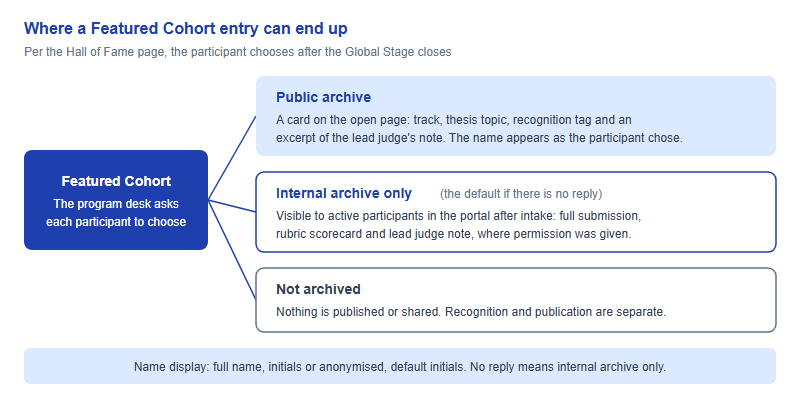
| Layer | Who can see it | What it contains | How to use it |
|---|---|---|---|
| Public Hall of Fame page | Anyone | A card per entry (track, thesis topic, judge-note excerpt, recognition tag) and a few short excerpts | Find the move each judge credited |
| Participant portal | Active participants, after intake | Full submissions, rubric scorecards and lead judge notes, where permitted | See how a move runs through a whole entry |
| Not archived | Nobody | Nothing published | Remember a missing entry may still have been Featured |
Two consequences follow. The public page is a curated subset, so do not count cards to judge how selective a season was: the S14 summary line mentions nine Featured entries, yet four S14 cards are shown. And the page says the S15 publication round runs through September, with each Featured participant contacted before anything appears. If S15 cards are not up yet, that is the process working.
Read for the move, not the topic
A card is short, which is useful: it forces you to find the one thing the judge credited. A move is a behaviour a reader can see on the page, such as dated revisions, a documented decision not to trade or a stated role for every holding. It is never the company, the sector or the conclusion.
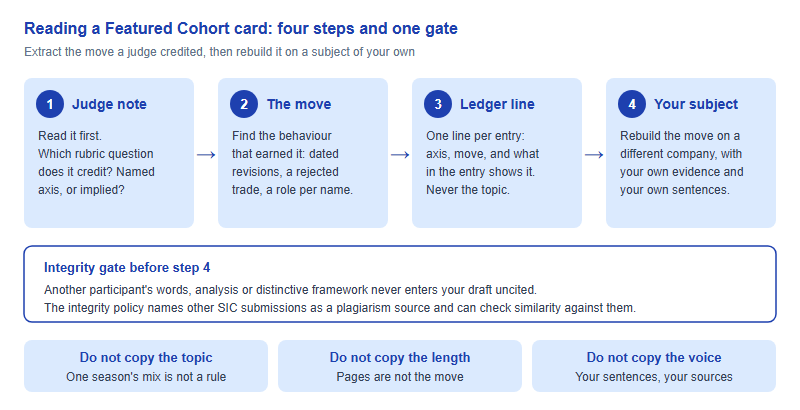
Read the lead judge's note before forming your own view, because it usually names an axis or restates one of the four rubric questions. Then ask what the participant did that a weaker entry would not have. If your answer is a company name, you have found the topic, not the move. Write one ledger line per entry, then rebuild the move on your own subject. Here is the method applied to the cards currently shown for S12 to S14:
| Season, division and area | What the card and judge note credit | The transferable move |
|---|---|---|
| S14 · Senior · Macro and rates | Axis 04: every Regional Stage revision dated, sourced and open about disconfirming evidence | Date and source every change of view, and say what forced it |
| S14 · Junior · Consumer discretionary | Weekly entries tested the thesis against the next week's data rather than its price; three rejected position changes documented | Log the trades you chose not to make, with the evidence that stopped you |
| S14 · Senior · ESG and industrials | Axis 02: eight primary sources, each claim traceable to a regulatory document or 10-K passage; a policy quantified as a cost-of-capital input | Turn a qualitative factor into a number a reader can follow |
| S14 · Junior · Healthcare | Sixteen positions, each with a stated role; diversification justified, not assumed | Give every holding a job and defend it on its own terms |
| S13 · Senior · Technology and AI | Axes 01 and 02 top tier: a two-sentence thesis, 22 pages that never wandered, and DCF, comparable-company and scenario analysis triangulated | Keep every page serving the two-sentence claim; cross-check one framework with another |
| S13 · Junior · Financials | Axis 04: a Grade 10 participant revised position sizes on disclosed reasoning, not price action, through regional banking turmoil | Change a size only with a written reason, especially when prices move fastest |
| S12 · Senior · Energy | A contrarian thesis argued and defended, with the strongest counter-arguments acknowledged in writing | Write the best case against yourself before a judge has to |
| S12 · Junior · Cross-sector | A deliberate five-name concentration made to work by rigour about what would falsify it, with quantified scenarios | If you concentrate, make it an explicit choice and quantify the downside |
Three ways past winners mislead a careful reader
The topic trap. The page calls S14 the most macro-heavy season in the programme's history, with six of nine Featured entries built on rate-cycle theses. That is easy to misread as a scoring preference. Nothing on the page says so, only one of the four S14 cards shown is a macro entry, and the archive spans consumer, healthcare, financials, energy and technology. A topic mix records what one cohort chose in one market. Pick your subject where your evidence is strongest; our guide to what the SIC is explains how the two divisions shape that choice.
The length trap. The two Senior reports whose length is given run to 28 and 22 pages, inside the typical 15 to 30 page range the format page states. Length is not what the notes praise. The S13 note credits 22 pages that never wandered, a discipline of cutting rather than adding.
The excerpt trap. A card is a curated extract. You cannot reverse-engineer an axis score from a few lines, and trying teaches you to imitate surfaces. Use the card to find the move, then check how it runs through a complete entry once you have portal access.
Where learning ends and copying begins
The Academic Integrity page is explicit. Presenting another person's words, analysis or work as your own without acknowledgement is plagiarism, and another SIC participant's submission is named as one such source. Lightly reworded text without citation still counts, a published framework must be named with its source, and verification methods include text-similarity checks against prior SIC submissions. The stated consequence is disqualification from the current season.
| What you take from a Featured entry | Where it sits | Why |
|---|---|---|
| The habit of dating and sourcing every revision | Learning | A discipline the rubric asks of everyone; nobody owns it |
| Labelling each holding with a role | Learning, with your own categories | The roles must come from your own holdings |
| The specific way an entry turned a policy into a valuation number | Credit it if it shapes your work | A distinctive construction is someone's analysis, and adapted frameworks must be cited |
| Rewording an entry's argument about the same company | Plagiarism risk | Lightly reworded text without citation is still plagiarism |
| Reusing your own entry from a previous season | Needs disclosure and approval | Otherwise the policy counts it as plagiarism |
The rule our editors use is short: a habit is free, an argument is not. Borrowing the particular way an entry quantified a policy is borrowing its analysis, so credit it if it shapes yours. Better still, build a method that fits your own subject, because a move rebuilt from first principles is one you can explain if the judging desk asks you to walk through your reasoning, which the integrity page reserves the right to do.
A three-entry protocol for the off-season
The Hall of Fame page opens with advice worth taking literally: read three Featured Cohort entries before you write your first thesis log. Choose them deliberately:
- One in your own division, so the format matches what you will submit.
- One from a sector you know nothing about, so the topic cannot distract you from the move.
- One whose judge note names your weakest axis, using the four questions set out in our breakdown of the SIC rubric.
Score each card against the four rubric questions before reading the judge's note, then compare. The Mentors page describes a past Omaha Dialogue session built on the same idea, a rubric workshop in which participants scored anonymised past submissions alongside the judging desk. Alone it is less precise, but it trains the same judgement, and your ledger lines become the checklist you run against your own draft.
If you are an S15 Featured participant choosing archive settings this month, the choice also shapes how the work can be checked later. The page describes Featured entries as one verifiable element of a broader application, and its FAQ lists three ways past participants cited them: linking to the published entry, attaching the submission as supplementary material, or referencing the work in an essay. The program desk can also write a verification letter on request. An admissions reader cross-checks an activity line or essay against the transcript and the rest of the file, so a public entry or a letter gives that reader something concrete to corroborate. The same page states that the organiser claims no credit for any participant's admissions outcome.
Frequently asked questions
Can anyone read the SIC Hall of Fame?
The public page shows cards and short excerpts. Full submissions, scorecards and judge notes sit in the participant portal, where permitted.
Does Featured Cohort recognition come with a prize?
No. Per the Hall of Fame page it brings publication with permission, a personalised judge scorecard and a season certificate.
Is it plagiarism to follow the structure of a Featured entry?
Adopting a research habit is learning. Presenting the words, analysis or distinctive framework of another entry as your own, uncited, is plagiarism.
When will S15 Featured Cohort entries appear?
The page says the publication round runs through September, after each Featured participant chooses how their work is archived.
Published by the SIC editorial desk, operated by Hanlin Education for China-based international-school students. Official rules are set by the competition and change from year to year — confirm current details on the official SIC site. Errors are corrected within 7 working days.