For prospective families navigating the landscape of international business competitions, the Student Investment Challenge (SIC) often appears alongside programs like the Wharton Global High School Investment Competition (WGHS), CBPA (China Business Professionals of America), Diamond Challenge (DC), Model Entrepreneur Competition (MEC), and DECA. A common misconception is that these contests are interchangeable credentials for college applications. In reality, they test fundamentally different skill sets. Choosing the wrong one can lead to mismatched effort; choosing the right one allows a student’s natural strengths in research, strategy, or presentation to become visible.
The Core Distinction: Analysis vs. Execution vs. Pitch
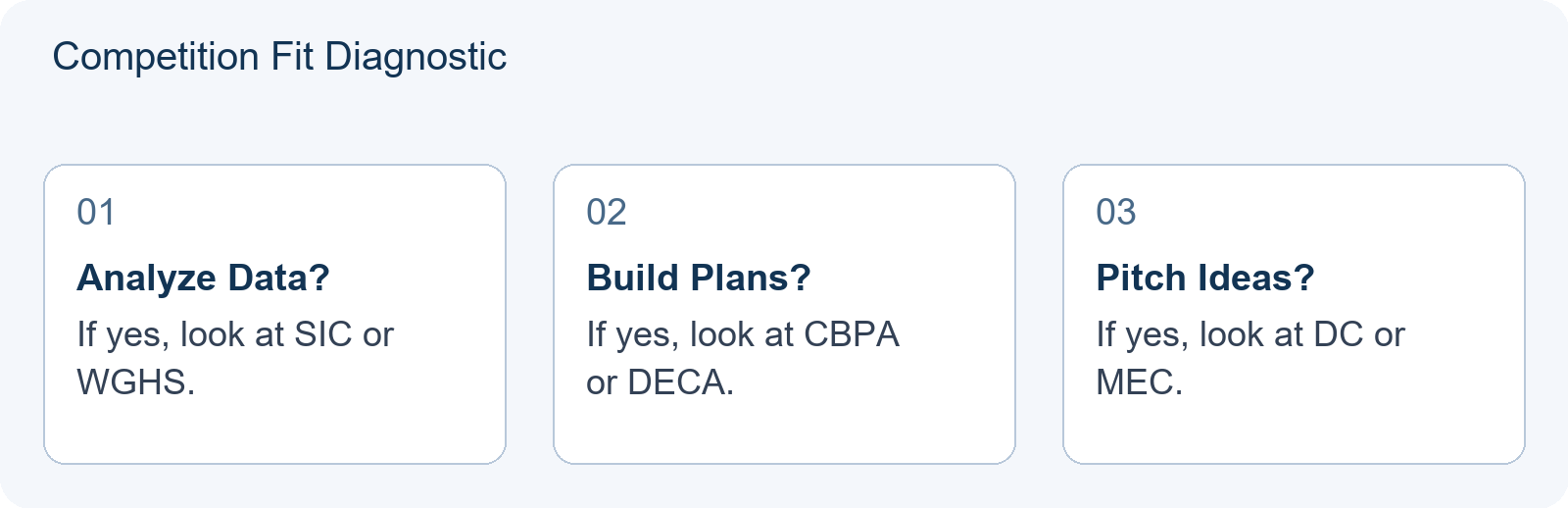
To match a student to a competition, we must first categorize what each contest actually measures. Based on Hanlin curriculum analysis of official competition structures, these six major contests fall into three distinct tracks:
- Financial Analysis & Portfolio Management: SIC and WGHS. These require deep quantitative research, understanding market mechanics, and constructing investment theses backed by data.
- Business Operations & Marketing: CBPA and DECA. These focus on broad commercial knowledge, case study analysis, marketing plans, and financial statement interpretation within a corporate context.
- Entrepreneurship & Venture Creation: DC and MEC. These emphasize creative problem-solving, business model design, pitch delivery, and validating startup ideas.
A student who excels at reading balance sheets but struggles with public speaking will likely find more suitable challenges in SIC or WGHS than in DECA’s interactive components. Conversely, a student with strong storytelling skills but less statistical training might find DC or MEC more accessible than SIC’s rigorous reporting requirements.
Deep Dive: SIC and WGHS – The Analyst’s Path
SIC and WGHS are prominent choices for students targeting finance, economics, or quantitative fields. Both involve managing virtual portfolios, but their evaluation criteria differ.
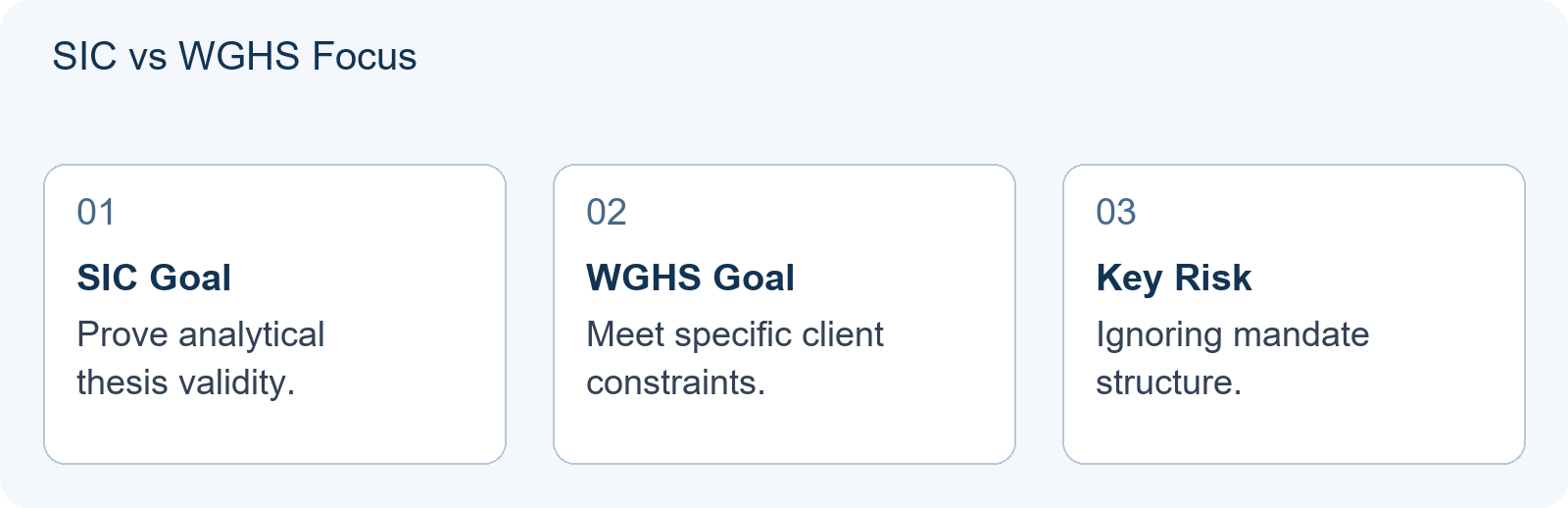
Student Investment Challenge (SIC): Organized with support from CEE and ACME, SIC offers two divisions. The Junior Division (Trading Track) is individual and focuses on online simulation execution. The Senior Division (Strategy Track) requires teams of 2-4 students to submit an investment strategy report alongside trading performance. The key differentiator is the written thesis. Success depends not just on returns, but on articulating why those returns were generated through rigorous fundamental or technical analysis.
Wharton Global High School Investment Competition (WGHS): Hosted by the University of Pennsylvania, WGHS involves team-based participation over a 10-week period. It places emphasis on client-centric portfolio management. Teams must define a hypothetical client profile and justify their asset allocation against that client’s risk tolerance and goals. While SIC rewards analytical accuracy and market insight, WGHS rewards holistic portfolio construction and adherence to a specific mandate.
Deep Dive: CBPA and DECA – The Generalist’s Toolkit
For students interested in broader business administration, marketing, or management, CBPA and DECA offer structured pathways that complement rather than compete with financial analysis.
CBPA (China Business Professionals of America): Recognized by the U.S. Department of Education, CBPA splits into Academic (individual multiple-choice) and Practical (team case studies) tracks. The Academic track tests hard knowledge: accounting principles, marketing mix, and business law. The Practical track involves creating full-scale business solutions, including financial projections and marketing strategies, presented via roadshow. This suits students who enjoy structured frameworks and comprehensive business planning.
DECA: As one of the largest high school business organizations in the US, DECA focuses heavily on applied learning. Events range from individual prepared events to team-based competitions where students solve business problems for judges. DECA is less about long-term portfolio tracking and more about immediate application of business concepts under time constraints.
Deep Dive: DC and MEC – The Innovator’s Stage
Diamond Challenge (DC) and Model Entrepreneur Competition (MEC) are designed for future founders and product managers. They prioritize creativity, feasibility, and persuasion.
Diamond Challenge (DC): Hosted by the University of Delaware, DC asks teams to develop a new venture idea. The core assessment is the quality of the business plan and the clarity of the pitch. Unlike SIC, there is no simulated trading. Instead, students must validate their assumptions through market research and present a viable path to profitability.
Model Entrepreneur Competition (MEC): Backed by Columbia Business School’s VFA program, MEC combines business simulation decisions with a formal business plan and English-language pitch. It adds a layer of operational decision-making (pricing, hiring, R&D) that pure pitch competitions lack.
Worked Teaching Illustration: Matching Strengths to Contests
Teaching illustration: Consider a hypothetical student, “Alex,” to illustrate how to apply this framework. Alex is a Grade 11 student with the following profile:
- Academic Strengths: High proficiency in AP Statistics and Microeconomics; enjoys analyzing historical price data.
- Weaknesses: Significant anxiety regarding public speaking; prefers written communication over verbal debate.
- Interests: Sustainable investing and ESG metrics.
Option A: DECA Individual Event. Alex would likely struggle here. DECA’s core format requires immediate, interactive response to judge questions. The high-pressure verbal environment contradicts Alex’s weakness, potentially leading to a poor score despite good underlying knowledge.
Option B: Diamond Challenge (DC). DC requires a final pitch presentation. While the written plan aligns with Alex’s interests, the mandatory oral defense introduces a bottleneck. If Alex cannot deliver a compelling narrative verbally, the project’s merit may be obscured.
Option C: SIC Senior Division (Strategy Track). This is the strongest fit. SIC evaluates the investment strategy report heavily. Alex can leverage statistical skills to build a robust ESG-screening model. The team aspect allows delegation: if Alex partners with a teammate who enjoys presenting, Alex can focus on the analytical backbone of the report. Furthermore, SIC’s S16 theme explicitly includes “AI+ESG Investing,” directly matching Alex’s interest area. The evaluation is document-heavy, playing to Alex’s strengths.
Contrasting Case: Where Superficial Similarity Fails
Teaching illustration: A common error is assuming that because both SIC and WGHS involve “investing,” they are identical. Consider “Jamie,” a student who joined WGHS expecting it to be like SIC.
In SIC, Jamie had previously succeeded by picking high-beta tech stocks based on momentum indicators. In WGHS, Jamie attempted the same strategy. However, WGHS requires defining a client mandate. Jamie failed to adjust the portfolio for a conservative client profile, resulting in excessive volatility. Despite having positive absolute returns, the team scored poorly on “Adherence to Client Constraints.” This illustrates a critical difference: SIC rewards analytical accuracy and market insight; WGHS rewards process discipline and client alignment. A student who ignores the structural differences between these contests risks underperforming even when their raw financial intuition is correct.
Strategic Sequencing: Avoiding Calendar Clashes
Families often ask if a student can do multiple competitions. The answer is yes, but timing is crucial. Most major business competitions run from September to April or May.
The “One Main + One Support” Approach: Attempting to lead teams in SIC, WGHS, and DECA simultaneously is unsustainable for most students. A better approach is sequencing. For example, a student might use the CBPA Academic track during the fall to build foundational knowledge, then apply that knowledge to the SIC Strategy Report in the winter. Alternatively, a student could participate in the SIC Junior Division (individual trading) in the fall, using that environment to learn market mechanics before tackling a team-based project later.
For students specifically planning around SIC, note that the S16 registration window closes on November 29, 2026. Families should verify current deadlines on official competition sites, as rules shift seasonally. For a detailed month-by-month plan that sequences SIC and WGHS without overlap, see our companion guide Two Competitions, One Academic Year: Sequencing the SIC and the Wharton Contest Without Wrecking Either.
Preparation Needs Assessment
Before committing to a competition, parents and students should conduct a simple diagnostic:
- Identify the Primary Skill: Is your child stronger at data analysis (SIC/WGHS), structured case solving (CBPA/DECA), or creative pitching (DC/MEC)?
- Evaluate Time Capacity: Can they dedicate 5-8 hours per week? Team competitions require coordination time that individual competitions do not. For realistic hour budgeting, see The SIC Hour Budget: Fitting 5-8 Hours a Week Around IB, AP and A-Level Exam Season.
- Check Language Proficiency: All major international contests require English submissions. If ESL support is needed, factor in extra time for editing and proofreading. Our guide on Analyst English for ESL Students: Sentence-Level Habits That Make an SIC Report Credible offers practical habits for non-native writers.
- Assess Team Dynamics: For team-based contests (SIC Senior, WGHS, DC, MEC), does the student have reliable peers? If not, consider starting with individual tracks (SIC Junior, CBPA Academic) to build confidence.
This assessment helps avoid the “prestige trap”—choosing a competition solely for its name without considering whether the student’s actual abilities align with the contest’s demands. The goal is not just participation, but meaningful engagement that yields strong results and genuine learning.
From Diagnosis to Draft: Turning the Alex Case into Actionable Practice
The previous section used a hypothetical student, “Alex,” to illustrate how to match personal strengths with competition formats. While identifying that SIC’s Senior Division suits a data-strong, presentation-anxious student is the first step, many families struggle to translate this insight into concrete preparation. The gap between knowing which contest fits and executing the work effectively requires a structured diagnostic and specific practice tasks.
The Diagnostic: Is Your Anxiety Structural or Situational?
A common error in self-assessment is assuming all public speaking anxiety is identical. For students like Alex, it is crucial to distinguish between two types of communication barriers:
- Situational Anxiety: Nervousness about being judged on delivery style (eye contact, voice projection) but confidence in the content. This can often be mitigated by team delegation.
- Structural Anxiety: A fundamental discomfort with real-time verbal defense where thinking speed is constrained by speech pace. This type of anxiety benefits significantly from written-heavy formats like SIC’s strategy report.
Diagnostic Question: If you had to explain your investment thesis to a friend via text message for 10 minutes, would you feel more confident than if you had to explain it face-to-face in 5 minutes? If the answer is yes, your strength lies in asynchronous, detailed articulation—a core competency of the SIC Senior Division. If the answer is no, you may need to address general communication skills before committing to any team-based pitch competition.
Concrete Next Practice Task: The “Silent Pitch” Exercise
To leverage Alex’s analytical strengths while testing the viability of the SIC path, assign a specific teaching illustration task called the “Silent Pitch.” This exercise simulates the core deliverable of the SIC Strategy Track without the pressure of live performance.
Step 1: Select a Single Stock. Choose one company relevant to the S16 theme (e.g., an AI-driven ESG firm). Do not build a portfolio yet; focus on depth over breadth.
Step 2: Write a 500-Word Thesis Statement. The rule is strict: no bullet points allowed. The argument must flow as a cohesive narrative. It must answer three questions explicitly:
- What is the mispricing? Why does the market currently undervalue or overvalue this stock?
- What is the catalyst? What specific event or trend will correct this mispricing within the next 6–12 months?
- What is the risk? What single factor could invalidate the thesis entirely?
Step 3: Peer Review for Clarity, Not Persuasion. Have a teammate read the document silently. They must highlight every sentence where they lose the logical thread. In DECA or DC, judges might forgive a confusing slide if the speaker recovers verbally. In SIC, the written report stands alone. If the logic breaks on paper, it breaks in scoring.
This exercise directly addresses Alex’s profile. It utilizes their statistical proficiency to find the “mispricing” and their preference for written communication to structure the argument. By removing the oral component, we isolate the analytical skill set that SIC rewards. If Alex can produce a clear, compelling 500-word thesis, they have validated their fit for the Senior Division. If they struggle to articulate the “why” behind the numbers, the issue is not just presentation anxiety—it is a gap in fundamental analysis that needs addressing before registration closes.
Frequently Asked Questions
Can I participate in both SIC and WGHS in the same year?
Yes, but it requires careful time management. Both involve significant research and writing. Many students choose one as their primary focus and treat the other as a secondary practice opportunity, or sequence them across different terms if schedules allow. Our detailed sequencing guide covers this.
Which competition is better for applying to Economics programs?
SIC and WGHS demonstrate skills most relevant to Economics and Finance majors, such as quantitative reasoning and market understanding. CBPA and DECA demonstrate skills most relevant to Business Administration or Marketing majors. DC and MEC demonstrate skills most relevant to Entrepreneurship or Innovation Management paths.
Do I need prior investment experience for SIC?
No. The Junior Division is designed for beginners to learn trading mechanics. The Senior Division expects more sophisticated analysis, but many successful teams start with basic knowledge and build up through research and mentorship. The S16 theme on AI+ESG Investing is accessible to newcomers with structured preparation.