Every SIC Senior Division strategy report defends a position. The difference between a persuasive thesis and a weak one is not the strength of your conviction, but the clarity of the evidence that would change your mind. Evaluators reward intellectual honesty: the ability to show that you have tested your own argument and know exactly where it could break.
This article works through a concrete method for building that honesty into your thesis. We will use a worked teaching illustration, examine a contrasting case where the same method fails, and end with a short diagnostic you can apply to your own draft before submission.
Why Falsifiability Matters in a Strategy Report
The SIC Senior Division strategy report asks teams to produce an investment thesis backed by research, valuation, and risk analysis. The evaluation rewards analytical rigor and research process, not mere assertion of belief. A falsifiable thesis states a specific condition under which it would be wrong.
For example: “We recommend a long position in Company X because its gross margin expansion to 35% by 2027 will drive a 20% upside to our target price.” The condition is explicit: gross margin must reach 35%. If it does not, the thesis fails. This gives evaluators a clear standard to assess your work against.
By contrast, an unfalsifiable thesis says: “Company X is a quality business with strong management and should outperform.” There is no condition that would prove this wrong. Quality and strong management are vague enough to survive any outcome. Evaluators cannot score what they cannot test.
Worked Teaching Illustration: Building a Falsifiable Thesis Step by Step
The following is a simplified teaching illustration using hypothetical numbers. It assumes an unchanged valuation multiple, no debt or cash, and a single-segment firm for clarity. This is not investment advice or a validated real forecast.
Suppose you are analyzing a fictional consumer electronics firm, AlphaTech, for your SIC strategy report. Your initial instinct is that the stock is undervalued because of its new product line.
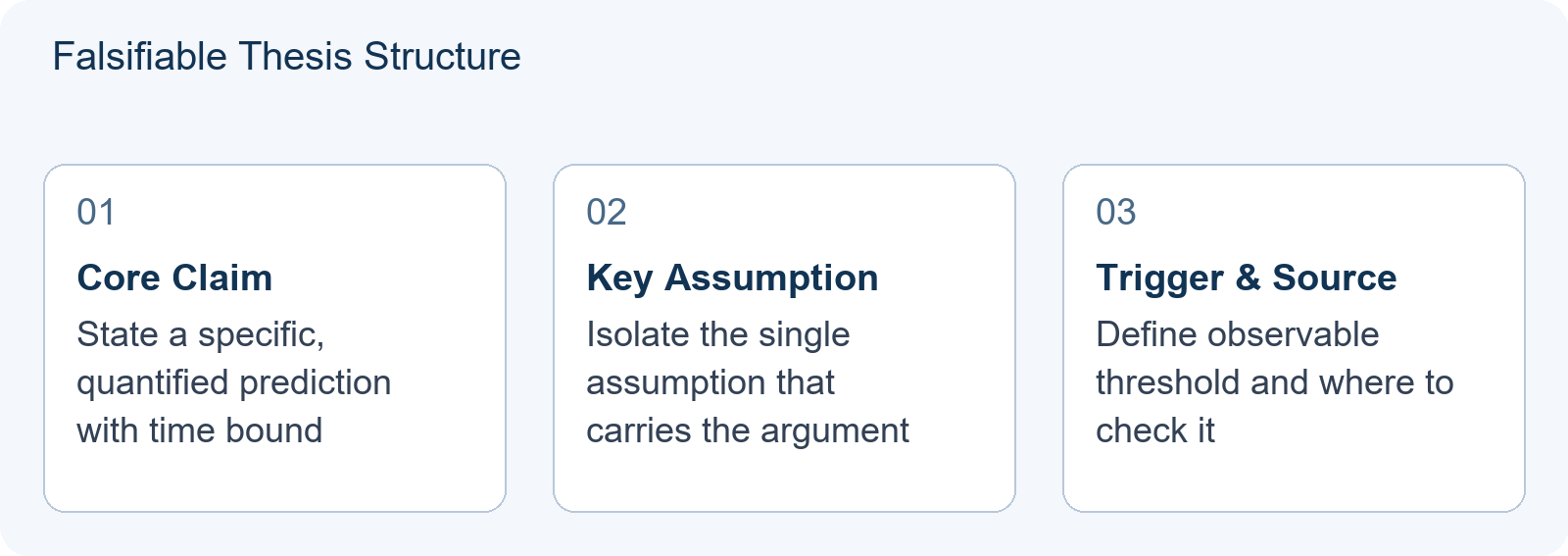
Step 1: State the core claim in measurable terms.
Instead of “AlphaTech will do well,” write: “AlphaTech’s new wearable segment will contribute $180 million in revenue for fiscal 2027.” This is specific, time-bound, and quantified.
Step 2: Identify the critical assumption.
The $180 million figure assumes a 15% market share in the mid-tier wearable category. State this explicitly: “Our revenue forecast assumes AlphaTech captures 15% of the addressable mid-tier wearable market, defined as devices priced $150-$300 globally.”
Step 3: Define the evidence that would change your mind.
Now specify what would invalidate the assumption: “If AlphaTech’s Period 1 unit sales data shows market share below 14%, we would revise our revenue forecast downward and reconsider the long position.”
Step 4: Show how you would gather that evidence.
Evaluators need to see that your trigger is observable, not hypothetical. In this case: “We will monitor quarterly shipment reports and competitor press releases. We have also flagged AlphaTech’s next earnings call as a decision point.”
This four-step structure reflects a core principle of research design: the discipline of your method matters as much as whether the stock actually rises.
Arithmetic Check: Verifying Your Trigger Threshold
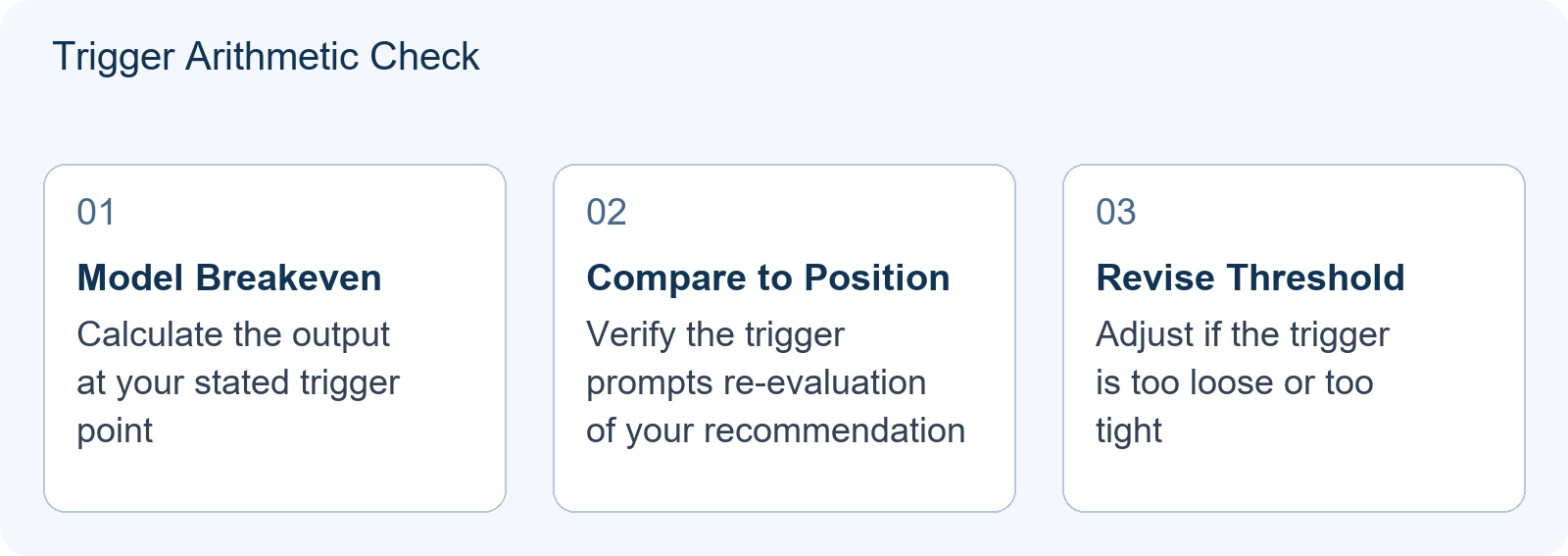
Teams often set triggers without checking whether the numbers actually work. Suppose your AlphaTech thesis uses a 15% market share assumption in a $1.2 billion addressable market, and your model values the company at 12x forward revenue. Your entry analysis suggests the position is attractive at an enterprise value of $1.6 billion.
First, calculate the break-even market share: $1.6 billion ÷ (12 × $1.2 billion) = 11.111%.
Now verify your trigger:
- At 15% share: $180 million revenue × 12 = $2.16 billion implied enterprise value
- At 14% share: $168 million revenue × 12 = $2.016 billion implied enterprise value
At 14% share, the implied value of $2.016 billion still exceeds your $1.6 billion entry threshold. This illustrates an important subtlety: a breached forecast does not automatically invalidate a position. The 14% trigger prompts re-evaluation, not proof of falsity. You must check whether the revised outcome still supports your investment case.
Suppose instead your trigger were set at 8% share. The implied value would be $96 million × 12 = $1.152 billion, below your $1.6 billion entry. This trigger would be meaningful: if market share fell to this level, the position no longer meets your return requirement. A trigger must be tight enough to matter, but not so tight that routine variance forces unnecessary reversals.
Contrasting Case: Where the Same Approach Collapses
Now consider a superficially similar thesis that fails. A team analyzes BetaEnergy, a renewable power utility, and writes: “BetaEnergy is positioned to benefit from the global energy transition and should see significant multiple expansion.”
The team then adds what looks like a falsifiability clause: “If the energy transition slows, our thesis may not hold.” This is not actually falsifiable. “Significant multiple expansion” is undefined. “The energy transition” is too broad to measure. The trigger — “slows” — has no threshold. An evaluator cannot test this.
The failure mode here is vague counterfactualism: the appearance of openness to being wrong without the substance. Teams often fall into this trap because they confuse intellectual humility with analytical rigor. Saying “we could be wrong” is not the same as saying “here is the exact data point that would make us wrong, and here is where we will look for it.”
The contrast with the AlphaTech case is instructive. Both are about growth stories. Both mention risks. But the AlphaTech thesis ties every claim to a specific metric, a specific data source, and a specific decision threshold. The BetaEnergy thesis uses directional language that absorbs any outcome.
Diagnostic: Apply This to Your Current Draft
Before finalizing your SIC strategy report, run this five-question check on your thesis statement:
- Is the core claim quantified? “Do well” or “outperform” is not enough. You need numbers: revenue, margin, market share, or valuation multiple.
- Is the critical assumption isolated? Identify the single assumption that, if wrong, most damages your conclusion. Do not hide it in a list of minor risks.
- Is the trigger specific and observable? “Management changes” is not a trigger. “CEO departure plus two consecutive quarters of missed guidance” is.
- Does the trigger actually change your position? Check the arithmetic. If the trigger fires and you would still hold the position, it is not a real trigger—but understand that a breached forecast may still allow model-implied upside.
- Have you named the data source and date? Evaluators need to see that your evidence is accessible, not theoretical.
If you answer “no” to any of these, your thesis needs revision. This is not a failure — it is the purpose of the drafting process.
Connecting to the Broader SIC Research Toolkit
Falsifiability does not exist in isolation. It interacts with every other section of your report. Your risk section should explicitly reference the triggers you have set. Your capital allocation analysis should show how management’s spending decisions affect your key assumptions. And your spreadsheet model should contain sensitivity tables that mechanically generate the outputs at your trigger points.
A thesis with strong falsifiability but weak sensitivity analysis will score lower than one that integrates both. The evaluator can see that you know what would change your mind, but cannot see how you would measure it.
For practical guidance on building these sensitivity tables, see our article on The Spreadsheet Behind Your SIC Valuation: Model Hygiene, Assumptions and Sensitivity Tables (2026). For structuring how your risk section interacts with your thesis, refer to The SIC Risk Section: What Would Have to Be True for Your Thesis to Lose. And for understanding how scenario analysis supports falsifiable claims, review SIC Scenario Analysis: Showing How a Valuation Changes When Assumptions Fail.
What This Means for Your Next Learning Task
If your diagnostic reveals that your thesis is currently unfalsifiable, your next task is not to find more bullish evidence. It is to identify the one assumption your entire case rests on and subject it to stress testing. This may require:
- Running a competitor product launch calendar check (for consumer-facing companies)
- Modeling revenue at 50%, 75%, and 125% of your base case to find the breakeven
- Interviewing industry sources about the plausibility of your market share assumption
The useful feedback you should seek from a mentor or peer reviewer is: “What is the smallest piece of new information that would make you abandon this position?” If you cannot answer quickly, your thesis is not yet ready.
Preparing for Consultation: What to Bring
If you are considering structured preparation support for the SIC Senior Division, the most productive initial conversation focuses on your current draft’s weakest falsifiability point. Before any consultation, prepare:
- Your current thesis statement in one sentence
- The single most important assumption underlying that thesis
- One data point you are currently monitoring that could invalidate it
This preparation respects your time and allows any discussion to move immediately to analytical substance rather than generic overview. Strategy report quality comes from iterative refinement, not initial inspiration.
For broader context on how SIC preparation fits alongside other programs in a single academic year, see our analysis of sequencing the SIC and Wharton programs. For the specific mechanics of the current registration window, refer to our guide on what to decide before the S16 deadline.
Frequently Asked Questions
Does a falsifiable thesis make my argument weaker?
No. Evaluators score analytical rigor, not bluster. A thesis that states exactly what would prove it wrong shows confidence in your research process and gives evaluators a clear standard to assess. Vague claims that survive any outcome cannot be scored and typically receive lower marks.
How many triggers should my SIC report include?
Focus on one primary trigger tied to your most important assumption. Additional triggers for secondary assumptions can appear in your risk section, but spreading yourself across too many dilutes the core argument. Quality of falsifiability beats quantity.
What if my trigger fires during the program and I have to change my position?
This is exactly the scenario the SIC framework is designed to reward. Document the new evidence, explain how it affects your model, and revise your recommendation with the same rigor as your original thesis. The evaluation values process and intellectual honesty over static correctness.