The Senior Division brief lets a team of 2–4 defend one company, one sector, or one macro position. Most teams pick a company without ever registering that a choice was made. That default is usually correct — but for a reason worth understanding, because the falsifiability burden rises sharply as you zoom out, and the rubric awards the same 25 risk points regardless of how hard you made your own life.
The option set the brief actually gives you
Two structural facts frame the decision. Senior Division teams produce a single investment strategy report in the 15–30 page range defending one company, sector, or macro position, at roughly 5–8 hours per member per week during the Regional Stage. Junior Division participants work individually on a simulated portfolio with weekly thesis logs, so the subject-type question mostly belongs to Senior teams. Both divisions are held to the same four-axis rubric. Season requirements can change, so confirm the current brief on the official SIC site.
The operative word is one. The choice is exclusive, and it propagates into every other decision you make: which primary sources count as evidence, how you phrase a kill criterion, how many pages the analysis needs, and how a defense conversation will go. Making it deliberately in week one costs an hour. Discovering in week ten that your report is arguing at two different altitudes costs a rewrite.
It is also worth separating this question from top-down research technique. Working from the economy down to a single name is a research method that ends at a company. What follows is about where your thesis stops — whether the sector or the macro position is itself the thing you are defending, and must therefore survive on its own terms.
The falsifiability burden rises as you zoom out
The risk axis wants failure conditions stated with a metric, a threshold and a timeframe — the published illustration is of the form “if gross margin compresses below 38% in two consecutive quarters”. That standard is identical at every altitude. What changes is how hard it is to meet.
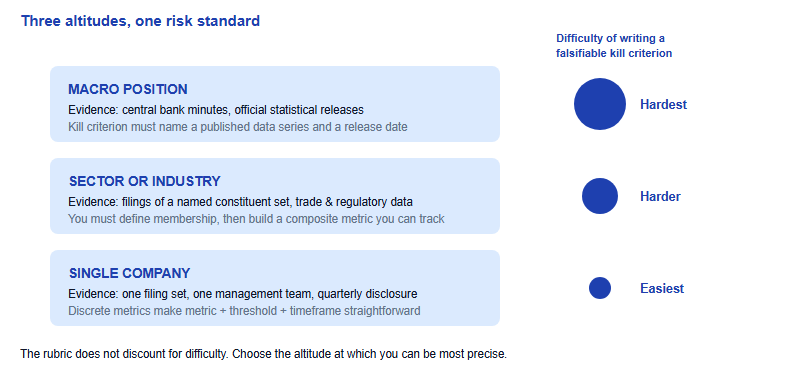
A single company gives you one consolidated filing set, one management team talking on the record every quarter, and metrics that are discrete and disclosed on a schedule. Writing a falsification condition is mechanical: pick the two assumptions your valuation is most sensitive to, name the disclosed line item, set a threshold, set a window.
A sector has no filings. There is no consolidated income statement for “European utilities”, so before you can be falsifiable you must first define what the sector is — which companies are in it and why — and then construct a measure that tracks it. That is real work, and it is work a company thesis simply does not require.
A macro position has data but no ownership. The series exist and are published on a calendar, which is an advantage; but the causal chain from your view to an investable conclusion is long, and every link is a place a judge can ask why. The difficulty is not finding numbers. It is committing, in advance, to the number that would prove you wrong.
The three subject types compared
| Subject type | Typical primary evidence | What a kill criterion looks like | Page pressure | Suits a team that… |
|---|---|---|---|---|
| Single company | 10-K, 10-Q, earnings transcripts, investor days | A disclosed line item crossing a stated threshold for a stated number of quarters | Comfortable in 15–30 pages; the constraint is depth, not breadth | Wants a clean, defensible score and has one strong analyst on the model |
| Sector or industry | Filings of a named constituent set, trade bodies, regulators, customs and pricing data | An industry-level measure — capacity, pricing, volumes — moving past a threshold within a window | High: you must cover several companies without becoming shallow on all of them | Has 3–4 members who can split constituents and a genuine structural argument |
| Macro position | Central bank minutes, official statistical releases, primary research | A named published series printing outside a stated range by a scheduled release date | Moderate on pages, heavy on justification of the transmission mechanism | Contains at least one member already comfortable reading statistical releases |
When a sector thesis is genuinely the right call
The sector route earns its keep when the bet is on an industry structure change that no single listed company expresses cleanly. Supply and demand moving out of balance, an input cost shift that reprices an entire value chain, a regulatory change that alters the economics for everyone in the sector, or consolidation changing pricing power — these are arguments about the industry, and forcing them into one ticker adds company-specific noise that has nothing to do with your insight.
Three requirements make a sector thesis defensible rather than vague:
- Define membership explicitly. Name the companies you are treating as the sector and say why those and not others. An undefined sector cannot be falsified, because the boundary can always move to accommodate the result.
- Build one composite metric you can actually track. Aggregate capacity, industry pricing, a volume series, or a weighted average of a disclosed metric across your named constituents. Show the construction in an exhibit so a reader can rebuild it.
- State how the view is expressed. A sector view still has to become an investable position — an equal-weighted basket of your constituents, an index, or an explicit statement that the thesis is analytical rather than a trade recommendation. Say which.
The failure mode to watch for is a sector thesis that is secretly three company theses stapled together: three mini-pitches, no industry-level claim, and a conclusion that is really “we like these three names”. If removing any one company would not change your argument, you have a sector thesis. If removing one collapses it, you have a company thesis wearing a sector title.
The macro brief: hardest to score, occasionally the strongest
Macro is the least-taken route and the one where the evidence axis is most naturally satisfied. The rubric lists central bank minutes among the primary sources it rewards (it names Fed minutes specifically), alongside filings and transcripts, in contrast to secondary commentary. Macro analysis done properly runs on primary statistical releases — which means a student who reads the actual releases rather than reporting about them is working with high-grade evidence from the first page.
The discipline that separates a strong macro brief from an essay is committing to falsification against published data. “We think inflation stays elevated” is a view; it scores nothing on the risk axis because nothing could disprove it on a defined timetable. Naming the series, the level and the release date that would end the thesis converts the same view into something that meets the standard. Statistical agencies and central banks publish release calendars in advance, which makes this achievable — the dates are knowable when you write.
The other requirement is the transmission mechanism: the explicit chain from your macro view to the asset. Skipping it is the most common structural weakness in student macro work, because it is the step where a defense question lands. Write it out as numbered links and pressure-test each one.
Honest guidance: unless someone on the team is already comfortable with primary statistical releases, the same hours usually produce a better score on a company thesis, where the evidence is more concentrated and the risk section writes itself more readily. That is a probabilistic observation about where teams tend to score well, not a rule — a well-constructed macro brief with real falsification points can be the strongest submission a team produces.
The hybrid trap, and locking the decision in week one
The most common real situation is a hybrid: the team likes a sector, so it pitches a company inside it. There is nothing wrong with that — it is how a great deal of professional research works. The error is leaving it undeclared, so the report argues at two altitudes and defends at neither.
Decide which one is the thesis and say so on page one. If the company is the thesis, the sector work is context and your kill criteria must be company-specific: a sector holding up will not save you if the company’s own metrics deteriorate. If the sector is the thesis and the company is the expression, you owe the reader two extra things — why that company tracks the sector view, and what your conclusion is if the sector view proves right while the company underperforms anyway. Teams that answer the second question in advance handle defense questions noticeably better.
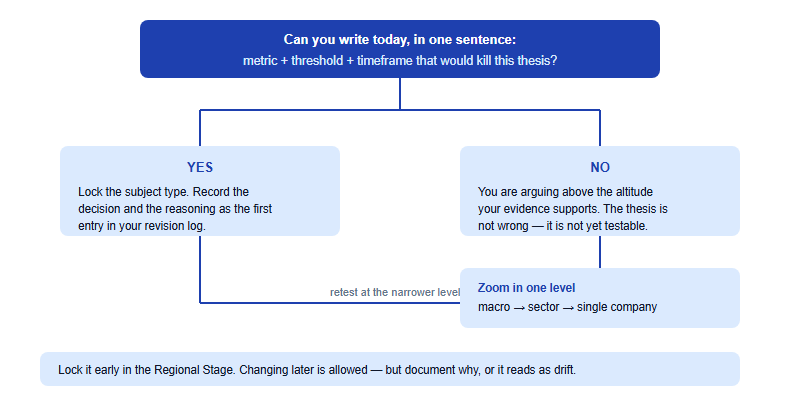
Run the test above in the first fortnight of the Regional Stage, while changing course is cheap. If you cannot state a falsification condition at the level you have chosen, the thesis is not wrong — it is not yet testable, and the fix is to zoom in one level and try again. Then lock it, and write the reasoning into your revision log as entry one.
Changing subject type mid-season is not automatically penalised. The revision axis rewards documented, reasoned change, so a team that moves from a sector thesis to a company thesis in week six because the industry data proved unavailable, and says exactly that, is demonstrating judgment. A team that drifts because the original question got difficult, and never mentions it, is demonstrating the opposite. The difference is entirely in whether the change is on the page. For the wider structure of the season and how the divisions differ, see the SIC overview.
Can a SIC Senior report cover more than one company?
Only as a sector thesis with a defined constituent set. The brief asks for one company, sector, or macro position, not a list of picks.
Is a macro thesis scored more generously because it is harder?
No. The four axes are weighted equally at 25 points each regardless of subject type, so choose the altitude where you can be most precise.
What if my sector view is best expressed through one stock?
That is fine. State on page one which is the thesis, and write your kill criteria at that same level.
When should the subject type be locked?
Early in the Regional Stage, once you can state a falsification condition. Record the decision and reasoning in your revision log.
Published by the SIC editorial desk, operated by Hanlin Education for China-based international-school students. Official rules are set by the competition and change yearly — confirm current details, deadlines and formats on the official SIC site. Errors reported to the desk are corrected within 7 working days.