A winning Student Investment Challenge (SIC) investment thesis is a short, defended argument for one company, sector, or macro view — built from a clear idea, honest research, one simple valuation case, named risks, and a stated level of conviction. SIC advancement turns on the clarity of that reasoning, not on your portfolio's return, so the thesis trail is the entry. This 2026 guide walks the method step by step.
Why reasoning — not returns — wins at the SIC table
The most common mistake we see from China-based applicants is treating SIC like a trading contest where the highest balance wins. It is not. SIC is judged on a four-axis rubric: thesis clarity, evidence quality, risk articulation, and revision discipline. The program states plainly that advancement turns on the strength of the thesis, not the growth of the portfolio. A team that loses money on paper but reasons cleanly can advance over a team that got lucky on a momentum stock.
That changes how you write. Your job is not to predict a price perfectly — it is to show a judge how you think under uncertainty. The Junior (Trading) track asks for a weekly thesis log; the Senior (Strategy) track asks teams of two to four for one end-of-stage strategy report. Both are scored on the same virtue: disciplined reasoning. For the full rubric, see our breakdown of the Four-Axis Rubric, section by section, and the complete 2026 SIC guide if you are new to the program.
A practical first-party note from our advising desk: the strongest thesis logs we have seen are the ones that change their mind on the record. A judge rewards a student who writes “in week 3 I assumed margins would hold; the Q2 print proved me wrong, so here is my revised view” far more than a student who pretends they were right all along. Revision discipline is a whole axis — use it.
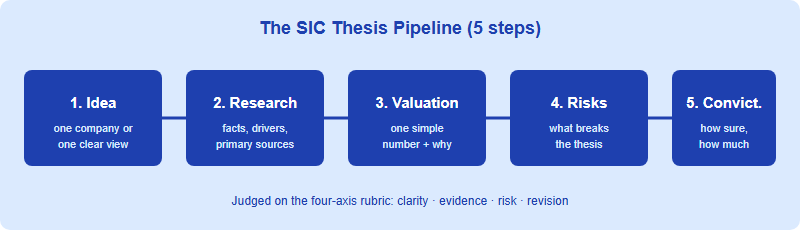
Step 1 — Find one idea and write it in one sentence
A thesis is a claim, not a description. Before you research anything, force yourself to write a single sentence: “I believe [company] is worth more (or less) than the market thinks because [one specific reason], and I expect [what] to happen by [when].” If you cannot fill that sentence, you do not yet have a thesis — you have a watchlist.
Pick something you can actually understand. A judge can tell within two paragraphs whether you grasp how a business makes money. For a first SIC entry, a company with a simple, visible revenue model (a consumer brand, a single-product software firm, an airline) is far easier to defend than a sprawling conglomerate. Scope down: one company beats one sector, and one sector beats “the global economy.”
- Good idea: “Margins are recovering faster than consensus expects because input costs peaked last year.”
- Weak idea: “This is a great company with strong fundamentals.” (No claim, no edge, nothing to test.)
- Test: Can someone disagree with your sentence? If no one can argue against it, it is not a thesis.
Step 2 — Research that produces evidence, not links
The evidence axis is where most entries quietly lose points. Judges reward specific, sourced facts over vague summaries. “Revenue grew” is weak; “revenue grew 18% year-over-year in the most recent annual report, driven by a 9% rise in average selling price” is strong. Always confirm figures against a primary source — the company's own filings, its investor-relations deck, or a recognized data provider — and cite it. If you are unsure of a number, write “confirm on the official source” rather than guessing.
Structure your research around the things that actually move the value: the drivers of growth, the management team and its strategy, the competitive position, and the risks. Three or four well-sourced facts beat fifteen shallow ones. The table below shows the difference a judge sees.
| Research element | Weak version (loses evidence points) | Strong version (wins evidence points) |
|---|---|---|
| Growth claim | “The company is growing fast.” | “Revenue +18% YoY (latest annual report); units +9%, price +8%.” |
| Source | A blog or unnamed “analysts.” | Company 10-K / annual filing, page cited. |
| Driver | “Demand is strong.” | “New subscription tier added X paying users in two quarters.” |
| Honesty | Hides the weak quarter. | “Q2 margin slipped 200bps; here is why I think it is temporary.” |
Step 3 — Build one simple valuation case
You do not need a 40-tab discounted-cash-flow model to win SIC. You need one clear valuation case a judge can follow — and, crucially, the assumptions behind it. A transparent, simple model with explicit inputs scores better than a black-box spreadsheet nobody can check.
The most defensible beginner approach is a multiples cross-check: take a comparable, reliable metric — for example a price-to-earnings (P/E) or EV/EBITDA multiple — and ask whether the company trades cheap or rich versus its peers and its own history, then explain why that gap should close. If you attempt a discounted-cash-flow estimate, state your three core inputs out loud (growth rate, margin, discount rate) and run a quick sensitivity: “if growth is 2 points lower, fair value drops by X%.” Showing the range is itself reasoning the rubric rewards.
- Anchor on one method, cross-check with a second — do not stack five and average blindly.
- State every assumption in plain words; a judge should be able to redo your math.
- Show sensitivity: what happens to your number if a key input is wrong?
- Connect price to thesis: the valuation must follow from Step 1's claim, not float free.
Step 4 — Name the risks (and what would prove you wrong)
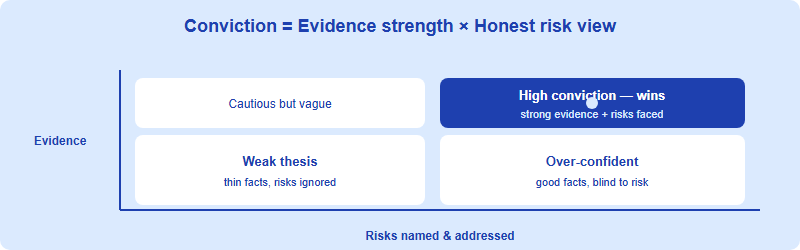
Risk articulation is a full axis of the rubric, and it is the fastest place to gain ground because so few students do it well. The best theses do not hide risks — they list them, weigh them, and say what would change the author's mind. Define your kill criteria: the specific events that would invalidate your thesis — two consecutive quarters of slowing growth, a margin falling below a level you name, a regulatory ruling, a key customer leaving. Stating these proves you are reasoning, not cheerleading.
Cover at least three categories: business risk (the company stumbles), valuation risk (you overpaid even if you are right), and external risk (rates, regulation, currency — relevant for the China and Asia cohorts watching FX). For each, say one sentence on how likely it is and what you would watch. If you want to see how examiners weight this, our piece on the four-axis rubric breaks down exactly what “good risk articulation” reads like.
Step 5 — State your conviction, then revise on the record
Conviction is not volume — it is calibrated confidence. End your thesis by saying how sure you are and why, and (for the Trading track) how that maps to position size: your highest-conviction idea earns the larger allocation, your speculative idea a small one. A sentence like “I hold moderate conviction: the valuation gap is clear, but margins are the swing factor I am least certain about” signals maturity. Overclaiming certainty you have not earned reads as naivety to a judge.
Finally, treat your thesis as a living document. The revision-discipline axis specifically rewards updating your view as facts arrive. In a weekly log, that means dating each entry and noting what changed and why. SIC's S15 season runs applications from March 20 to June 1, 2026, with regional and global stages through the summer and the signature Omaha summit timed to Berkshire Hathaway's shareholder meeting — confirm the current calendar on the official SIC site. That long runway exists precisely so you can show your thinking evolve. If you are still deciding between programs, our SIC vs Wharton side-by-side explains why SIC rewards the thesis trail rather than a ten-week return.
Frequently asked questions
Do I need a complicated DCF model to win SIC?
No. One transparent valuation case with stated assumptions and a sensitivity check scores better than a black-box model a judge cannot follow.
Does losing money in the simulation hurt my SIC score?
No. SIC advances entries on thesis clarity, evidence, risk, and revision — not on portfolio returns. Clean reasoning can beat a lucky gain.
How long should an SIC investment thesis be?
Long enough to defend one claim well. Favor three or four sourced facts, one valuation case, named risks, and stated conviction over padding.
Published by the SIC editorial desk, operated by Hanlin Education for China-based international-school students. The Student Investment Challenge (SIC) is a distinct program and is not the Wharton Global Youth High School Investment Competition. Season dates, divisions, and rules can change — confirm current details on the official SIC site before you apply. We correct any errors within 7 working days.