The Student Investment Challenge (SIC) Senior Division is built around a team of 2–4 students producing one end-of-stage research brief plus a defense. A strong team is not four analysts doing the same work in parallel — it is a small unit with one owned thesis, clear role boundaries, and a weekly revision cadence locked in before the portfolio is ever built. This guide shows how to structure that team so the rubric works for you, not against you.
Why team structure is a rubric question, not a logistics question
Most students treat “forming a team” as a friendship decision: pick three people you like, split the company list, regroup before the deadline. That approach loses points on two of the four axes before anyone has read a 10-K. SIC judges every Senior entry on the same Four-Axis Rubric — Thesis Clarity, Evidence Quality, Risk Articulation, and Revision Discipline, each weighted 25% — and two of those axes are decided almost entirely by how the team operates rather than by raw analytical talent.
Thesis Clarity collapses when four people each contribute a paragraph and the brief reads like a committee wrote it. Revision Discipline — the axis where the strongest teams most often lose points — collapses when nobody owns the weekly update and the thesis quietly mutates to fit whatever the portfolio happened to do. Both are structural failures. You prevent them by deciding, in week one, who owns the single sentence and who owns the weekly log.
One framing rule from the program desk is worth internalising: SIC is a research program, not a trading contest. Recognition is awarded for research output and process, not for beating the market. So the team is not a fund with a star portfolio manager; it is a small research group whose output is a document a skeptic cannot easily dismiss. Build the team for that goal.
The four roles every SIC Senior team needs
Even a two-person team needs all four functions below — the people just wear more than one hat. The point is that every function has a named owner, so nothing falls through the cracks in the final fortnight. A useful test: for each role, you should be able to name one student who is accountable if that part of the brief is weak.
| Role | Owns | Single deliverable they are accountable for | Fits the student who… |
|---|---|---|---|
| Thesis lead | The one-sentence bet and the brief’s spine | A thesis a non-expert grasps in two sentences, defended end-to-end | Writes clearly and can kill their own darlings |
| Evidence lead | Sourcing, the citation trail, the verified-source allowlist | Every number traceable to a primary document in one click | Is patient with 10-Ks, transcripts, and Fed minutes |
| Risk lead | The falsification case — what would make the thesis wrong | Named metrics, thresholds, and time windows for each risk | Enjoys arguing the other side |
| Revision & process lead | The weekly cadence, the change-log, version control | A dated record of what changed and why, every week | Is organised and will chase teammates |
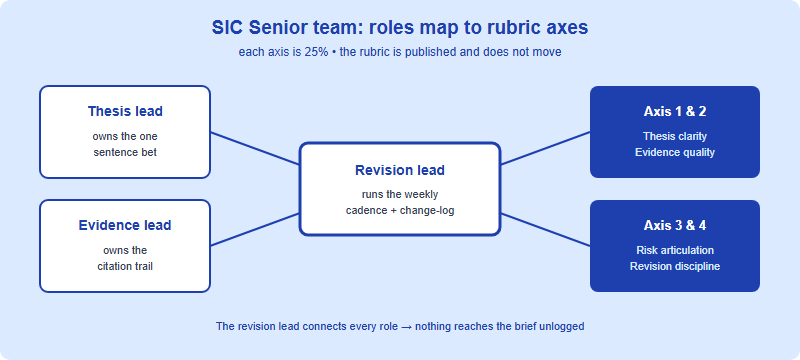
Notice that three of the four roles map directly onto rubric axes. That is deliberate. When a role maps to an axis, the owner knows exactly what “good” looks like, because the rubric is published in advance and does not move during the season. The revision lead is the one role that has no glamour and the highest marginal value — it is the difference between a team that updates when facts change and a team that rationalises.
The weekly cadence: build it before you build the portfolio
Revision discipline is procedural, not analytical. The teams that score well here decide their meeting rhythm in week one and treat each weekly entry as a structured update, not a chance to re-justify the original call. A workable cadence for a Senior team across the Regional Stage looks like this:
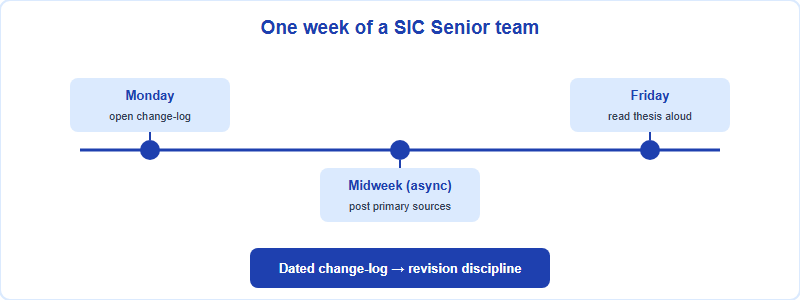
- Monday (30 min): revision lead opens the change-log. Each member states one thing that changed in their area and whether it strengthens or weakens the thesis.
- Midweek (async): evidence lead posts any new primary sources to a shared, dated folder; risk lead updates the falsification table if a threshold was crossed.
- Friday (45 min): thesis lead reads the current one-sentence bet aloud. If it has drifted from last week without a logged reason, that drift is flagged, not buried.
The single most damaging team pattern is the “silent mutation”: the portfolio moves, the thesis quietly reshapes to fit, and by August the brief defends a position the team never deliberately chose. A dated change-log is the cheapest insurance against it. If your team can show a reviewer a clean record of what changed, when, and why, you are already operating in the top quartile of revision discipline.
Two cadence habits separate teams that hold this discipline from teams that drift. First, keep the meeting short and fixed — a recurring 30-to-45-minute slot that never moves beats a long, occasional crisis session, because consistency is what builds the documented trail judges reward. Second, separate “updating” from “re-justifying.” When a fact changes, the team’s job is to record the change and ask whether it strengthens or weakens the bet — not to reach for reasons the original call was still right all along. A team that treats every weekly entry as a defence of the past loses the very axis the cadence exists to protect.
Junior vs Senior: when a “team” is actually one person
Team structure only applies to the Senior Division. The Junior Division is for individual participants, who carry a simulated portfolio plus a weekly thesis log on their own. If you are deciding which track to enter, the team question is genuinely load-bearing: a strong solo researcher who works better alone may be better served by Junior, while students who learn by arguing should look at Senior. The trade-offs are covered in our companion guide on choosing a division — and division definitions, team sizes, and eligibility bands are set by SIC, so confirm the current rules on the official site before you commit.
For Senior teams specifically, two structural cautions matter for our China-based international-school readers. First, SIC’s onboarding (eligibility verification, and school consent for younger grade bands) takes time, so settle your roster early rather than at the application buzzer. Second, if your teammates sit in different time zones or different campuses, the revision lead’s job is harder — budget for it by agreeing on one fixed weekly synchronous slot in a time zone everyone has written down. Never assume everyone means the same clock when they say “Friday.”
A first-week checklist for a new SIC Senior team
- Confirm your roster and team size against the official SIC division rules (teams are 2–4 — confirm current bands on the official site).
- Assign all four functions by name, even in a pair. Write down who owns each axis.
- Agree one fixed weekly synchronous meeting, with the time zone spelled out.
- Create a shared, dated source folder and a single change-log document on day one.
- Draft a placeholder one-sentence thesis in week one — you will rewrite it, but the team needs a spine to revise against.
- Read the SIC overview together so everyone shares the same mental model of what the program rewards.
Do all six in week one and you remove most of the failure modes that surface in the final fortnight — the unowned section, the undated source, the silently mutated thesis. None of these require more talent. They require a structure decided early and held to.
Frequently asked questions
How many people are on a SIC Senior team?
The Senior Division is for teams of 2–4 students; the Junior Division is for individuals. Confirm current team sizes and eligibility bands on the official SIC site, as program rules are set by the competition.
Can a SIC team be just two people?
Yes. A pair still needs all four functions — typically one student pairs Thesis with Risk, the other pairs Evidence with Revision — so no rubric axis is left unowned.
Which role matters most on a SIC team?
The revision lead. Revision discipline is the axis where strong teams most often lose points, and a dated weekly change-log is the cheapest way to protect it.
Do SIC Senior teams give a live oral pitch together?
The official site references a “research brief + defense” but does not publish the defense’s format. Do not assume a live podium pitch — confirm the current defense format on the official SIC site.
Published by the SIC editorial desk, operated by Hanlin Education for China-based international-school students. Official rules are set by the competition and change yearly — confirm current details (division sizes, eligibility, deadlines, the defense format) on the official SIC site. Any error is corrected within 7 working days.