In the Student Investment Challenge (SIC), the Senior Division engine is a research brief plus a defense — and the defense is where a confident thesis either holds or unravels. Writing it well means stating, in advance, exactly what would make your bet wrong, then showing you have already weighed it. This guide shows how to build that defense around the risk-articulation axis. One caution up front: the official site does not publish the defense’s format, so confirm that separately.
First, what “defense” does and does not mean
SIC’s official Senior engine is described as “research brief + defense.” That tells you a defense step exists. It does not tell you the defense is a live oral presentation, a slide deck, a virtual panel, or a written section — the official site does not publish its format, time limit, or judge composition. It is easy to import the wrong mental model from competitions that run timed podium Q&A, but SIC is a written, rubric-judged research program, not a live trading contest. Before you prepare for any specific delivery format, confirm the current defense format on the official SIC site.
What is documented is the standard your work is held to: the four-axis rubric. So this guide focuses on the part of the defense you can build regardless of format — the substance: a falsifiable risk case and a set of pre-empted counter-arguments. Whether you ultimately deliver that substance on a page or out loud, the thinking is identical, and it maps directly onto Axis 3, Risk Articulation.
The core move: make your thesis falsifiable
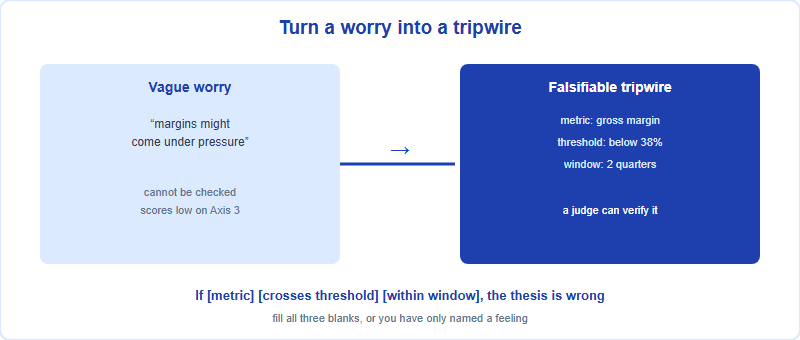
The rubric’s risk axis asks a single question: what would have to be true for this thesis to be wrong? Strong entries answer in concrete, falsifiable terms. Weak entries answer in hand-waves. The difference is specificity — a named metric, a named threshold, a named time window.
| Hand-wave (scores low) | Falsifiable risk (scores high) | Why the second wins |
|---|---|---|
| “If the macro turns against us…” | “If the policy rate is cut fewer than two times this year…” | A reader can check it against a real event |
| “If margins come under pressure…” | “If gross margin falls below 38% for two consecutive quarters…” | Names the metric, threshold, and window |
| “If competition heats up…” | “If the top competitor’s unit share rises above 30% by Q4…” | Turns a vague fear into a tripwire |
| “If demand weakens…” | “If same-segment shipments decline year-on-year for two quarters…” | Falsifiable, not rhetorical |
A simple discipline produces this: for every risk, write a sentence in the form “If [named metric] [crosses threshold] [within window], the thesis is wrong.” If you cannot fill in all three blanks, you have not finished thinking about the risk — you have only named a feeling. The act of forcing thresholds also strengthens your underlying thesis, because you often discover the bet depends on a variable you had not consciously chosen.
There is a second payoff that teams under-rate. A falsifiable risk is also a measurable one, which means your weekly process can actually track it. “Watch for competition” gives the team nothing to check on a Monday; “watch whether the lead competitor’s unit share crosses 30% by Q4” gives them a number to pull each week and a clear trigger for action. Falsifiable risks are not just better for the score — they are the only kind your revision cadence can monitor, which is why the strongest defenses read like a set of instruments, each with a needle the team checks on schedule.
Pre-empt the skeptic: argue the other side before the judge does
A defense is not only about your risks — it is about the counter-arguments a skeptical reader will raise. The strongest briefs include a short “steelman” of the opposing case: the most credible version of why the thesis fails, stated fairly, then addressed. This does two things. It signals intellectual honesty, and it removes the judge’s most obvious line of attack by getting there first.
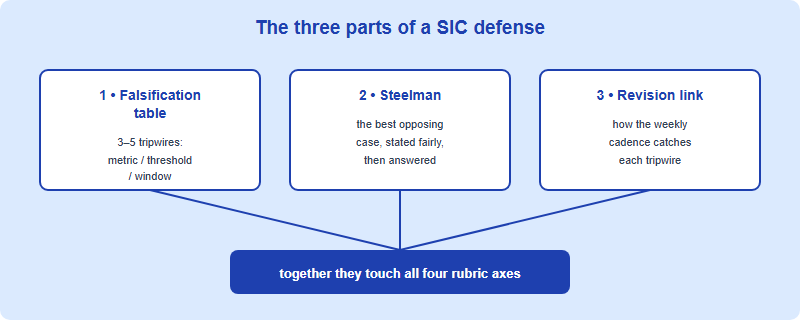
A workable structure for the substance of a defense, in three parts:
- The falsification table. Your three to five tripwires, each with metric / threshold / window, as above. This is the backbone.
- The steelman. One paragraph stating the best opposing case — not a strawman you can knock over easily, but the version a thoughtful skeptic would actually make — followed by your honest response. Sometimes the right response is “this is a genuine risk we accept, and here is why the asymmetry still favours the bet.”
- The revision link. A short note on how your weekly process would catch each tripwire if it triggered. This connects the defense to Axis 4, Revision Discipline, and shows the thesis is not frozen.
Resist two temptations. First, do not pad the risk section with risks so unlikely they cost nothing to admit — judges read that as evasion. Name the risks that genuinely could break the thesis. Second, do not let the defense quietly rewrite the thesis. If the original bet drifts as you write the defense, log the drift; do not bury it. A team whose thesis silently mutates to dodge its own risks is exactly the pattern the revision axis is designed to catch. The habit that prevents this is simple: write the defense against a frozen copy of the thesis, and treat any change you discover as a logged decision, not a quiet edit.
How the defense connects to the rest of your brief
The defense is not a bolt-on chapter; it is the stress test of everything upstream. A clean defense exposes weak links in the thesis, the valuation, and the evidence — which is why writing it early, in draft, is more useful than saving it for the final week. The relationship runs both ways:
| Upstream section | What the defense pressure-tests | Rubric axis touched |
|---|---|---|
| Thesis | Is the bet stated narrowly enough to be falsifiable at all? | Thesis Clarity |
| Evidence | Does each tripwire trace to a primary source a judge can open in one click? | Evidence Quality |
| Risk case | Are the thresholds specific, or are they hand-waves? | Risk Articulation |
| Weekly process | Would your cadence actually catch a triggered tripwire? | Revision Discipline |
For our China-based international-school readers, a final practical point: keep the defense’s sources primary and globally reachable. SIC’s evidence axis is strict — a tripwire that depends on a number a judge cannot verify in one click is a tripwire that scores nothing. Build the falsification table from the same verified-source allowlist you used for the main brief, and you avoid a last-minute scramble to substantiate your own risks. And again: because the defense’s delivery format is not published, confirm it on the official SIC site before you rehearse for any particular format.
A defense-writing checklist
- Write 3–5 falsifiable risks, each as “If [metric] [threshold] [window], the thesis is wrong.”
- Confirm every tripwire’s number traces to a primary, one-click-verifiable source.
- Add one honest steelman of the opposing case, then your response — no strawmen.
- Link each tripwire to how your weekly process would catch it.
- Cut any “risk” that is too unlikely to matter; it reads as evasion.
- Log, do not bury, any drift the defense reveals in the original thesis.
- Confirm the current defense format (live vs written, time limit, judges) on the official SIC site.
A defense built this way does the judge’s hardest work for them — and that is the point. You are not trying to prove your thesis is risk-free; you are proving you understand its risks better than a skeptic does. That is the standard the risk axis rewards, and it is the difference between a brief that sounds confident and one that is genuinely defensible.
Frequently asked questions
Is the SIC defense a live oral pitch?
The official site references a “research brief + defense” but does not publish the defense’s format, time limit, or judge composition. Do not assume a live podium pitch — confirm on the official SIC site.
What makes a risk “falsifiable” for SIC?
It names a specific metric, a threshold, and a time window a judge could check — for example, “gross margin below 38% for two consecutive quarters.” Vague phrases like “if the macro turns” score low.
Should I include arguments against my own thesis?
Yes. A short, honest steelman of the strongest opposing case — then your response — signals intellectual honesty and removes the judge’s most obvious line of attack.
When should I write the defense?
Early, in draft. The defense stress-tests the thesis, valuation, and evidence, so writing it sooner surfaces weak links while there is still time to fix them.
Published by the SIC editorial desk, operated by Hanlin Education for China-based international-school students. Official rules are set by the competition and change yearly — confirm current details, including the defense format, on the official SIC site. Any error is corrected within 7 working days.