To an admissions reader, SIC signals one thing well: that you can build, defend and revise a real investment thesis under expert critique — not that you beat the market. Because SIC is judged on research quality rather than simulated returns, the honest and persuasive way to present it is as a body of structured intellectual work, not as a contest you placed in. This guide shows how to write it up across the activities list, essays and interviews without overclaiming.
What SIC actually signals (and what it does not)
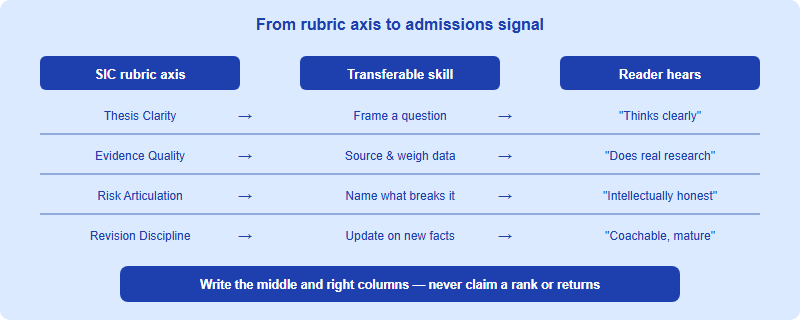
The Student Investment Challenge (SIC) is a research program for grades 6–12, operated by SKT and run for the China/Asia international-school audience as an editorial desk under Hanlin Education. Its evaluation is rubric-based — Thesis Clarity, Evidence Quality, Risk Articulation, Revision Discipline — and the program is explicit that recognition is not awarded for portfolio returns. That design decision is exactly what shapes the admissions signal.
| SIC genuinely signals… | SIC does NOT signal… |
| You can form a thesis and state it clearly under uncertainty | You are a "top trader" or have proven returns |
| You source and weigh evidence (filings, data, macro context) | You are guaranteed admission anywhere |
| You can articulate risk and what would prove you wrong | A national or global "rank" or "championship" |
| You revise your view on the record as facts change | That finance is the only field you can do this in |
| You sustain independent or collaborative research over months | A substitute for grades, rigour or a coherent overall story |
The reason this matters: admissions officers at competitive business and economics programs see a great many "investment competition" lines that all blur together. What stands out is not the activity name but the evidence of a transferable intellectual habit — thinking clearly, defending a claim, and changing your mind honestly. SIC's own framing is that it gives a reader "something specific — a piece of structured intellectual work — to evaluate." Your job is to surface that specific thing. If you have not yet, start with the SIC overview and the rubric breakdown, because the four rubric axes are the vocabulary admissions readers respond to.
Writing the Common App activities list line
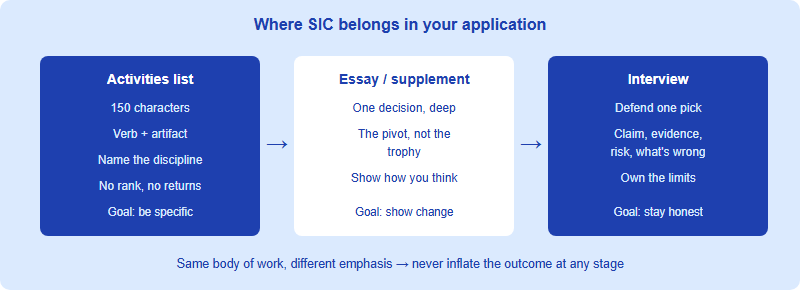
The Common App activities list gives you very little room — a short role/position field and a description capped at 150 characters. Every word has to earn its place. The mistake students make is spending those characters on the program's name and prestige claims. Spend them instead on what you produced and what it shows.
- Lead with the verb and the artifact: "Authored," "Managed," "Researched," "Defended" — then the concrete output (a strategy report on one company; a months-long portfolio with weekly thesis logs).
- Name the discipline, not a placement: describe the work (equity research, risk analysis, thesis revision). Do not write "ranked," "champion," or "top X" unless the program's own recognition language supports the exact claim — and even then, returns and ranks are not what SIC certifies.
- Be specific and verifiable: a reader should be able to picture the artifact. "Wrote a 20-page strategy report arguing [sector] mispricing; revised the thesis twice as new filings landed" beats "participated in a prestigious global investment competition."
Illustrative phrasings (adapt to your real work — do not copy):
| Weaker (prestige-led) | Stronger (work-led) |
| "Competed in top global high-school investment competition." | "Managed a simulated equities portfolio over 4 months; logged and revised an investment thesis weekly." |
| "Led team to high placement in investment challenge." | "Co-authored a team strategy report on one company; owned the risk and valuation sections." |
| "Achieved strong portfolio returns." | "Built a thesis on [company], stress-tested it against downside scenarios, and updated it as evidence changed." |
Using SIC in essays and supplements
An essay is where SIC's rubric design pays off most, because the strongest college essays are not about winning — they are about thinking and changing. The Revision Discipline axis is a gift here: a "time I was wrong and updated" story is far more persuasive than a "time I won" story.
- Write the pivot, not the trophy: the moment a filing or a piece of data forced you to abandon a thesis you were attached to, and what you did next. That is the exact intellectual maturity selective programs screen for.
- Show one decision in depth: resist summarising the whole season. Pick one company, one risk you mis-judged, one paragraph you rewrote three times — and go deep.
- Connect to a genuine interest: if economics, data, or decision-making under uncertainty is your real intellectual home, SIC is evidence of that home — not the destination itself.
Interviews: be ready to be cross-examined
If you list SIC, assume an interviewer who knows finance might ask you to defend your thesis — which is exactly the skill SIC trains. Prepare to talk about one pick in a way that survives a follow-up question.
- Know your strongest thesis cold: the claim, the two or three pieces of evidence, the main risk, and what would prove you wrong. This mirrors the four rubric axes.
- Own the limits: "Here is where I was uncertain" reads as honesty, not weakness. Bluffing a number you cannot defend is the fastest way to lose credibility.
- Never inflate the outcome: if asked "how did you place?", describe what SIC recognises (research output and process) accurately. Misrepresenting a rubric program as a ranked tournament can be checked and will undermine you.
A note for the international-school applicant specifically
For students applying from China and the wider Asia international-school circuit, SIC carries a slightly different weight than it does for a US-based applicant, and it pays to be deliberate about it. Admissions readers at US and UK programs see a heavy volume of finance- and economics-flavoured activities from this region, and many of them blur into one another precisely because they are described in interchangeable, prestige-led language. The differentiator is rarely the program brand — it is whether the line on the page reads like a real piece of work a specific student did.
- Lean on the artifact, because it travels. A reader anywhere can evaluate "a 20-page strategy report that revised its thesis twice." A region-specific recognition tier they have never heard of carries far less, and inviting them to weigh an unfamiliar "rank" can backfire.
- Mind the calendar overlap. The Global Stage (July–August) sits in the same window as summer programs and application-prep season. If SIC is going to anchor part of your story, protect the time to do the work well rather than spreading yourself thin — thin work produces a thin line on the page.
- Keep the program description accurate in translation. Whether you write your application in English or discuss it with a counsellor in Chinese, the underlying claim must stay true to what SIC certifies (research output and process), not drift into "national champion" framing that the program does not support.
The compliance line you should never cross
No academic program — SIC included — guarantees admission to any university, and no one can promise that an activity will "get you in." Treat anyone who claims otherwise with suspicion. SIC's value on an application is real but bounded: it is one credible piece of evidence of how you think, sitting inside a wider story that still depends on your grades, rigour and coherence. Present it that way, and it does honest work. For where SIC sits relative to other options — and why the two are not interchangeable — see our SIC vs Wharton comparison. For any claim about specific recognition wording, advancement, or how alumni have used their entries, confirm the current language on the official SIC site before you put it in an application.
Frequently asked questions
Does SIC help with college admissions?
It can serve as credible evidence that you research, defend and revise an investment thesis. It is not a guarantee of admission, and it works best as one part of a coherent application, not a standalone hook.
Can I say I "ranked" or "won" SIC?
Only if the program's own recognition language supports that exact claim. SIC is rubric-based and does not certify returns or a rank, so describe your research output accurately instead.
How do I write SIC in the Common App activities list?
Lead with a verb and the concrete artifact (a strategy report, a portfolio with weekly logs), name the discipline, and keep it specific and verifiable within the 150-character limit.
What is the best SIC essay angle?
A "time I was wrong and revised" story. It showcases the Revision Discipline rubric axis and the intellectual honesty selective programs look for, more than any "I won" narrative.
Published by the SIC editorial desk, operated by Hanlin Education for China-based international-school students. Official rules are set by the competition and change yearly — confirm current details on the official SIC site. Any errors will be corrected within 7 working days.