The SIC S15 2026 season runs in four stages: an application window of March 20 – June 1, 2026; a Regional Stage across April – July; the Omaha Dialogue in early May (timed to the Berkshire Hathaway annual meeting); and a Global Stage in July – August. The stages overlap, so the season rewards students who plan backwards from these dates rather than reacting to them. This guide tells you what to actually do in each stage.
The four stages, with dates
The Student Investment Challenge (SIC) is a research program for grades 6–12, operated by SKT and run for the China/Asia international-school audience as an editorial desk under Hanlin Education. Below are the S15 stages exactly as published. Note that the Regional and Global stages are date ranges, and the Omaha Dialogue sits inside the Regional window — this overlap is the single most misunderstood part of the calendar.
| Stage | When (S15 / 2026) | What it is |
| 1 · Application | March 20 – June 1, 2026 | Inquiry, eligibility check, division choice, onboarding |
| 2 · Regional Stage | April – July 2026 | The core working period — portfolio + logs (Junior) or strategy report (Senior) |
| 3 · Omaha Dialogue | Early May 2026 | Summit aligned with the Berkshire Hathaway annual meeting |
| 4 · Global Stage | July – August 2026 | Top entries from both tracks advance for the global cohort and recognition |
Timezone caution: the official site states these as calendar windows, not exact clock deadlines. Any specific submission cut-off time and the timezone it is measured in — this matters for a 23:59 deadline when you are in China (UTC+8) versus a US-referenced cut-off — should be confirmed on the official SIC site or with the program desk. Never assume a deadline is local time. If you are new to the program, read our SIC overview first, then come back to this calendar.
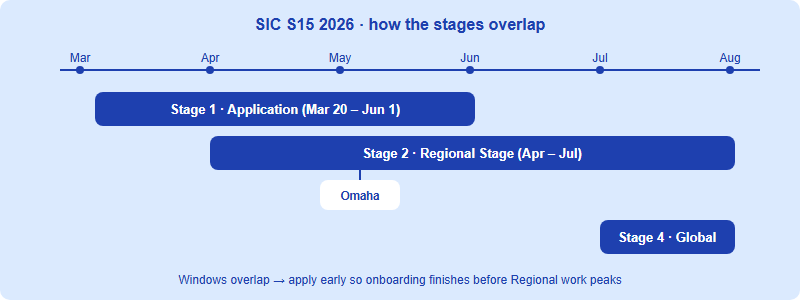
Stage 1 · Application (March 20 – June 1): apply early, not at the buzzer
The application window is wide — over two months — but applying near June 1 is a strategic error. SIC's onboarding (eligibility verification, school consent for grades 6–9, division selection) takes time, and the Regional Stage is already running from April. A student who applies in late May loses weeks of the working period to paperwork.
- Do now: start the inquiry through the program desk; SIC uses an advisor intake rather than a self-serve form, so the earlier you raise your hand, the earlier staff can confirm eligibility and consent.
- Decide: Junior or Senior. If you are unsure, settle this before you onboard — the format shapes everything afterwards.
- Prepare: for grades 6–9, line up the school consent your participation requires so it does not stall onboarding.
- Confirm: the exact application close time and timezone — treat "June 1" as a date to beat by a week, and verify the precise cut-off on the official site.
Stage 2 · Regional Stage (April – July): the season is won here
This is the longest stage and where your actual SIC artifact is built. What you do depends on your division.
| Regional Stage focus | Junior (Trading Track) | Senior (Strategy Track) |
| Weeks 1–2 | Set up your process; define what you will track and why | Agree a thesis; assign sections; set an evidence standard |
| Ongoing | Manage the portfolio; write the weekly thesis log every week without gaps | Research in parallel; reconcile findings into one argument |
| Mid-stage | Review your log for a clear, evolving thesis — not just trades | Use any draft-review checkpoint to fix structure early |
| Stage end | A coherent log that shows judgement under uncertainty | A unified report on one company, sector or macro call |
The rubric is the same for both: Thesis Clarity, Evidence Quality, Risk Articulation, Revision Discipline. The Regional Stage is where each of those is either earned or lost — especially Revision Discipline, which you can only demonstrate by changing your mind on the record over time. For exactly how each axis is scored, see the SIC rubric breakdown. A practical rule: do not save your "real" thinking for the final week. Judges value a thesis that visibly matured across April, May and June over one assembled in July.
Stage 3 · Omaha Dialogue (early May): a fixed program moment inside the Regional Stage
The Omaha Dialogue is timed to coincide with the Berkshire Hathaway annual shareholders meeting in early May. Because it falls inside the Regional Stage, students sometimes treat it as a separate, optional sidetrack — or panic that it is a hard checkpoint that ends their season if missed. Neither framing is reliable.
- What to verify: whether the Dialogue is in-person, virtual, invitation-based, or open, and what (if anything) is required to take part. The official site frames it as a program event aligned with the Berkshire meeting; the specifics of attendance, cost and format should be confirmed with the program desk — do not infer them.
- How to plan around it: keep your Regional work moving through early May regardless. If you do participate, treat the surrounding ideas (value-investing thinking, capital allocation) as fuel for your thesis, not a distraction from it.
Stage 4 · Global Stage (July – August): for advancing entries
The official site states that top entries from both tracks are selected for the global cohort and recognition. The exact selection mechanism, how advancement is communicated, and the precise nature of the recognition are not spelled out publicly and should be confirmed with SIC rather than assumed. What you can plan for:
- Timing overlap with summer: July–August coincides with summer programs, travel and other commitments common to international-school students. If you are aiming to advance, protect some availability in this window rather than over-booking your summer.
- Recognition framing: SIC recognition is rubric-based, not a ranked-prize ladder. Present any outcome honestly — the credible signal is the body of research work, not a claimed "placement." Do not describe SIC as a tournament you "won" unless the program's own language supports that.
A planning rule for the whole season
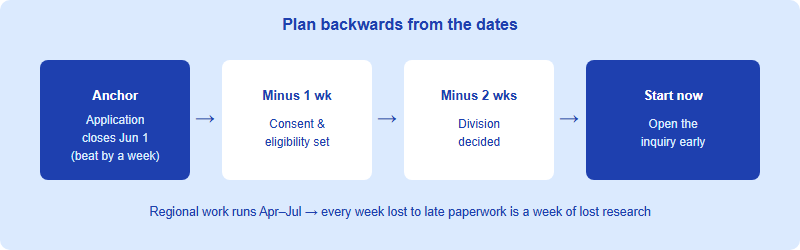
The dates above are for S15 (2026). SIC is a yearly program, and stage windows shift season to season — so for any future season, re-confirm every date on the official site before you build a plan around it. The principle, however, is durable: apply early, treat the Regional Stage as the real work, plan around Omaha rather than fearing it, and protect summer availability if you are aiming for the Global Stage. For how SIC's calendar deliberately avoids clashing with other programs, our SIC vs Wharton comparison maps the two timelines side by side.
Frequently asked questions
When does the SIC 2026 application window open and close?
The S15 application window is March 20 – June 1, 2026. Confirm the exact closing time and timezone on the official SIC site, and aim to apply well before the deadline.
Is the Omaha Dialogue a required checkpoint?
The site frames it as a program event in early May, aligned with the Berkshire Hathaway meeting. Whether attendance is required, in-person or open is not detailed publicly — confirm with the program desk.
What timezone are SIC deadlines in?
The official site states stages as date ranges, not exact clock times or a timezone. Verify any specific submission cut-off and its timezone directly with SIC before relying on it.
What happens in the Global Stage?
Top entries from both tracks are selected for the global cohort and recognition. The precise selection and recognition details are not published — confirm on the official site rather than assuming a ranked outcome.
Published by the SIC editorial desk, operated by Hanlin Education for China-based international-school students. Official rules are set by the competition and change yearly — confirm current details on the official SIC site. Any errors will be corrected within 7 working days.