Choose the SIC Junior Division if you work best alone and want to build a personal investing process across months — it is individual entry, built on a simulated portfolio and weekly thesis logs. Choose the Senior Division if you want to debate a thesis with a team of 2–4 and produce one polished long-form research report. Both are judged on the same rubric, so the right answer is about how you work, not which sounds more impressive. This guide walks you through the decision.
The two divisions at a glance
The Student Investment Challenge (SIC) is a research-focused program for students in grades 6–12, operated by SKT as a China/Asia editorial desk under Hanlin Education for the international-school audience. It runs two parallel tracks that recognise two genuinely different working styles. Neither is a "beginner" or "advanced" tier — they are different formats. Here is the side-by-side, with anything not fixed by the official site flagged as such.
| Dimension | Junior Division (Trading Track) | Senior Division (Strategy Track) |
| Entry format | Individual | Team of 2–4 students |
| Core deliverable | Simulated portfolio managed continuously, with a weekly thesis log of trades, reasoning and revisions | One team-authored investment strategy report on a company, sector or macro position |
| How work is produced | Solo craft — you own every decision | Collaborative — workload split by sector or method, thesis debated internally |
| Eligibility | Grades 6–12 (school consent required for grades 6–9) | Grades 6–12 (school consent required for grades 6–9) |
| Judged on | The same Four-Axis Rubric | The same Four-Axis Rubric |
| Weekly hours | Confirm on the official SIC site / with the program desk | Confirm on the official SIC site / with the program desk |
The single most important line in that table is the last-but-one row: both divisions are scored on the same rubric. SIC does not award more recognition to the Senior report than to the Junior portfolio. As the program states, recognition is awarded by evaluating research output and process, not by rank or simulated returns. A student who chooses the wrong format for their temperament does not look more serious — they usually produce weaker work, because they are fighting their own working style for five months. For the rubric itself, see our breakdown of the SIC rubric.
What each division actually demands of you
The brochure differences (individual vs team) hide the differences that matter day to day. Here is what the two divisions feel like over a season.
Junior Division: a personal process, sustained
- The skill it builds: discipline. You make decisions every week, write down why, and then have to live with — and revise — those decisions in your log. Judges can see your thinking change over time.
- The trap: treating it as a stock-picking game. SIC is explicit that you are not judged on terminal portfolio value. A Junior entrant who beats the market with no clear reasoning scores worse than one who underperforms but documents a sharp, honest, evolving thesis.
- Who thrives: self-directed students who like reading filings, watching macro signals, and owning a craft alone — and who can keep a weekly habit for months without a teammate holding them accountable.
Senior Division: one argument, defended together
- The skill it builds: structured collaboration and long-form argument. Your team produces a single research report, which means you must agree on a thesis, divide the work, and write in one coherent voice.
- The trap: a "stapled" report — four sections written by four people that never reconcile. Judges reward a unified argument, not four mini-essays. Coordination is the real difficulty, not the finance.
- Who thrives: students who think out loud, enjoy defending a view against pushback, and can manage the unglamorous parts of teamwork — version control, deadlines, and a shared standard of evidence.
First-party note from the editorial desk: across the international-school cohorts we work with, the most common avoidable mistake is a strong solo-leaning student joining a team for "safety," then carrying 70% of the report while resenting it — or a collaborative student going solo to look independent, then losing momentum by week six with no one to debate. Pick the format that matches your wiring. The rubric does not reward the harder-sounding choice.
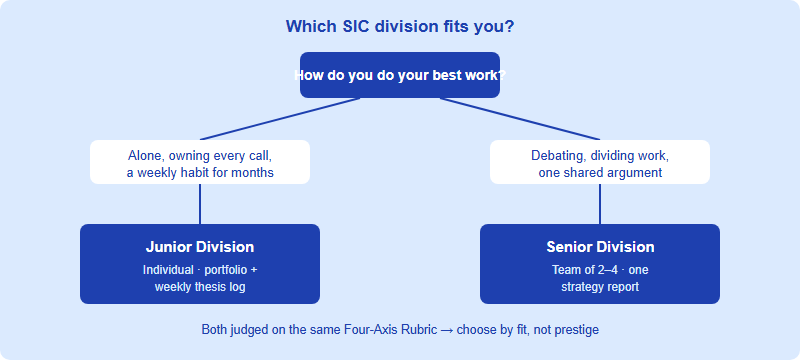
Does grade level decide it?
A frequent question from parents is whether younger students "belong" in Junior and older students in Senior. That is not how SIC is structured. Eligibility for both divisions is grades 6–12. A grade-12 student can absolutely enter the Junior Division if solo portfolio work suits them; a motivated grade-9 student can join a Senior team. Use grade only as a soft input, weighted behind temperament and time:
- Grades 6–9: school consent is required either way. Many younger students find the Junior Division a cleaner first experience because they control the pace — but a younger student with strong, motivated older teammates can thrive in Senior. Confirm consent requirements with the program desk.
- Grades 10–12: often weighing this against an internship or other research commitment. The Senior report is a more concentrated, defensible artifact to discuss in interviews; the Junior log demonstrates sustained independent judgement. Both are legitimate.
If you are still deciding whether SIC is the right program at all before picking a division, start with our overview of what SIC is.
A four-question decision checklist
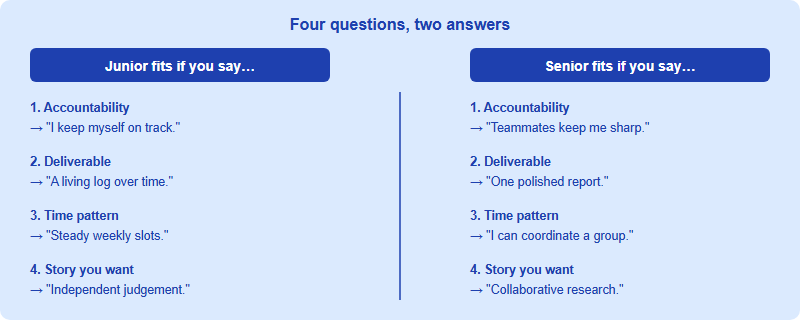
Score yourself honestly across the four questions. If three or four answers lean the same way, you have your division. If you split 2–2, default to the format that matches question 1 (accountability) — over a five-month season, the way you stay motivated matters more than any other single factor.
How the season's shape should factor in
The division you pick interacts with the SIC season calendar, and that interaction is worth thinking through before you commit. The core working period is the Regional Stage, which runs across roughly April to July, and the two divisions stress your schedule differently across those months.
- Junior is a marathon of small weekly efforts. Because the deliverable is a portfolio plus a weekly thesis log, the load is spread evenly — a steady cadence with no single crunch. This suits students whose calendars are predictable week to week but who could not absorb a sudden multi-week sprint on top of exams.
- Senior concentrates effort into a shared report with checkpoints. A team report tends to have heavier coordination peaks — agreeing the thesis early, then reconciling everyone's research into one document before a deadline. This suits students who can clear a few intense weeks but would struggle to maintain a solo weekly habit for months.
- Both must survive the summer overlap. The later part of the season runs into July–August, when many international-school students travel or attend summer programs. A Junior student needs to keep logging through that period; a Senior team needs every member reachable for the final push. Map your real summer before you choose — not the summer you hope to have.
If you want the full stage-by-stage calendar to plan against, our companion guide on the SIC program and season lays out what each stage demands. The exact dates shift each season, so confirm the current window on the official SIC site.
The single biggest failure mode in each division
Knowing how each division most commonly goes wrong is often more useful than knowing how it goes right — because the failure modes are predictable and avoidable.
| Division | Most common failure | The fix |
| Junior | A log that records trades but no evolving reasoning — a diary, not a thesis | Write the "why" and the "what changed," not just the "what." Judges score thinking, not activity. |
| Senior | A "stapled" report: four sections by four people that never reconcile into one argument | Agree the central thesis in week one; assign an editor to enforce a single voice and standard of evidence. |
Both failure modes trace back to the same root: treating SIC as an output to assemble rather than a thesis to develop. The rubric's Revision Discipline axis exists precisely to reward students who let their view mature on the record — which is hard to fake in either division if you start late.
Can you switch, or enter both?
Whether you can change divisions after applying, or participate in both tracks in the same season, is an operational detail that the program desk handles — confirm on the official SIC site or with the SIC program desk. Do not assume a switch is possible mid-season; plan as if your initial choice is your season choice. The application is handled through an inquiry channel rather than a self-serve form, so raise any division questions at intake when staff can advise on consent, fit and onboarding.
Frequently asked questions
Is the Senior Division more prestigious than the Junior Division?
No. Both tracks are evaluated on the same Four-Axis Rubric, and recognition is based on research quality, not which division you chose or simulated returns.
Can a grade-12 student enter the Junior Division?
Yes. Eligibility for both divisions is grades 6–12. Choose by working style and time, not grade. Confirm any consent requirements with the program desk.
How many people are on a Senior team?
Senior Division teams are 2 to 4 students. The Junior Division is individual entry only.
How many hours per week does each division take?
The official site does not publish a fixed weekly figure. Ask the SIC program desk for the current season's expectation before committing.
Published by the SIC editorial desk, operated by Hanlin Education for China-based international-school students. Official rules are set by the competition and change yearly — confirm current details on the official SIC site. Any errors will be corrected within 7 working days.