Top-down sector research for the Student Investment Challenge (SIC) means narrowing from the macro picture, to one industry, to a single defensible company — before you open a valuation model or a 10-K. Strong SIC briefs almost always sit on a sector view, because the official Senior engine lets a team defend “a company, sector, or macro position.” This guide walks that funnel and shows where each step feeds the four-axis rubric.
Why the funnel comes before the math
Most first-time SIC competitors start at the bottom: they pick a company they already like, then hunt for reasons it will go up. That is backwards, and judges can tell. SIC is a research program, not a trading contest — recognition rewards research output and process, not raw returns — so a thesis that exists only because the stock is popular has no spine to defend.
The top-down funnel fixes this by forcing you to answer a bigger question first: why this part of the economy, now? When your company pick is the logical endpoint of a sector argument, three things improve at once. Your thesis clarity sharpens because the bet has a context. Your evidence quality rises because sector research naturally pulls primary macro sources. And your risk articulation gets concrete because you already know which macro variables your thesis depends on. You can see exactly how those axes are scored in our walkthrough of the SIC rubric.
This does not mean every SIC entry must be a macro call. It means every entry should be able to answer “what has to be true about the wider economy and this industry for my pick to work?” The funnel is how you get that answer on paper.
The three levels of the funnel
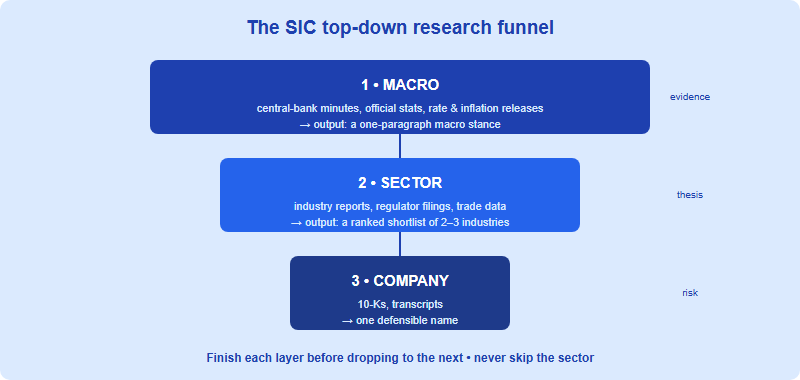
Think of top-down research as three narrowing layers, each producing a written output you carry into the next. The discipline is to finish a layer before dropping to the one below it — the most common mistake is jumping straight from a vague macro hunch to a specific stock, skipping the sector entirely.
| Level | The question | Primary sources to use | Output you carry down | Rubric axis it strengthens |
|---|---|---|---|---|
| 1 · Macro | What is the economy doing, and where is policy headed? | Central-bank statements and minutes, official statistics, rate and inflation releases | A one-paragraph macro stance with named drivers | Evidence quality |
| 2 · Sector | Which industry benefits or suffers under that stance? | Industry reports, regulator filings, sector ETFs’ holdings, trade data | A ranked shortlist of 2–3 industries with a reason | Thesis clarity |
| 3 · Company | Within the winning sector, which single name expresses the bet best? | 10-Ks, earnings transcripts, primary company disclosures | One company + the metric that proves it leads the sector | Risk articulation |
A worked illustration (hypothetical, for method only): a team forms a macro stance that a rate-cutting cycle is plausibly underway. At the sector level they shortlist housing-linked industries, regulated utilities, and small-cap growth — then pick one because it is the most directly rate-sensitive, not the most exciting. Only at level three do they choose a single company, and they justify that choice with one hard number that shows it leads its sector. The bet now reads as a chain: macro → sector → company, each link sourced.
Doing the sector layer well: the part most teams skip
The sector layer is where briefs are won, because it is the layer most teams rush. Three habits separate a strong sector analysis from a thin one:
- Define the sector by what it does, not by a ticker. “Semiconductors” is too broad; “fab-less chip designers exposed to data-centre demand” is a sector you can actually reason about. Specificity here flows straight into thesis clarity later.
- Find the sector’s one or two swing variables. Every industry turns on a small number of drivers — a commodity input price, a regulatory decision, a demand cycle. Name them. These become the falsifiable thresholds your risk lead will use.
- Rank, don’t just list. A shortlist of three industries with a stated reason each is far stronger than a single industry asserted. Showing your work — why this sector beat the runner-up — is exactly the kind of documented reasoning SIC rewards over a confident guess.
A practical tool for the sector layer: open a sector ETF’s published holdings and read the top ten names. You are not buying the ETF — you are using its constituents as a free, primary map of who actually competes in the industry, before you commit to studying one of them in depth.
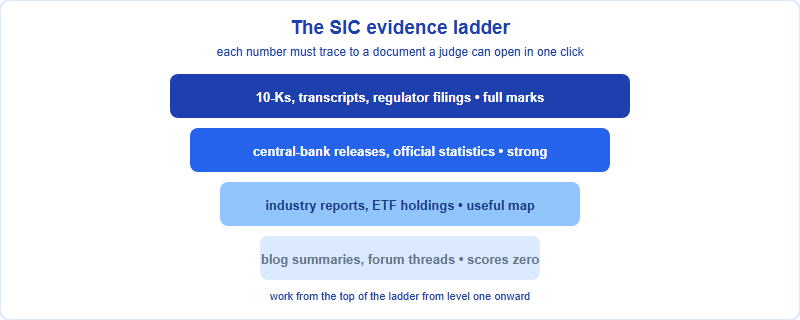
Underneath all of this sits source quality. Prefer primary sources: a figure pulled from a primary filing is verifiable; the identical figure quoted “as reported by” a blog is far weaker. (Confirm exact source-scoring on the official SIC site.) Build the sector layer from the top of that ladder and your evidence score is protected before you write a word of the company analysis.
Where the funnel hands off to the rest of your prep
Top-down research is the front end of the SIC workflow, not the whole of it. Once the funnel delivers a single company, you move into the deeper, company-level work covered elsewhere in this series: turning the chain into a written argument is a job for the investment thesis; pressure-testing the price is valuation; verifying the operating reality is reading the 10-K. The funnel’s value is that it makes all three downstream steps easier, because you arrive at them already knowing why this company, in this sector, under this macro stance.
| After the funnel delivers a company… | Next step | What it answers |
|---|---|---|
| You have one name and a sector reason | Write the investment thesis | Can a non-expert grasp the bet in two sentences? |
| You have a thesis | Run a valuation | Is the price defensible, or already pricing the story in? |
| You have a valuation | Read the 10-K | Does the filing confirm or contradict the operating story? |
| You have all three | Build the risk/falsification table | What macro or sector fact would make this wrong? |
For our China-based international-school readers, one note on sources: build the habit of citing primary, globally accessible documents from the start. Aim for each cited number to trace back to a document a judging panel can open directly, and confirm any source-eligibility guidance on the official SIC site. Working from primary macro and sector sources from level one onward means you never have to retrofit citations later.
A sector-research checklist for your SIC brief
- Write a one-paragraph macro stance with at least two named, sourced drivers.
- Translate that stance into a ranked shortlist of 2–3 industries, each with a reason.
- Define your chosen sector narrowly — by function, not by a single ticker.
- Name the sector’s one or two swing variables; these become your risk thresholds.
- Use a sector ETF’s holdings as a primary map of the competitive set.
- Only then pick one company — and state the single metric that shows it leads.
- Confirm any program rules (deliverable length, division, deadlines) on the official SIC site.
Run the funnel in this order and your eventual stock pick is not a guess you have to defend — it is a conclusion the reader can follow from the top of the economy down to one name. That chain is what turns a decent SIC entry into a defensible one. If you are still deciding whether SIC is the right fit, start with our complete SIC overview.
Frequently asked questions
What is top-down research in the SIC context?
It means narrowing from the macro economy, to one industry, to a single company — finishing each layer before the next — so your final stock pick sits on a defensible sector and macro view.
Does a SIC brief have to be a macro call?
No. But every entry should answer what must be true about the economy and industry for the pick to work. SIC’s Senior engine lets teams defend a company, sector, or macro position.
What sources count for the sector layer?
Primary ones: industry and regulator filings, trade data, central-bank releases, and a sector ETF’s published holdings. Prefer these over secondary aggregators.
Why not just pick a company I already like?
Because judges reward documented reasoning, not popularity. A top-down chain gives the pick a context a skeptic cannot easily dismiss; a standalone favourite has no spine to defend.
Published by the SIC editorial desk, operated by Hanlin Education for China-based international-school students. Official rules are set by the competition and change yearly — confirm current details (deliverable formats, division rules, deadlines) on the official SIC site. Any error is corrected within 7 working days.