The most common reason a Student Investment Challenge (SIC) thesis is weaker than the analyst behind it is not a maths error or a missed number — it is a cognitive bias the writer never noticed. Because SIC scores thesis clarity, evidence quality, risk articulation, and revision discipline, biases hurt you twice: they distort the underlying decision, and they leave visible fingerprints a judge is trained to spot. This guide walks through seven biases that quietly weaken student investment reports and pairs each with a concrete habit to keep your reasoning honest.
Why judges are effectively bias detectors
A SIC judge cannot see your portfolio’s future, but they can see your thinking. When a report only presents evidence that supports the buy, ignores obvious risks, or leans on the fact that “everyone likes this stock,” the judge reads those as tells — signs the analysis was driven by feeling rather than discipline. That is why the site’s editorial position is that conviction beats returns at the judging table: a well-reasoned thesis that acknowledges what could go wrong outscores a lucky return the writer cannot fully explain.
Behavioral finance is the study of exactly these systematic thinking errors. You do not need to master the academic literature to compete, but you do need to recognise the handful of biases that show up most in student briefs — and build the small habits that neutralise them. Doing so directly strengthens two rubric axes at once: risk articulation (you name the downside honestly) and thesis clarity (your argument stops contradicting itself).
It helps to understand why these errors are so hard to catch on your own. Biases feel like reasoning, not mistakes — when you seek out supporting evidence, it feels like diligence; when you follow the crowd, it feels like prudence. That is what makes an outside reader so valuable and why judges are so effective: they have no emotional stake in your idea, so the moves that feel natural to you look like gaps to them. The goal of this guide is to let you become that outside reader of your own work before a judge has to.
The seven biases, and how each shows up in a brief
| Bias | What it is | How it shows up in a SIC report |
|---|---|---|
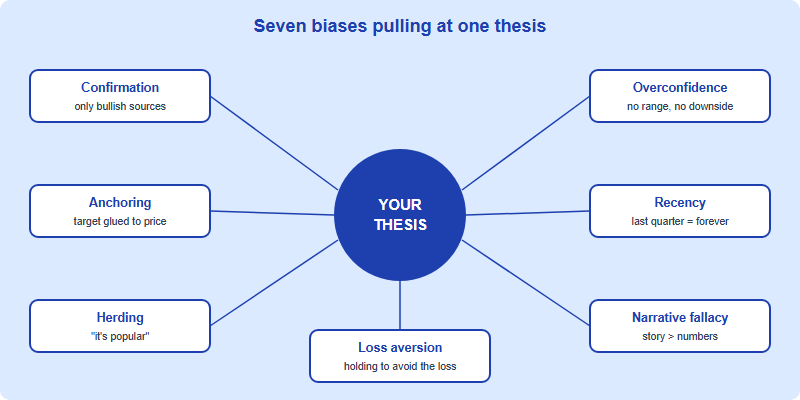
| Confirmation bias | Seeking evidence that supports what you already believe | Every source cited is bullish; no disconfirming data appears |
| Anchoring | Over-relying on the first number you saw | A price target glued to the current price or a past high |
| Herding | Following the crowd because it is the crowd | “This is a popular, well-known company” used as a reason |
| Overconfidence | Overestimating the precision of your own view | A single-point forecast with no range and no “if I’m wrong” |
| Loss aversion | Feeling losses more than equal gains | Holding a broken position to avoid “realising” the loss |
| Recency bias | Overweighting the most recent events | Extrapolating last quarter’s trend as if it must continue |
| Narrative fallacy | Preferring a good story over messy data | A clean, compelling story that the numbers don’t actually support |
Read that “how it shows up” column carefully, because it is also a checklist of what a judge notices. A report that cites only bullish sources signals confirmation bias. A price target that just happens to sit a round percentage above today’s price signals anchoring. “It’s a famous company” signals herding. None of these are fatal on their own, but together they turn a thesis from an argument into a wish.
The counter-habits: turning biases into scoring points
Biases are automatic, so you cannot simply decide to stop having them. What works is installing habits that force the opposite behaviour. Each of the following is small, repeatable, and directly visible to a judge — meaning the fix does not just improve your decision, it shows up as a stronger report.
| Bias | Counter-habit | Rubric axis it strengthens |
|---|---|---|
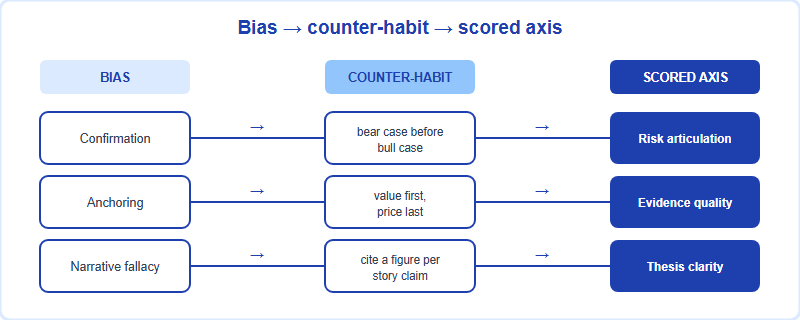
| Confirmation | Write the bear case in full before you write the buy | Risk articulation |
| Anchoring | Derive a value independently, then compare to price last | Evidence quality |
| Herding | State a reason the crowd could be wrong, or drop the idea | Thesis clarity |
| Overconfidence | Give a range and one line on what would break the thesis | Risk articulation |
| Loss aversion | Pre-set exit rules; sell on thesis, not on price feeling | Revision discipline |
| Recency | Look at several years, not just the latest quarter | Evidence quality |
| Narrative fallacy | For each story claim, cite the number that backs it | Thesis clarity |
The single most powerful of these is the first: write the bear case before the bull case. Force yourself to build the strongest possible argument against your own idea before you are allowed to defend it. This is sometimes called the pre-mortem — imagine it is the end of the season and your thesis failed, then explain why. If the bear case is weak, your conviction is earned; if it is devastating and you have no answer, you just saved yourself from a losing position. Either way, the risk articulation axis rewards you for having done it in writing. The “defense” half of a strong brief is built on exactly this move.
A second high-leverage habit addresses anchoring and the narrative fallacy together: value the company before you look at its price, and cite a number behind every sentence of the story. If you form a view of what a business is worth from its fundamentals first, the market price becomes a thing you compare against rather than a magnet your target drifts toward. And if every clause of your compelling narrative is chained to a verified figure, the story can no longer float free of the data. For the mechanics of turning that reasoning into a scored document, see the section-by-section rubric breakdown.
The reason these habits work is that they change the order in which you think, not just the content. A biased process reaches its conclusion first and gathers support afterwards; a disciplined process gathers evidence and lets the conclusion follow. Reordering the steps — bear case before bull case, valuation before price, figure before claim — is what converts a private hunch into an argument a stranger can check. The chain below shows how each named bias is caught by a specific counter-habit and turned into points on a specific rubric axis.
A bias audit for your final read-through
Before you submit, do one pass whose only purpose is to hunt for your own biases. Read the report as a skeptic who wants it to fail, and ask:
- Confirmation: Does a genuine counter-argument appear, or is every source on my side?
- Anchoring: Did I derive value independently, or does my target simply hug the current price?
- Herding: Have I written a specific reason the consensus might be wrong?
- Overconfidence: Is there a range and an explicit “this thesis breaks if ___” line?
- Loss aversion: Are my exit rules written down in advance, independent of price?
- Recency: Am I looking at multi-year context, not just the latest data point?
- Narrative: Is every story claim backed by a figure I can source?
None of this requires you to become a behavioral economist. It requires the humility to assume you are biased — everyone is — and the discipline to write your way out of it. That combination is precisely what SIC’s rubric is built to reward, and it is the through-line connecting a clear thesis, honest risk articulation, and genuine revision discipline. If you want the wider context of how these judgment skills fit into the competition as a whole, start with our complete guide to what SIC is.
Frequently asked questions
Do I need to study behavioral finance formally to do well at SIC?
No. You only need to recognise the handful of biases that appear most in student briefs and install simple counter-habits, like writing the bear case first, before you submit.
What is the single most useful anti-bias habit?
Writing the bear case before the bull case — a pre-mortem. Building the strongest argument against your own idea first exposes confirmation bias and strengthens the risk-articulation axis.
How do judges even detect bias in a written report?
Through fingerprints: only-bullish sources, a target glued to the current price, or “it’s popular” used as a reason. A report that names its own risks reads as disciplined, not weak.
Isn’t a confident, single-number forecast more impressive to judges?
Usually the opposite. Overconfidence shows as false precision; a range plus a clear “this breaks if ___” reads as honest analysis and tends to score better on risk articulation.
Published by the SIC editorial desk, operated by Hanlin Education for China-based international-school students. Official rules are set by the competition and change yearly — confirm current details on the official SIC site. Any errors will be corrected within 7 working days.