Evidence quality is one of the four axes SIC judges score, and it is the one students most often lose points on without realising it. A number is only as strong as where it came from: a figure pulled from a company’s own annual filing carries weight, while the same figure copied from an anonymous forum post carries none. This guide maps out where to find reliable company and market data, how to rank sources from primary to unusable, and how to cite them cleanly in a SIC Investment Strategy Report or weekly thesis log so that every claim in your thesis can be traced.
Why sourcing is a scored skill, not an afterthought
SIC’s official four-axis rubric names evidence quality alongside thesis clarity, risk articulation, and revision discipline. In practice this means a judge reading your report is not just asking “is this claim true?” but “can I see where this came from, and do I trust that source?” A brilliant thesis built on shaky numbers is a shaky thesis. The editorial desk that runs this site treats verification as non-negotiable, and describes how it checks every figure it publishes in how the SIC editorial desk verifies every number — the same standard you should hold your own brief to.
The mistake beginners make is treating data as decoration: they find a chart that supports the story and paste it in. The competitor who scores well does the opposite — they start from the primary document, extract the number themselves, and cite it precisely. That habit is the difference between a report a judge can audit and one they have to take on faith. It also reflects how SIC positions itself against research-lighter formats; our side-by-side comparison of SIC and the Wharton Global High School Investment Competition shows why a traceable evidence trail matters here specifically.
A reliability ladder for financial sources
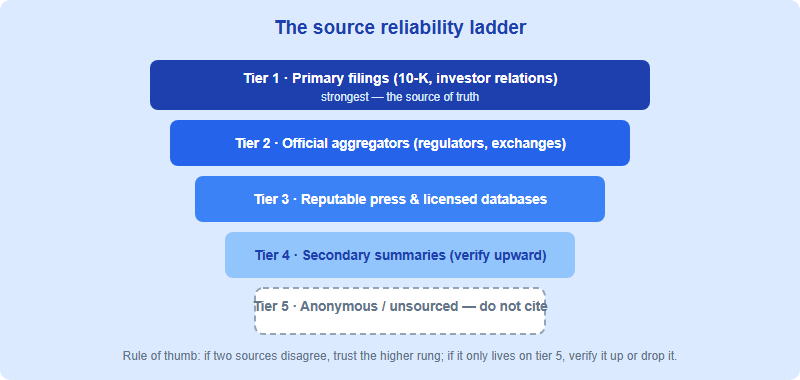
Not all sources are equal, and the single most useful mental model is to rank them. When two sources disagree, the higher rung wins. When you can only find a claim on a low rung, that is a signal to either verify it upward or soften your language.
| Tier | Source type | Examples | Best used for |
|---|---|---|---|
| 1 — Primary | The company’s own regulatory filings and investor materials | Annual report / 10-K, quarterly report, official investor-relations page, earnings release | Revenue, margins, debt, segment data, management’s own words |
| 2 — Official aggregators | Government and exchange data | Securities-regulator filing databases, stock-exchange disclosure portals, central-bank and statistics-bureau data | Verifying filings, macro indicators, share counts |
| 3 — Reputable financial press & databases | Established outlets and data providers | Major financial newspapers, recognised market-data terminals your school may license | Context, timelines, expert commentary, cross-checking |
| 4 — Secondary summaries | Explainers and analyst write-ups | Broker notes, reputable analysis blogs | Finding leads to verify upward — never the final citation |
| 5 — Unusable | Anonymous or unverifiable | Forum posts, social media rumours, AI chatbot output with no source | Nothing. Do not cite. |
A note on AI tools: a chatbot can help you understand a concept or draft a sentence, but a figure it produces without a traceable source sits on tier 5. If you cannot follow the number back to a filing or an official database, it does not belong in your brief. This is not a rule against using tools — it is the same standard you would apply to any unsourced claim.
Where the numbers actually live
Once you know the ladder, the practical question is where to look first. For a company-level thesis — the heart of most Senior Division reports — the fastest route to tier-1 data is almost always the company itself.
- The annual report (10-K or local equivalent). This is where revenue, profit, debt, segment breakdowns, and risk factors live in the company’s own words. If your thesis rests on a financial fact, this is where you confirm it. Our companion guide, the complete guide to what SIC is, links onward to how to read one of these filings efficiently.
- The investor-relations (IR) page. Every listed company runs one. It carries earnings releases, investor presentations, and the official investor contact — the cleanest place for the latest quarterly numbers and management commentary.
- The regulator’s filing database. Securities regulators host searchable archives of everything a company has filed. Use these to confirm that a figure you saw elsewhere matches the official document, and to check filing dates.
- The exchange’s disclosure portal. Stock exchanges publish company announcements and disclosures, useful for share counts, corporate actions, and timelines.
- Official statistics and central-bank sites. For any macro claim in a top-down thesis — growth, inflation, interest rates — go to the statistics bureau or central bank rather than a news summary of them.
Note that specific database names, URLs, and which market-data terminals your school licenses vary by country and by year — confirm the current official sources for the market you are analysing rather than assuming. The principle is stable even when the addresses change: go to the body that produces the number, not the site that repeats it.
How to cite a source in a SIC brief
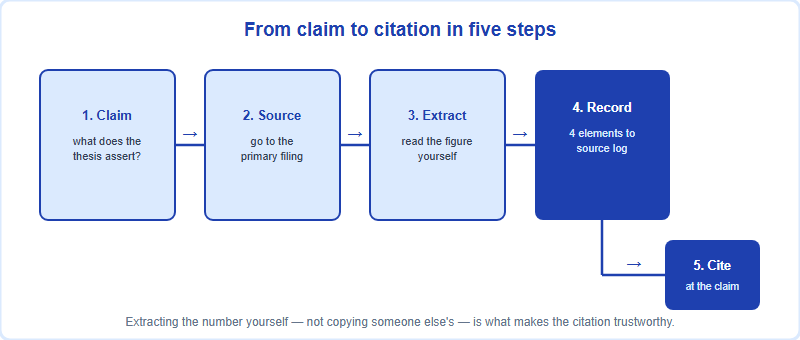
A citation has one job: let a judge find the exact number you used, quickly. You do not need a formal academic bibliography style unless the current SIC guidelines ask for one — confirm the required format on the official site — but you do need every non-obvious figure to be traceable. A workable, judge-friendly citation carries four elements.
| Element | Why it matters | Example fragment |
|---|---|---|
| Who produced it | Establishes the tier and authority | Company X FY2025 Annual Report |
| What document / section | Lets the judge locate it inside the source | Consolidated income statement, p. 42 |
| The specific figure | The claim being supported | Revenue of [figure] for FY2025 |
| Date accessed / period | Data changes; anchors it in time | Fiscal year ended [date]; accessed [date] |
Two disciplines turn this from theory into a scoring advantage. First, cite at the point of the claim, not in a lump at the end. A sentence like “revenue grew because the core segment expanded (Company X FY2025 Annual Report, segment note)” is far stronger than an unmarked paragraph followed by a wall of links. Second, keep a source log as you go. Every time you use a number, drop its four elements into a running list. When you assemble the final report you already have a complete, dated evidence trail — the same working habit that supports the “revision discipline” axis and mirrors how a careful desk verifies its own numbers.
A pre-submission evidence audit
Before you submit, run one focused pass over your report that ignores the prose entirely and looks only at the numbers. This is the fastest way to catch the errors that quietly cost evidence-quality points:
- Highlight every specific figure, percentage, and date in the document.
- For each one, confirm you can name the tier-1 or tier-2 source it came from — not a summary of it.
- Delete or soften any claim that only traces to tier 4 or 5. “Reportedly” is not a source.
- Check that each citation lets a stranger find the exact number in under a minute.
- Confirm dates: is this the latest filing, and does the period match what your sentence claims?
- Cross-check your two or three most load-bearing numbers against a second source on the ladder.
Teams that skip this audit are the ones who lose points to avoidable slips — a stale figure, a number that traces only to a forum, a percentage nobody can reproduce. It is also one of the failure patterns in our review of common SIC mistakes. Fifteen minutes of auditing your own evidence is one of the highest-return things you can do before the deadline, precisely because the evidence-quality axis is scored and most competitors never check their own sources with this much discipline.
Frequently asked questions
Can I use an AI chatbot to find data for my SIC brief?
Use it to understand concepts or draft text, but any figure it gives without a traceable source is unusable evidence. Always confirm the number in a primary filing or official database before citing.
What counts as a primary source for a company?
The company’s own regulatory filings (such as the annual report or 10-K) and its official investor-relations materials. These are the strongest tier because the numbers come straight from the issuer.
Does SIC require a specific citation format?
Citation-format requirements can change yearly — confirm on the official SIC site. Regardless of format, every non-obvious figure should be traceable to its source with producer, document, figure, and date.
Two sources give different numbers — which do I use?
Trust the source higher on the reliability ladder, usually the company’s own filing over a news summary. Note the discrepancy in your log and cite the primary figure.
Published by the SIC editorial desk, operated by Hanlin Education for China-based international-school students. Official rules are set by the competition and change yearly — confirm current details on the official SIC site. Any errors will be corrected within 7 working days.