Building a portfolio is a single decision; running one across a full Student Investment Challenge (SIC) season is dozens of them. Position sizing and selling discipline are the two skills that separate a portfolio you can defend from one that simply drifted. Because SIC advancement turns on the clarity of your thesis rather than the growth of your portfolio, every size you set and every position you exit is really an argument you will have to justify in your Investment Strategy Report or weekly thesis log — so treat sizing and selling as writing, not just trading.
Why sizing and selling are separate skills from construction
Most first-time competitors think about a portfolio once: they pick names, split their capital, and move on. The problem is that the day-one allocation is the easy part. Over the following weeks prices move, theses are confirmed or broken, and new information arrives. A portfolio that is never re-examined is not “long-term conviction” — it is neglect wearing a costume.
SIC’s structure makes this explicit. The Junior Division runs on an individual portfolio simulation with a weekly thesis log, and the Senior Division builds toward a defended Investment Strategy Report. Both formats reward you for showing your reasoning change over time. The official four-axis rubric — thesis clarity, evidence quality, risk articulation, and revision discipline — literally names “revision discipline” as a scoring axis. That axis is where sizing and selling live. If you want to read how the four axes fit together, our section-by-section rubric breakdown is the companion piece to this one.
| Skill | When it happens | Rubric axis it feeds | Common failure |
|---|---|---|---|
| Construction | Day one | Thesis clarity | Owning too many names to defend |
| Position sizing | Entry + ongoing | Risk articulation | Equal-weighting everything by default |
| Selling discipline | Ongoing | Revision discipline | Holding a broken thesis out of hope |
| Documentation | Weekly | Evidence quality | Logging prices, not reasoning |
Sizing by conviction, not by reflex
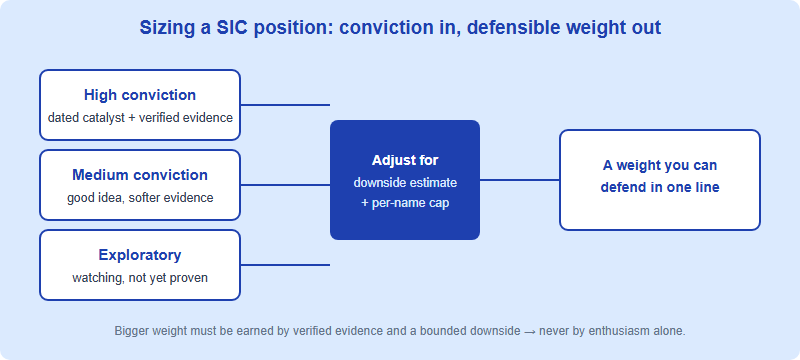
The default instinct is to equal-weight: five ideas, twenty percent each. Equal-weighting is defensible as a starting point, but it quietly says every idea is equally good, which is almost never true. A stronger habit is to size each position to reflect two things you can actually articulate: how confident you are in the thesis and how much you could lose if you are wrong.
You do not need a complex formula for a student competition. You need a rule you can explain to a judge in one sentence. A workable framework:
- Conviction tier. Rank each idea High / Medium / Exploratory. A High-conviction name has a clear catalyst, evidence you have verified from primary sources, and a specific reason the market may be mispricing it.
- Downside estimate. For each name, write one line: “If my thesis is wrong, the realistic downside is roughly X%.” A position where the downside is vague should be smaller, not larger.
- Cap the tail. Set a maximum weight for any single name before you start (for example, no position above a fixed share of the book). This protects you from letting one lucky winner balloon into the whole story.
- Leave room to be wrong. If you cannot name what would make you cut a position, it is probably too big.
The point is not that a High-conviction idea deserves a huge weight — it is that you can defend the weight you chose. “I sized this at 15% because the catalyst is dated, the downside is bounded, and I verified the numbers in the 10-K” is a rubric-friendly sentence. “I put in 40% because I really like it” is not.
Selling discipline: deciding in advance, not in the moment
Selling is where most portfolios quietly fall apart, because the two hardest sells are emotional opposites. You hold losers hoping they come back, and you dump winners the moment they wobble. Both are decisions made in the moment, driven by how the price feels rather than what the thesis says.
The fix is to decide the exit rules before you need them and write them into your log. There are only a few honest reasons to sell:
- The thesis broke. The specific reason you bought is no longer true — the catalyst was cancelled, the numbers came in the opposite way, the moat you described eroded. This is the cleanest sell and the one judges respect most, because it shows revision discipline in action.
- The thesis played out. The catalyst happened and the mispricing closed. Holding “because it’s been good to me” is not a thesis.
- A better idea needs the capital. You found a higher-conviction position and something has to fund it — but you should be able to explain why the new name is genuinely better, not just newer.
- Risk got out of hand. A position grew past your per-name cap and now dominates the book. Trimming back to your rule is discipline, not timidity.
Notice what is not on the list: “the price dropped and I got scared,” or “the price rose and I got greedy.” Price movement is information that should make you re-check the thesis; it is not, by itself, a reason to trade. The most valuable habit you can build is the pre-mortem: on the day you buy, write the sentence “I will sell this if ___.” When that sentence comes true, you already made the decision calmly — you are just executing it.
Making the weekly log do the work
Whether you are in the Junior Division writing a weekly thesis log or a Senior team building toward an Investment Strategy Report, the log is not a scoreboard. Judges are not primarily interested in what your portfolio returned that week; they want to see how your thinking evolved. A log that only records prices is throwing away the easiest points on the “revision discipline” and “evidence quality” axes.
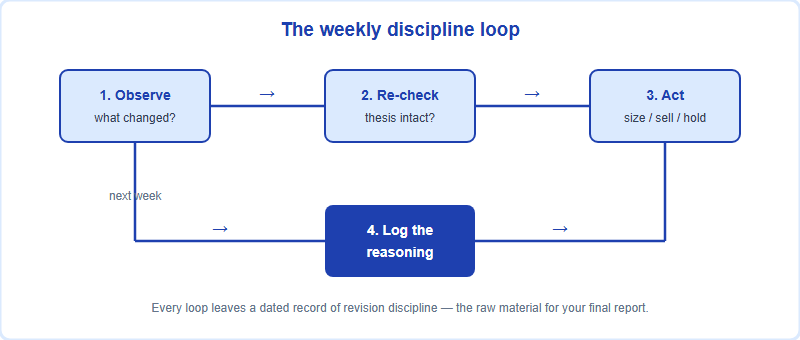
A high-value weekly entry answers four questions in a few lines each:
| Prompt | What a weak entry writes | What a strong entry writes |
|---|---|---|
| What changed? | “Stock X went up 4%.” | “X reported earnings; revenue confirmed the growth my thesis assumed.” |
| Does new info confirm or challenge the thesis? | (skipped) | “Confirms — margins held, so I am keeping the position.” |
| Any sizing or selling action? | “No change.” | “Trimmed Y back to my 15% cap after it ran; redeployed into Z.” |
| What would change my mind next week? | (skipped) | “If Z’s next data point misses, my catalyst is dead and I exit.” |
Kept honestly, a season of these entries becomes the backbone of your final report. You are not scrambling to reconstruct why you did things — you have a dated trail showing you sized by conviction, sold on thesis, and updated on evidence. That trail is exactly what the four-axis rubric is built to reward. Teams that neglect it are the ones described in our roundup of common SIC mistakes that cost teams the final.
A first-week checklist for the rest of the season
You can put all of this in place in one sitting. Before your next log entry, set the rules once so that every future week is execution, not improvisation:
- Assign every current holding a conviction tier and write a one-line reason for its weight.
- Write the downside estimate for each position: “if I’m wrong, roughly X%.”
- Set a hard per-name cap and check whether anything already exceeds it.
- For each name, complete the sentence “I will sell this if ___” and keep it in the log.
- Decide your weekly log template — the four prompts above — and reuse it every week.
Do this and your portfolio stops being a static bet and becomes a documented argument that improves each week. That is precisely the behaviour SIC’s rubric is designed to reward: not the team that got lucky, but the team that can show, entry by entry, that it sized with reason, sold with discipline, and updated with evidence. For the bigger picture of how these weekly decisions ladder up across the season, see our complete guide to what SIC is and how it works.
Frequently asked questions
Should I equal-weight my SIC portfolio to keep it simple?
Equal-weighting is a fine starting default, but sizing by conviction and downside earns more on the risk-articulation axis — as long as you can defend each weight in one sentence.
Does selling a position hurt my score because it looks indecisive?
No. Selling because a thesis broke is revision discipline, which is a named rubric axis. Judges reward a documented, reasoned exit over stubbornly holding a broken idea.
Do judges care more about my returns or my reasoning?
The official principle is that advancement turns on thesis clarity and articulation, not portfolio growth. Log your reasoning, not just prices; confirm current judging details on the official SIC site.
How often should I make sizing or selling changes?
Only when the thesis, evidence, or your risk limits actually change — not because the price moved. Over-trading on price noise is a classic mistake; decide exit rules in advance.
Published by the SIC editorial desk, operated by Hanlin Education for China-based international-school students. Official rules are set by the competition and change yearly — confirm current details on the official SIC site. Any errors will be corrected within 7 working days.