An economic moat is a durable structural advantage that lets a company defend its profits from competitors — and it is one of the most persuasive things you can demonstrate in a SIC thesis, because it answers the judge's deepest question: why will this still be a good business in five years? This guide gives you five moat categories, a concrete evidence test for each, and a way to write moat claims that survive scrutiny rather than sounding like brochure copy.
Why moats matter more in a judged competition than in a real portfolio
In real markets, a mediocre business at a cheap price can still be a fine trade. In a judged research competition, the calculus shifts. Judges are reading your brief cold, often alongside a stack of others, and they reward arguments that are structurally defensible — claims that do not collapse the moment someone asks “what stops a competitor from copying this?” A moat argument, done properly, is exactly that kind of claim. If you have not yet read how the competition's judging framework weighs the quality of reasoning, start with our section-by-section walkthrough of the SIC rubric — moat analysis feeds directly into the axes that reward depth of business understanding.
There is a second, quieter reason moats matter for students: they force you to do qualitative research. Many first-time teams over-index on numbers — revenue growth, margins, a valuation multiple — because numbers feel objective. But numbers describe the past. A moat argument is a claim about the future durability of those numbers, and it is where a 16-year-old analyst can genuinely out-think a lazy adult one, because it depends on reading, logic, and honest scepticism rather than on a Bloomberg terminal.
The five moat types, and what each one actually requires
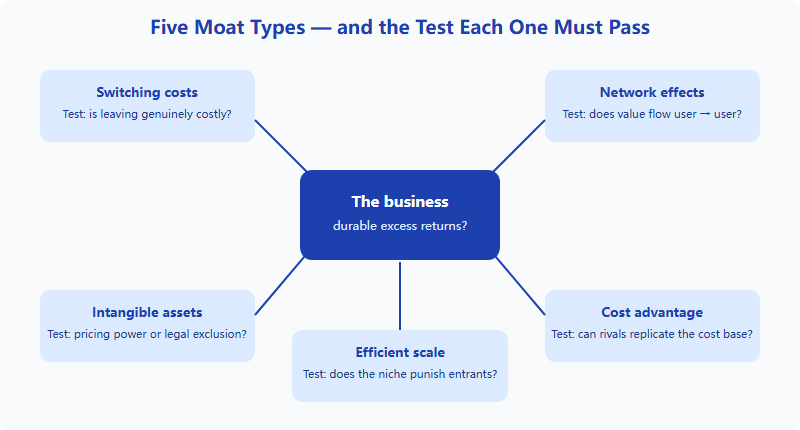
Most durable advantages fall into five families. The names vary across textbooks, but the underlying mechanics are stable. The critical discipline is this: naming a moat type is not evidence of a moat. Each type has specific conditions that must hold, and your brief should show those conditions, not just assert the label.
| Moat type | The mechanism | What must be true for it to hold | Classic student error |
|---|---|---|---|
| Switching costs | Leaving the product is painful, risky, or expensive for customers | Real migration cost (data, retraining, integration, contractual lock-in); measurable retention | Calling habit “switching costs” when leaving is actually free |
| Network effects | Each new user makes the product more valuable to other users | Value must flow between users, not just from scale; multi-homing must be hard | Confusing “lots of users” with a network effect |
| Intangible assets | Brands, patents, licences, or regulatory approvals that block rivals | The intangible must confer pricing power or legal exclusion, with an expiry date you have checked | Citing brand “fame” without evidence customers pay more for it |
| Cost advantage | Structurally lower unit costs than any rival can match | The advantage must come from scale, location, or process others cannot replicate | Treating a temporary input-price win as structural |
| Efficient scale | The market only profitably supports a small number of players | Niche demand, high fixed costs, rational incumbents who do not overbuild | Applying it to large, growing markets where entry is attractive |
The evidence test: how to prove (or break) a moat claim
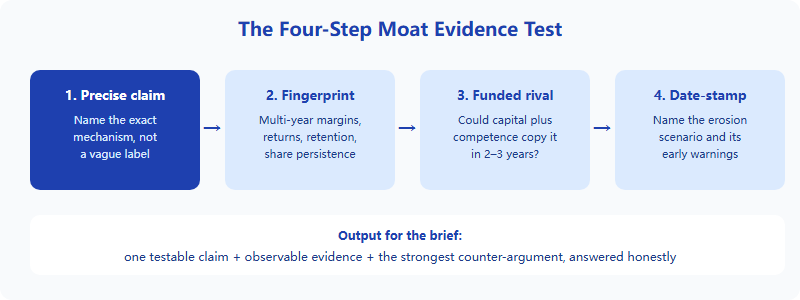
A moat claim in a SIC brief should be built the way a lawyer builds a case: a specific claim, supported by observable evidence, tested against the strongest counter-argument you can find. Here is a four-step sequence that works within a student's time budget.
- Step 1 — State the mechanism precisely. Not “the company has a strong brand,” but “customers pay a persistent price premium of X% over the nearest substitute for a functionally similar product, which indicates brand-driven pricing power.” Precision makes the claim testable — which is exactly what judges want to see.
- Step 2 — Find the financial fingerprint. Real moats leave marks in the numbers over multi-year periods: gross margins that stay elevated versus peers, returns on capital that do not mean-revert, market share that holds through downturns, retention or renewal rates the company discloses. One year proves nothing; look for persistence across at least a full cycle of results.
- Step 3 — Run the “funded rival” thought experiment. Imagine a competitor with serious capital and competent management attacking this exact business. What would they need to replicate? If your honest answer is “mostly money and two years,” you do not have a moat — you have a head start. If the answer involves something money cannot quickly buy (an installed base, a regulatory licence, a decade of accumulated user data), the moat claim strengthens.
- Step 4 — Date-stamp the moat. Every moat erodes under some condition: patents expire, technology shifts sideways around network effects, regulation opens closed markets. Name the erosion scenario explicitly in your brief. Counter-intuitively, this makes your thesis more credible, because it shows you understand that a moat is a rate of decay, not a permanent state.
Notice that none of these steps requires paid data. Annual reports, earnings materials, competitor filings, and industry coverage — the same public-source discipline that applies to every part of a SIC brief — are enough. If you are new to the competition and want the full picture of what the research季 involves before going deeper, the complete SIC overview guide covers structure and expectations; format details for the current season should always be confirmed on the official SIC site.
Connecting the moat to your valuation — the step most teams skip
A common structural flaw in student briefs: a well-written moat section that then has no consequence anywhere else in the document. The moat paragraph says the business is exceptional; the valuation section then applies an average multiple and assumes fading growth, as if the moat section had never been written. Judges notice this inconsistency instantly, because it suggests the moat section was decoration rather than analysis.
The fix is mechanical. A moat, if real, should show up in your assumptions in one or more of these ways:
- Duration of above-average economics. If you argue the moat is durable, your forecast can defensibly hold margins or returns above the industry norm for longer than a no-moat company would deserve — and you should say precisely how long, and why.
- Lower risk of the downside case. A genuine moat narrows the distribution of outcomes. That can justify more confidence in your base case — but be explicit about the reasoning rather than silently choosing optimistic numbers.
- The “no-moat discount” check. Ask what your target would be worth if the moat failed. If the answer is “dramatically less,” then the moat is the load-bearing wall of your thesis, and your defense section should concentrate its firepower there.
This linkage — qualitative claim, quantitative consequence, explicit risk — is what separates a coherent investment argument from a collection of well-written but disconnected sections.
Moat mistakes we see repeatedly in student briefs
From our editorial desk's reading of student research over multiple seasons, moat sections fail in predictable ways. Check your draft against this list before submission:
- The adjective moat. “Strong brand,” “leading position,” “innovative culture” — descriptions, not mechanisms. If you cannot say what specifically stops a rival, delete the sentence.
- The double-counted moat. Listing five moat types for one company. Genuinely wide-moat businesses usually rest on one or two mechanisms; listing five signals that you have not identified which one actually matters.
- The growth-moat confusion. Fast revenue growth is not a moat; it often attracts competition rather than repelling it. A moat is about the defensibility of returns, not their current size.
- The static moat. No mention of erosion, disruption, or expiry. Every judge has watched famous moats fail; a brief that treats a moat as permanent reads as naive.
- The imported moat. Copying a moat rating or phrase from a research provider without doing the underlying test. If a judge probes one layer deeper and you cannot support the claim in your own words, the borrowed authority becomes a liability. This is also the kind of comparative business-quality thinking that distinguishes SIC-style long-form research from shorter-format competitions — see our side-by-side comparison with the Wharton investment competition for how the formats differ.
A worked structure for the moat section of your brief
Here is a compact template you can adapt. It fits in roughly 250–350 words inside a full brief and touches every element judges look for:
- Sentence 1–2: the specific moat mechanism, named and defined in the context of this company.
- Sentence 3–5: the financial fingerprint — two or three multi-year data points from primary sources that are consistent with the mechanism.
- Sentence 6–7: the funded-rival test — what replication would require and why it is hard, in concrete terms.
- Sentence 8–9: the erosion scenario — what would weaken this moat, and the early indicator you would monitor.
- Final sentence: the valuation consequence — how this moat justifies the specific assumption in your model that depends on it.
Ten sentences, no filler, every claim testable. That density of reasoning per word is what a strong SIC brief feels like to read — and it is a skill that transfers directly to university-level research writing, whatever you end up studying.
FAQ
Does every SIC stock pick need a moat?
No. Some legitimate theses are valuation- or event-driven. But if your thesis assumes above-average profitability persists, you owe the judges a moat argument — or an honest admission that you are betting without one.
How many moat types should I claim for one company?
Usually one, at most two. Identify the load-bearing mechanism and argue it deeply. A list of five moat labels reads as padding and invites questions you cannot answer.
Can I use a research provider's moat rating in my brief?
You can cite it as one input, but never as the argument itself. Judges reward reasoning you can defend in your own words, built from primary sources like annual reports and competitor filings.
What if my research shows the moat is weaker than I hoped?
Say so. A brief that honestly downgrades its own moat claim and adjusts the valuation accordingly demonstrates exactly the intellectual honesty the judging framework rewards.
Published by the SIC editorial desk, operated by Hanlin Education for China-based international-school students. Official rules, dates and formats are set by the competition and change yearly — always confirm current details on the official SIC site. Factual errors reported to the desk are corrected within 7 working days.