An earnings call is a quarterly conference where company executives present results and take live questions from professional analysts — and its transcript is one of the richest free primary sources a SIC competitor can use. Numbers tell you what happened; the call tells you how management thinks, what they dodge, and whether their story stays consistent over time. This guide shows you where to find calls, how to read them efficiently, and how to turn what you hear into evidence a judge will credit.
Why earnings calls belong in a student research process
Most student briefs are built entirely from annual reports and third-party articles. That is a solid foundation, but it leaves out the one primary source where management is put under pressure in real time. In the scripted half of a call, executives say what they planned to say. In the Q&A half, professional analysts probe the weak points — and the gap between the script and the answers is often the most informative data you will collect all season.
For a competition brief, calls do three jobs that no other free source does as well:
- They reveal management quality. Do executives answer hard questions directly, or retreat into slogans? Do they quantify, or hand-wave? Over several quarters, does what they promised actually happen? These are observable, citable facts — not vibes.
- They date-stamp the narrative. Comparing what management said four quarters ago with what they say now lets you test whether the company's story is stable, improving, or quietly being rewritten. Narrative drift is an early warning that pure financial statements will not show you for another year.
- They give you the bear case for free. The sharpest questions on a call are usually the exact objections a SIC judge would raise. Analysts have already stress-tested your thesis for you — your job is to listen and take notes.
If you have not yet mapped where this fits in the overall research season, the complete SIC overview explains the competition's research-first structure; the current season's exact format and dates should be confirmed on the official SIC site.
Where to find calls, and the anatomy of what you will hear
Every listed company with meaningful analyst coverage hosts calls, and the materials are free. The investor-relations (IR) section of the company website carries webcasts, slide decks, and often transcripts; several finance portals also publish transcripts within a day or two of the call. You do not need any paid service — which matters, because a SIC brief built on sources any student can access is a brief every claim of which a judge can verify.
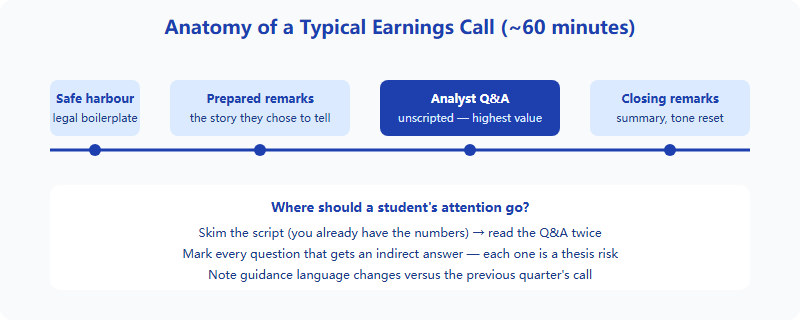
A typical call has a fixed anatomy, and knowing it lets you allocate attention efficiently:
Five signals to listen for — and how to log them as evidence
Reading a transcript without a framework produces highlighter soup. Use these five signals, and log each observation in a simple table (quarter, quote, signal type, implication for thesis). That log becomes a citable exhibit in your brief.
| Signal | What to look for | Bullish read | Bearish read |
|---|---|---|---|
| Directness under pressure | How the CEO/CFO handles the hardest question of the call | Specific numbers, admits unknowns, answers the question asked | Answers a different question; repeats slogans; blames macro for everything |
| Guidance language drift | Verb and adjective changes quarter to quarter (“expect” → “hope”; “strong” → “resilient”) | Language stable or strengthening with evidence | Softening qualifiers appear before numbers deteriorate |
| Promise-versus-delivery | Commitments made 2–4 quarters ago, checked against outcomes now | Stated milestones hit or honestly re-explained | Milestones quietly dropped, renamed, or perpetually “on track” |
| Metric switching | Which numbers management chooses to headline | Consistent metric set through good and bad quarters | New flattering metrics appear exactly when old ones turn ugly |
| Analyst temperature | The tone and topic concentration of questions | Questions about growth allocation, expansion detail | Multiple analysts circling the same wound (margins, churn, debt) |
Two cautions. First, tone-reading has limits: some excellent operators are dull speakers, and some skilled promoters run mediocre businesses. Treat call signals as hypothesis generators that must be confirmed in the filings, never as standalone proof. Second, quote precisely and in context. Judges — like the professional analysts on the call — react badly to clipped quotes that reverse meaning, and misquoting a primary source damages the credibility of everything else in your brief. The same evidentiary standard that runs through the SIC judging rubric applies here: claims must be sourced, and sources must say what you claim they say.
A repeatable 60-minute workflow per company
You do not have unlimited hours, and calls are only one input among many. Here is a workflow the desk recommends for a team covering one company across a research season. It assumes transcripts rather than audio — reading is three to four times faster than listening.
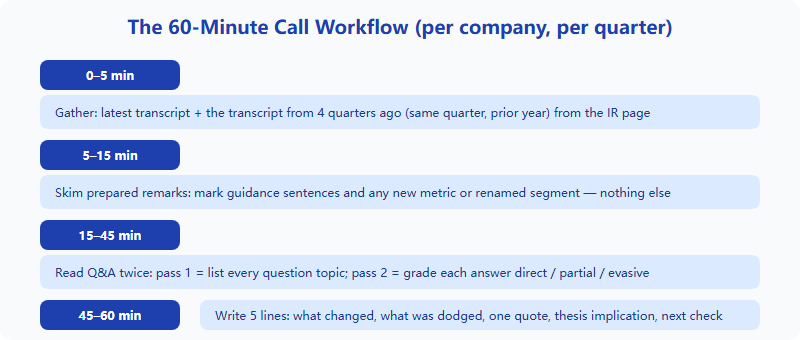
The final five-line note is the point of the whole exercise. A season of these notes gives you something very few student teams have: a longitudinal record of management behaviour, in your own words, with quotes and dates. When your brief says “management has guided conservatively and beaten its own guidance in each of the last three quarters” — with citations — you are operating at a level most competitors never reach.
Turning call notes into brief-ready evidence
Raw notes are not analysis. Three conversion patterns work well in a SIC brief:
- The consistency exhibit. A short table of “what management said” versus “what happened,” across three or four quarters. This is the cleanest possible evidence for (or against) trusting the forward-looking statements your valuation depends on.
- The dodge as risk flag. If two consecutive calls saw analysts ask about the same issue and get indirect answers, promote that issue into your risk section — and say explicitly that the flag came from Q&A behaviour. Judges recognise this as sophisticated sourcing.
- The quote as thesis anchor. One precisely cited management sentence — about capital allocation, pricing, or competitive response — can anchor a whole section of your argument. Use sparingly: one strong quote per section beats ten decorative ones.
Note what is absent from this list: predicting the stock's reaction to the next call. Guessing short-term earnings reactions is speculation, not research, and it plays poorly in a competition that rewards reasoned conviction — a distinction that also separates SIC's research-brief format from shorter trading-oriented contests, as covered in our SIC versus Wharton comparison.
Common mistakes when students first use transcripts
- Reading only the latest call. A single call has no baseline. The minimum useful unit is two calls a year apart; four consecutive quarters is better.
- Quoting the script instead of the Q&A. Prepared remarks are marketing. If your brief only quotes the scripted half, you have cited a press release with extra steps.
- Over-reading tone. “The CFO sounded nervous” is not evidence. “The CFO declined to reaffirm the margin target when asked directly by two analysts” is.
- Ignoring who asks. Note which firms' analysts push hardest and on what. Recurring pressure from multiple independent questioners is a stronger signal than one analyst's hobby-horse.
- Letting the call replace the filings. Calls supply colour and management signal; the audited numbers live in the reports. Every quantitative claim still needs a filing citation.
FAQ
Do I need to listen to the audio, or is the transcript enough?
Transcripts are enough for 90% of the value and far faster. Listen to audio only for one or two pivotal exchanges where wording alone seems ambiguous.
How many quarters of calls should a SIC team read?
Four consecutive quarters is the sweet spot: enough to test promise-versus-delivery and language drift, still manageable inside a school-term time budget.
Are earnings-call transcripts really free?
Generally yes — company investor-relations pages host webcasts and materials, and major finance portals publish transcripts. No paid terminal is needed for SIC-level research.
Can I cite an earnings call as a source in my brief?
Yes, and you should: cite the company, the quarter, and the speaker, and quote exactly. A precisely cited Q&A exchange is among the strongest primary evidence a student brief can carry.
Published by the SIC editorial desk, operated by Hanlin Education for China-based international-school students. Official rules, dates and formats are set by the competition and change yearly — always confirm current details on the official SIC site. Factual errors reported to the desk are corrected within 7 working days.