IB Economics, A-Level Economics and AP courses give SIC competitors a real head start — supply-and-demand logic, market-structure vocabulary, macro awareness — but they leave four specific gaps: reading financial statements, valuing a company, sizing risk, and writing to persuade an investor rather than an examiner. This guide maps exactly what your coursework transfers, what it does not, and an eight-week bridge plan for closing the gaps before the research season peaks.
The good news: what your economics classroom already gave you
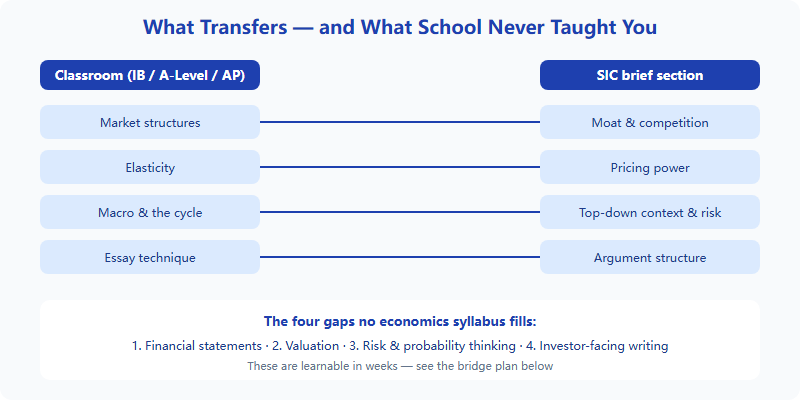
Students at Chinese international schools typically arrive at SIC from one of three curricula — IB Diploma, A-Levels, or AP — and all three build genuinely transferable foundations. From the desk's experience working with China-based teams across curricula, the transfers cluster into four assets:
- Market-structure reasoning. If you can explain why an oligopoly sustains higher margins than perfect competition, you already hold the core logic behind competitive-advantage analysis. SIC just asks you to apply it to one real company instead of a stylised diagram.
- Macro literacy. Interest rates, inflation, exchange rates, business cycles — the macro half of any economics syllabus is precisely the vocabulary you need to reason about how the economic environment affects your sector and your company.
- Elasticity intuition. Price elasticity of demand, taught in every curriculum's first term, is secretly the foundation of pricing-power analysis — one of the most valuable qualities an investor can identify in a business.
- Structured written argument. IB internal assessments, A-Level essays and AP free-response questions all train claim-evidence-evaluation writing. The skeleton of a good SIC brief is the same; what changes is the audience and the stakes, as we cover below.
So if you are hesitating to enter because you have “only” done school economics and never touched a real stock, the honest answer is: you are closer than you think, and the competition is designed as a research apprenticeship, not a professionals' trading contest. For the full picture of how the season works, see the complete SIC overview — and confirm current-season details on the official SIC site, since formats are set by the competition and can change yearly.
The concept map: where each school topic lands in a SIC brief
The table below maps common syllabus topics (labels vary slightly across IB, A-Level and AP, but the concepts are shared) to the specific section of an investment brief where they do work. Use it to inventory what you already own before spending any time on new material.
| School concept (IB / A-Level / AP) | Where it appears in a SIC brief | The upgrade SIC demands |
|---|---|---|
| Market structures & barriers to entry | Competitive-advantage / moat section | From stylised diagrams to evidence about one real company's defensibility |
| Price elasticity of demand | Pricing-power assessment | Finding real-world proxies: price rises versus volume response in reported results |
| Macroeconomic policy & the business cycle | Top-down context and risk section | Tracing one specific channel from macro variable to company earnings, not reciting theory |
| Costs, revenue & economies of scale | Margin analysis | Reading actual cost structure from the income statement rather than assuming a curve |
| Market failure & externalities | Regulatory-risk assessment | Identifying which specific regulation could change this company's economics |
| Exchange rates & trade | Revenue-exposure analysis for multinationals | Locating the geographic revenue split in company disclosures |
| Essay technique (claim → evidence → evaluation) | The entire brief | Writing for a sceptical investor who checks sources, not an examiner with a mark scheme |
The four gaps — and why the exam mindset is the fifth, hidden one
Gap 1: financial statements. Economics syllabi discuss firms in the abstract; none require you to open an actual annual report and find revenue by segment, margin trends, or debt maturities. This is the single largest gap, and the one to close first, because every other investment skill consumes statement data as input.
Gap 2: valuation. School economics tells you prices come from supply and demand — but not how to estimate what a specific company's shares are worth. Multiples and simple discounted-cash-flow thinking are new machinery for almost every school-taught economist.
Gap 3: risk and probability. Exam questions have correct answers; investments have distributions of outcomes. Learning to say “here is my base case, here is what breaks it, here is roughly how likely that is” is a mental shift, not just a technique.
Gap 4: investor-facing writing. An examiner rewards you for displaying syllabus knowledge; an investment judge rewards you for reaching a defensible decision efficiently. That means cutting theory recitals, leading with the conclusion, and sourcing every number — the register shift is real and takes practice. The judging framework's emphasis on evidence and reasoning quality is dissected in our section-by-section rubric walkthrough, which is worth reading before you write a single page.
And the hidden fifth gap: the mark-scheme reflex. Students trained to reverse-engineer examiners often try to reverse-engineer judges — stuffing briefs with every framework they know. It backfires. A brief that deploys two concepts deeply beats one that name-checks ten. Depth over coverage is the adjustment that exam-optimised students find hardest, and the one that pays most.
An eight-week bridge plan alongside school
This plan assumes roughly three to four hours per week — realistic alongside an IB or A-Level term — and takes you from “classroom economics” to “ready to research a real company.” Adjust pacing to your own season timing.
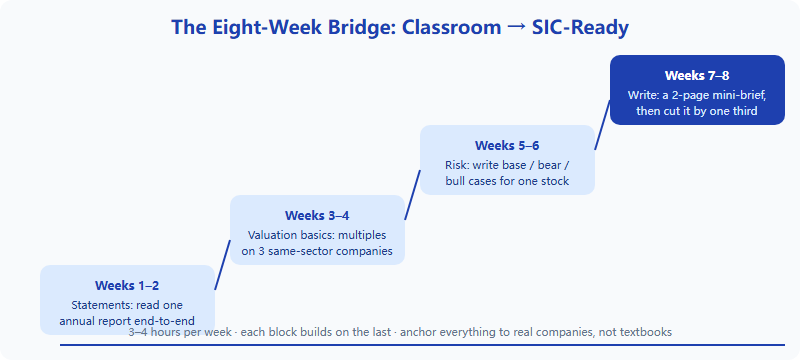
- Weeks 1–2 — statements. Pick a company whose products you use. Read its most recent annual report cover to cover — slowly, with a notebook. Goal: locate revenue by segment, gross and operating margin, cash generation, and debt. You will understand perhaps 60% on the first pass; that is normal and sufficient.
- Weeks 3–4 — valuation. Take three companies in the same sector and compare simple multiples. The goal is not precision; it is developing the reflex of asking “what am I paying for each unit of earnings, and why does one company deserve more?”
- Weeks 5–6 — risk cases. For one company, write three half-page scenarios: base, bear, bull. Force yourself to name the specific assumption that separates each case. This directly converts your exam-trained “evaluation” skill into investment form.
- Weeks 7–8 — the register shift. Write a two-page mini-brief combining all of it: recommendation first, evidence second, risks third. Then cut it by a third. The cutting is the lesson — investor writing is compression.
Teams following a structure like this enter the season with every muscle already warmed up, which matters because the competitive field is genuinely strong — and because research depth is exactly what differentiates SIC's long-form format from shorter portfolio-game competitions, a contrast we detail in the SIC versus Wharton side-by-side.
Using SIC to feed back into your coursework — honestly
The bridge runs both directions. The research habits SIC builds — primary sourcing, data handling, structured argument under uncertainty — strengthen your economics coursework in return: real-world examples make classroom essays sharper, and the discipline of citing filings carries over to any research-based school assignment. Two cautions, though. First, follow your school's and curriculum's academic-integrity rules on reusing material between contexts; when in doubt, ask your teacher. Second, do not frame SIC as a shortcut to grades or admissions — it is a training ground, and the durable payoff is the skill set itself. No competition participation guarantees any academic or admissions outcome, and any claim otherwise should make you sceptical of whoever is making it.
FAQ
Do I need to have taken economics at school to compete in SIC?
No. Coursework helps, but the essential skills — statement reading, valuation basics, structured writing — are learnable from scratch, and many strong competitors start without any formal economics.
Which curriculum prepares students best for SIC — IB, A-Level or AP?
None has a decisive edge. All three build the same transferable core; the four gaps (statements, valuation, risk, investor writing) are identical whichever syllabus you follow.
How is writing a SIC brief different from writing an economics essay?
An essay displays knowledge for an examiner; a brief drives a decision for a sceptical reader. Lead with the conclusion, source every number, and cut theory that does no work.
Can I start the eight-week bridge plan mid-season?
Yes — compress blocks rather than skipping them. Statements first, always; every later skill depends on being able to read what the company actually reports.
Published by the SIC editorial desk, operated by Hanlin Education for China-based international-school students. Official rules, dates and formats are set by the competition and change yearly — always confirm current details on the official SIC site. Factual errors reported to the desk are corrected within 7 working days.