The Student Investment Challenge is judged on research and reasoning, and no real family money is ever at stake. Over a season your child researches an investment case, writes it up, and has to be able to explain every part of it. The useful parental contributions are logistical and conversational: protecting study time, asking blunt questions about the argument, and staying entirely off the analysis. This guide covers the commitment, the integrity line, and what to verify yourself.
What your child is actually signing up for
Parents usually arrive with one of two wrong pictures. The first is a stock-picking game — buy, sell, whoever ends highest wins. The second is a school essay with a finance topic. Neither is right. The work is a piece of research: your child forms a view about a company or a market, gathers evidence from public filings and data, builds a valuation, writes a structured report, and documents the reasoning behind every revision. What is being judged is the quality of the reasoning and the evidence behind it, not the luck of a short-run price move.
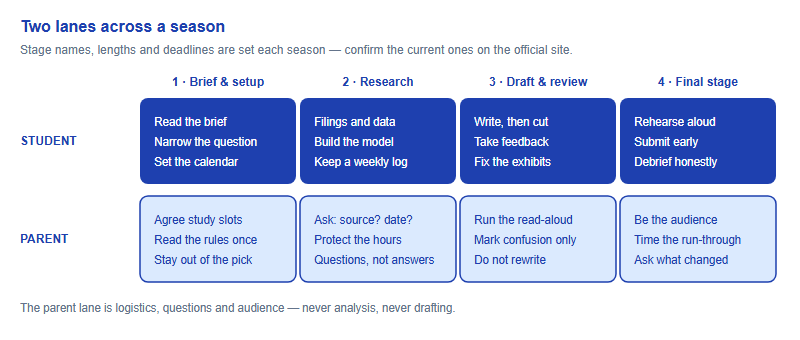
The season runs in stages, and the effort is lumpy rather than steady. Early weeks in the report track are lighter — reading, narrowing a question, learning where the numbers live. The middle is grinding and unglamorous. The weeks around the written deliverable are heavy, and they are where a family calendar either helps or hurts. If you want the full shape of the competition before you commit, start with our guide to what the SIC is.
One reassurance worth stating plainly: a prior finance background is not the binding constraint. Students who do well tend to have reading stamina and the patience to rewrite. The finance itself — how a cash flow statement works, what a multiple means — is learnable inside a season. A child who reads carefully in English and does not mind being told their first draft is unclear is in good shape.
The five questions parents ask first
These come up in almost every conversation we have with families. The honest answers are short, and several of them end in “check the official site” — not as a deflection, but because eligibility, fees and formats are set by the competition and revised between seasons. Third-party listings and group-chat screenshots go stale within months.
| Question | Short answer | Where to verify |
|---|---|---|
| Is real family money at risk? | No. No real money is used; the individual division manages a simulated portfolio. | Any account, platform or fee question — official SIC site |
| Does my child need a finance background? | No. Reading stamina and clear written English matter more; the finance is learned during the season. | — |
| Solo or in a team? | Division rules differ, and team work adds real coordination cost on top of the research. | Current season rules — official SIC site |
| How many hours a week? | Plan around exam blocks; published weekly hour ranges differ by division. | Published weekly guidance — official SIC site |
| Does the school have to be involved? | Requirements around school affiliation and consent are set in the rules and vary by division. | Enrolment rules — official SIC site |
| What does it cost? | Fees are set by the organiser and can change between seasons. | Official SIC site only — never a forum post |
Where your help ends: the integrity line
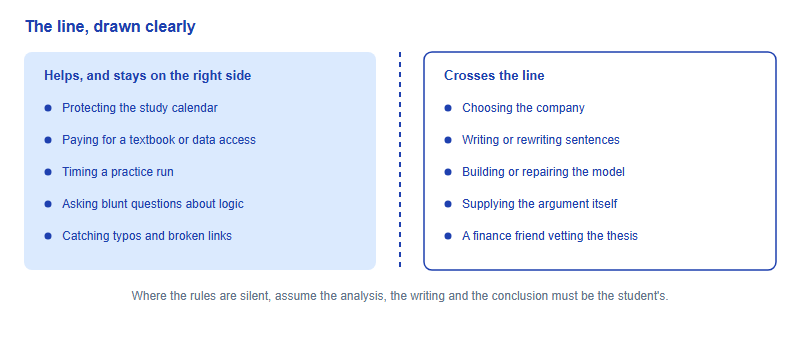
This is the section that matters most, and it is the one families most often get wrong with entirely good intentions. The competition rules define what outside assistance is permitted, and you should read that section yourself rather than relying on a summary. Where the rules are silent, apply the default that every research competition assumes: the analysis, the writing and the conclusions must be the student's.
The test is simple. Would your child be able to explain, unaided and under questioning, why every sentence in the report says what it says? If the answer is no for any paragraph, that paragraph is a problem no matter how much better it reads.
A specific warning for parents who work in finance, banking or accounting — and in the families we work with, that is a lot of you. The temptation is not to write the report; it is subtler. It is answering “is this a good company?” over dinner, or fixing the discount rate because you can see it is wrong. Both hand your child a conclusion they did not reach. The professional habit to borrow instead is the one good managing directors use with juniors: answer a question with a better question. “What would have to be true for that to hold?” teaches; “use nine percent” does not.
The same line applies to tutors, older siblings, and AI tools. It is not about who helps — it is about whether the analytical work and the sentences originate with the entrant. If the rules require assistance to be declared, declare it; a declared, permitted contribution costs nothing, and an undeclared one can cost the entry.
How to read a draft when finance is not your field
You do not need to know what a discounted cash flow is to be genuinely useful at draft stage. You are not checking whether the analysis is correct — a mentor and, eventually, a judge does that. You are checking whether it is clear, and clarity failures are visible to anyone. A judge reading under time pressure behaves exactly like a smart non-specialist, so your reaction is a good proxy for theirs.
Five questions, asked in this order, will surface most of the problems:
- In one sentence, what are you claiming, and over what time frame? If it takes three sentences, the report has no thesis yet.
- What does the market believe that you think is wrong? A case that agrees with everyone gives a reader nothing to weigh.
- Where did this number come from, and when did you get it? Pick one figure at random. The answer should be immediate.
- What would have to happen for you to be wrong? A student who cannot answer this has not yet stress-tested anything.
- If I read only page one, would I know what you concluded? Judges do not read in the order students write.
Two mechanical tricks work better than commentary. Ask your child to read a section aloud to you — sentences that were confusing to write are physically hard to say, and they will start editing before you comment. And point at any chart and say “explain this to me.” If the explanation takes longer than the chart saves, the chart needs redrawing. In both cases your job is to mark where you got lost, not to fix it. For what the assessors themselves are weighing, our breakdown of the rubric is worth twenty minutes of your time.
What a result does inside a university application
This is usually the real question behind the enquiry, so let us be precise about it. An admissions reader is not scoring a trophy cabinet; they are triangulating whether a picture of a student holds together. A competition result gets cross-checked against the rest of the file — does the transcript show the maths and economics record you would expect? Does the activity list suggest a sustained interest or a single opportunistic entry? Can the student write about the work in their own voice in an essay, or does it appear once and vanish?
That is the honest value: corroboration. Several results and activities across one profile validate each other, and it is the mutual consistency that makes the whole file believable. A research competition is well suited to this because it leaves behind an artefact — a written report your child can talk about — rather than only a line on a list.
Three cautions. No result guarantees an outcome anywhere, and anyone telling you otherwise is selling something. Any admission statistic you are shown should carry a source; when we cite organiser materials, we attribute them, and you should expect the same of every other party. And the practical test is the one families skip: if your child cannot explain their thesis in ninety seconds to a stranger, the line on the activity list is doing less work than you think. Parents also frequently ask whether to enter more than one investment competition in a year — they are separate contests, run by separate organisers, with different deliverables and calendars, and our side-by-side with the Wharton Global High School Investment Competition lays out the differences before you double-book a term.
What to check on the official site before you commit
Take fifteen minutes and verify these yourself. Every item varies by season, and each one has caused a family we know a genuine problem when taken second-hand.
- Eligibility: grade band and age, and which division your child falls into.
- Team rules: whether entry is individual or team, and the permitted size.
- Enrolment: what the school must do, if anything, and what consent is required.
- Fees: the amount, what it covers, and the refund position.
- Deadlines — and critically, the time zone they are stated in. A deadline read in the wrong zone is the most avoidable way to lose a season.
- Deliverables: format, length limits, and what each division has to submit.
- Permitted assistance and citation policy — the section discussed above.
- What arrives after the season closes, in terms of feedback or scoring reports.
None of these should come from a forum post, a screenshot forwarded in a parent group, or an article — including this one. We publish guidance on how to work; the competition publishes the rules, and only the current version on the official SIC site counts.
FAQ
Is the SIC a trading competition where my child risks money?
No real money is at risk. One division manages a simulated portfolio and one writes a report; confirm the current formats on the official SIC site.
Can I edit my child's report?
Fixing a typo is fine. Rewriting an argument is not. The analysis, the structure and the conclusions must belong to your child.
My child has no finance background. Is that a problem?
No. Reading stamina and clear written English matter more, and the finance can be learned inside a single season.
Will this competition get my child into a top university?
No result guarantees admission. It works as one corroborating data point that a reader checks against the transcript, activities and essays.
Published by the SIC editorial desk, operated by Hanlin Education for China-based international-school students. Official rules are set by the competition and change from year to year — confirm current details on the official SIC site. Errors are corrected within 7 working days.