For students aiming for the SIC U-FEB Quiz, understanding its role in the competition is critical. This quiz is a component of the Global Station evaluation, specifically designed for Senior Division (Strategy Group) teams who have advanced from the initial rounds. It is important to note that the Junior Division (Trading Group) does not advance to the Global Station and therefore does not participate in this assessment.
What Is the SIC U-FEB Quiz?
The U-FEB Quiz assesses your team’s grasp of fundamental financial concepts. Unlike the investment strategy report, which requires deep analysis of specific stocks and macroeconomic trends, the quiz focuses on core knowledge. Based on recent seasons like S15, the content typically includes:
- Financial terminology and definitions.
- Basic investment principles.
- Understanding of market mechanics.
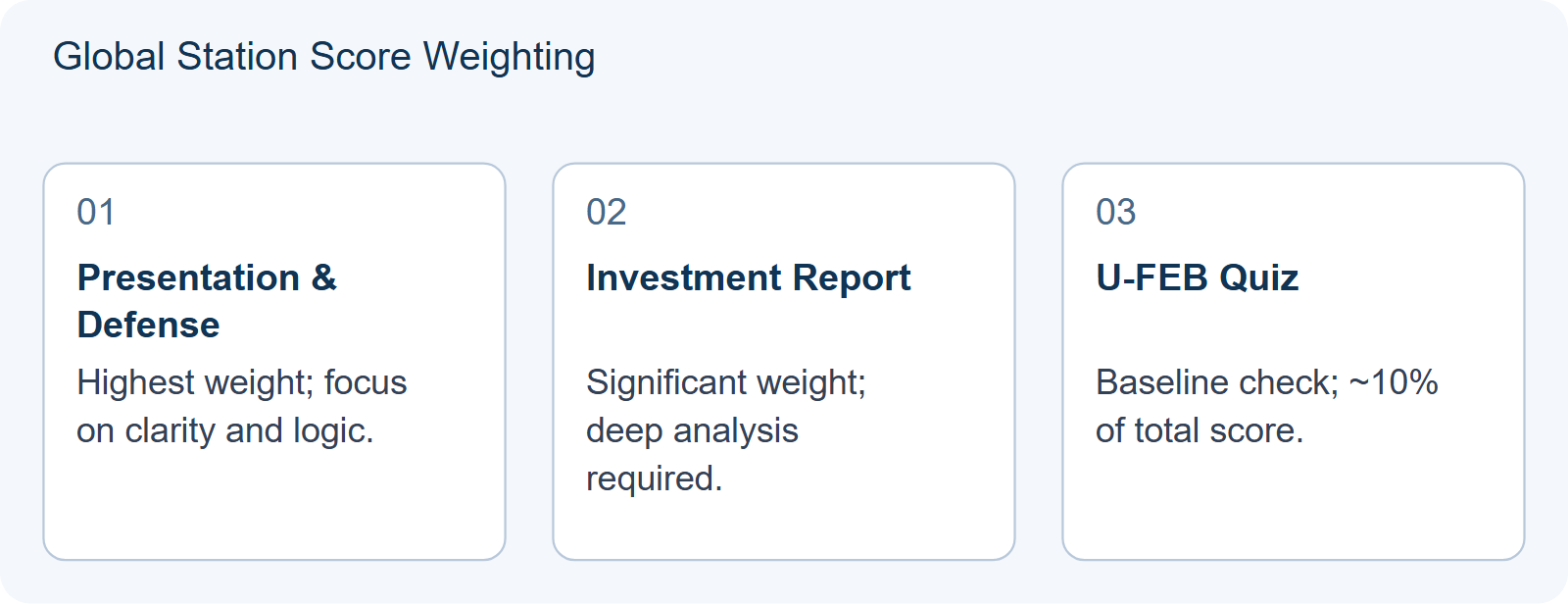
This section usually accounts for approximately 10% of the total Global Station score. While the weight might seem modest compared to the presentation or report, it serves as a baseline check for academic readiness.
Logistics and Timing
Preparation must account for the tight scheduling of the Global Station. In the S15 season, the quiz was conducted online within a one-hour window. The first 30 minutes were allocated for environment checks and login procedures, leaving the final 30 minutes for actual answering. For the upcoming S16 season, while exact minute-by-minute breakdowns are subject to official announcements, teams should prepare for a similar compressed timeline. Do not assume you will have extra time for troubleshooting during the active answering phase.
Strategic Preparation: Balancing Quiz and Report
A common mistake among Strategy Group teams is over-preparing for the quiz at the expense of the investment report. Since the report carries significantly more weight (often around 25-55% depending on the season’s specific rubric), your primary focus should remain on developing a robust thesis. However, neglecting the quiz entirely can cost valuable points.
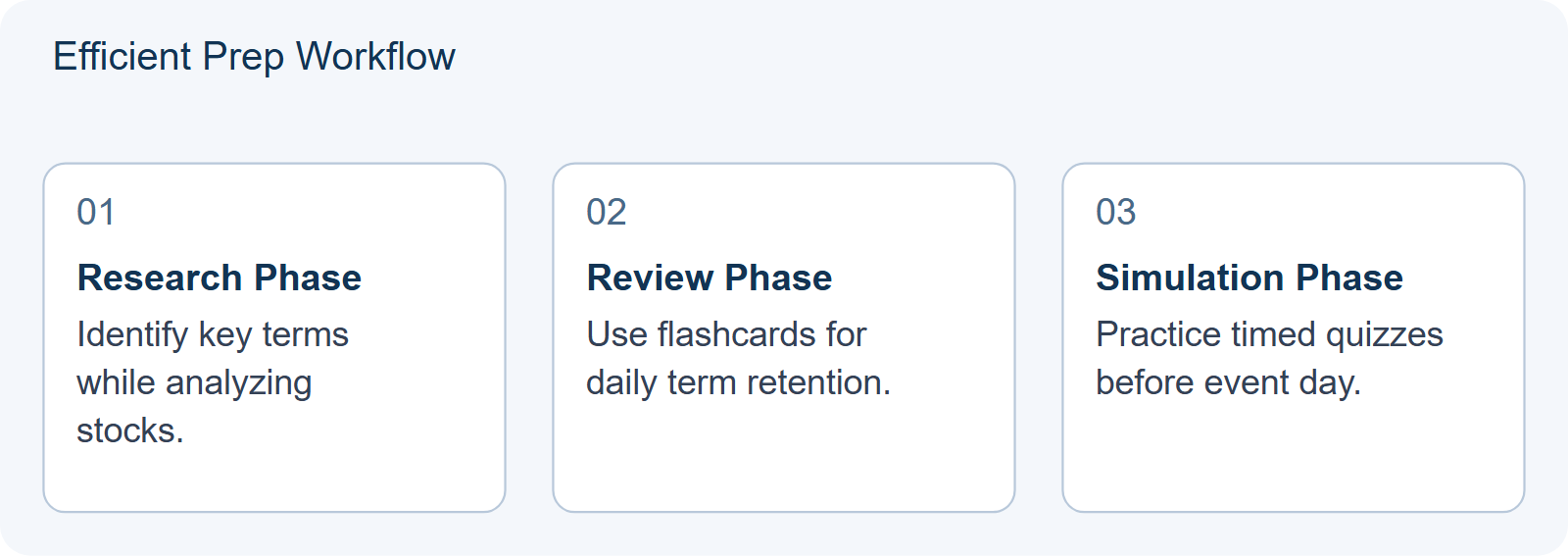
To optimize your time, integrate quiz preparation into your regular study routine rather than treating it as a separate sprint. Review key terms as you research companies for your portfolio. If you are analyzing a tech stock for ESG factors, ensure you understand the underlying financial metrics involved. This dual-purpose approach ensures you are reinforcing both your analytical depth and your terminological accuracy.
| Component | Focus Area | Preparation Priority |
|---|---|---|
| U-FEB Quiz | Definitions, Basic Concepts | Maintain steady review |
| Investment Report | Analysis, Valuation, Strategy | High intensity |
| Presentation | Communication, Defense | High intensity |
Actionable Study Tips
1. Flashcard Creation: As you read financial news or analyze balance sheets, create flashcards for new terms. Use spaced repetition apps to review them daily.
2. Mock Timed Sessions: Practice answering sample questions under strict time limits. Simulate the pressure of the 30-minute answering window to build speed and confidence.
3. Team Knowledge Sharing: Divide topics among team members. One person might specialize in accounting ratios, another in market structures. Share summaries to ensure everyone covers the basics.
Remember, the goal is not to become a finance expert overnight but to demonstrate solid foundational knowledge. By keeping the quiz preparation integrated with your main research tasks, you protect the quality of your strategy report while securing those essential baseline points.
HYPOTHETICAL/ILLUSTRATIVE: The “Balance Sheet” Decision Point
To apply the advice of integrating quiz preparation with report writing, consider a specific decision point faced by a Senior Division team during their final two weeks before the Global Station. Team Alpha is analyzing a mid-cap industrial company for their investment strategy report. They need to determine if the company’s debt-to-equity ratio signals distress or opportunity. This analytical task requires them to pull data from the latest quarterly earnings release.
Here, the team faces two plausible choices regarding how to handle the financial terminology involved in this analysis. Choice A is to treat the quiz and the report as separate silos. The team members focus exclusively on building their valuation model and narrative for the report, assuming they will cram definitions into flashcards during late-night study sessions later. Choice B is to use the immediate research task as a live quiz prep session. As they calculate the ratios, they explicitly define each component (e.g., distinguishing between current liabilities and long-term debt) and discuss why these distinctions matter for market mechanics, which is a core quiz topic.
The decision changes based on time efficiency and cognitive retention. Under Choice A, the team risks superficial understanding. When they eventually sit down to review flashcards, they may memorize definitions without context, leading to errors when the quiz asks about the practical implications of those terms in market scenarios. Furthermore, the dedicated cramming time detracts from polishing the presentation slides, which carry higher weight. Under Choice B, the learning is contextual. By debating whether a spike in short-term debt affects liquidity ratios during their actual analysis, they reinforce the exact concepts tested in the U-FEB Quiz. This method ensures that every minute spent researching the stock also serves as active recall practice for the quiz.
A reusable self-check for teams is the “Definition-Application Link.” Whenever you encounter a new financial term while working on your report, ask: “Can I explain this term to my teammate using only the data we just analyzed?” If the answer is no, you have identified a gap in both your report logic and your quiz readiness. Spend five minutes clarifying the definition together before moving on. This prevents the accumulation of vague knowledge that fails under timed pressure.
| Scenario | Action Taken | Outcome for Quiz Prep |
|---|---|---|
| Calculating P/E Ratio | Memorize formula only | Low retention; risk of confusion with similar metrics |
| Calculating P/E Ratio | Discuss impact of share buybacks on EPS | High retention; links math to market mechanics |
This illustrative example demonstrates that the most effective preparation is not additional hours of studying, but smarter integration of existing tasks. By treating every analytical step in the report as a potential quiz question, teams secure baseline points without sacrificing the depth required for the high-weight components. The key is to remain vigilant about terminology precision during the creative process, ensuring that the foundational knowledge assessed by the U-FEB Quiz is built simultaneously with the strategic thesis.
Preparing for the SIC U-FEB Quiz requires balancing analytical depth with efficient report writing. Start by fitting your hours around exam season to avoid burnout. Ensure your thesis structure is solid using a page-by-page blueprint, and refine your arguments through a mid-stage draft review. These steps help you produce a high-quality submission without sacrificing academic performance elsewhere.
Frequently Asked Questions
Does the Junior Division take the U-FEB Quiz?
No. The U-FEB Quiz is part of the Global Station evaluation, which is exclusive to Senior Division (Strategy Group) teams. Junior Division participants do not advance to this stage.
How long is the actual answering time for the quiz?
Based on the S15 schedule, the quiz had a 30-minute answering window after a 30-minute setup period. S16 specifics should be confirmed via official announcements, but plan for a similar tight constraint.
Should I prioritize quiz prep over my report?
No. The report and presentation carry much higher weights. Integrate quiz prep into your research process by noting down definitions and concepts as you work, rather than dedicating separate large blocks of time.